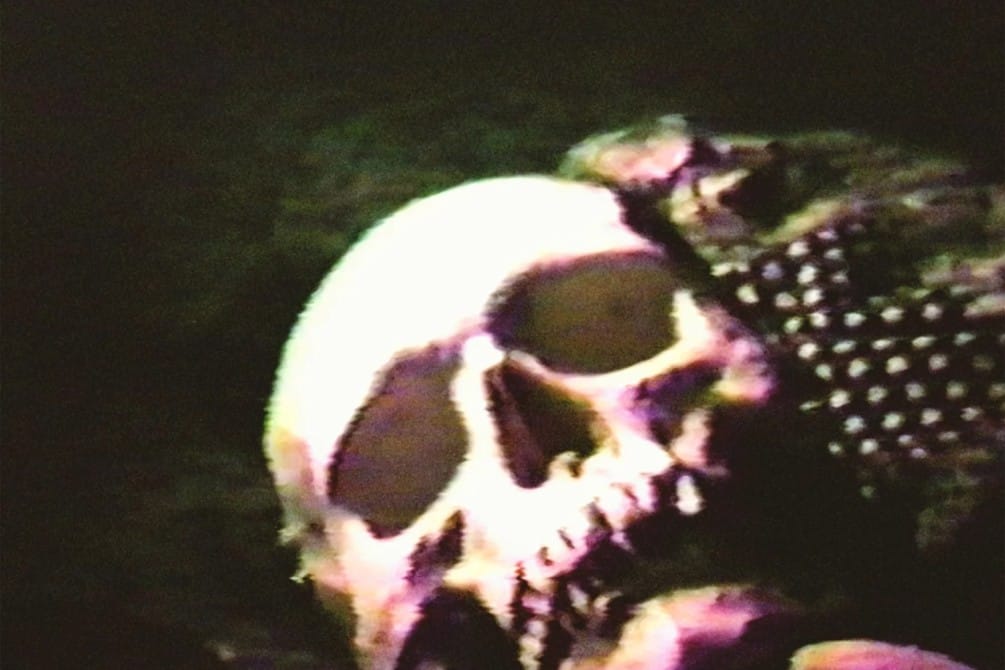
Bleeding Skull produced a Blu-ray edition of the film works of John Timmis IV which contained two of his feature films: Cannibal Orgy and Nightmare City. Watching them back to back is a compelling experience because Cannibal Orgy contains repurposed and recontextualized footage from Nightmare City. One example of how this manifests is in the killing of the president in both features: in the case of Nightmare City, the incident is a casualty from lacing the water supply with LSD in an attempt to fight against an authoritarian government rounding up those considered as not contributing to society whereas Cannibal Orgy presents it as a successful terrorist attack in a movie that casts its outsiders as pitiful, drugged-out wastrels. If I remember correctly, at least some of the kills are recycled as well. Interestingly, the Blu-ray is advertised as “Cannibal Orgy and the Films of JT IV” so the re-cut film is advertised more prominently in comparison to the original. We tend to intuitively consider the original as more important but in this case, we’re heading backwards (in regard to the curatorial element). John Timmis IV is most famous for his lost film The Cure for Insomnia which is notable for being eighty-five hours long. People desperately wanted to recover it out of curiosity – what is it like to see eighty-five hours of poetry, rock music videos and pornography? This film was likely more conceived of as an event than a product. I think of it as akin to the film 60 Seconds of Solitude in the Year Zero. This film on the death of cinema was shown only once while its film-strip was destroyed simultaneously. And yet, this element of liveness (in that the action of playing that exact film was to become irreproducible) was disrupted by an individual that had sneaked in a phone and produced a pirate copy. And so, one can see the film even now – albeit from afar and with an audience below. This performance deepens whatever meaning the original film had, however. The film is preserved and yet in a manner that still refers to its nature as an event. We are forced to see the death of cinema through the eyes of a cellphone. This personal recording does not obey filmic form as the camera shakes at times and the in-camera audio is not particularly clear. The recording itself does not demonstrate purposefulness or intentionality – the fundamental filmic qualities – in the traditional sense. The recording is thus an intervention into a work of art akin to Cai Yuan and Jai Jun Xi jumping onto Tracey Emin’s “My Bed”. Similarly, people are trying to rescue an event from obscurity via the search for the uncut version of The Cure for Insomnia. Cannibal Orgy is substantially more gory than Nightmare City due to its featuring an extended scene of the cannibal cultists devouring a woman. Reviews of Cannibal Orgy refer to it as a parody of the satanic panic and there’s merit to that due to the somewhat cartoonish nature of the characters. Still, that sense of unreality, exacerbated by the film being preserved from VHS copies due to the super 8 masters having been lost, only heightens the ugly purposelessness of the violence. John Henry Timmis IV having been diagnosed as a psychopath makes the scene in Nightmare City of his character pleading with his father to house him lest he be kidnapped or murdered by the violent police force come across as autobiographical – this, of course, is jumping the gun somewhat as I remember gazing upon some sculptures evocative of shrapnel and rubble and assuming that the artist had seen war when he had in fact never seen a battlefield. In Cannibal Orgy, a news program telling of police brutality is shown in between the murders committed by the motley crew of satanic cannibal drug addicts. And so, we can see here a kind of dialectical relationship between the two films: one is about violence originating from people who are entirely abject in a world that has government-backed violence occurring in the background whereas the other is about the explosion of a previously normal world into fascistic violence. They may be opposites but they come together to form an authorial worldview. This demonstrates to a degree the principle that the quality of “outsiderness” typically manifests at the intersection of the inscrutable and the didactic. While there’s not necessarily sympathy for the cannibals, they are certainly pathetic in a manner that makes their outbursts of violence seem inevitable. In essence, “outsiderness” is a quality that is similar to “literary” – both indicate idiosyncrasy but the former is associated with a kind of compelling “failure”. That is to say, the uncanny effect of a work being unintentional. For example, Fletcher Hanks was referred to as an having an “outsider style” on the blurb of a collection of his comics despite the fact that he did receive an education in cartooning and “creat[ed] drawings of furniture and metalwork for the Index of American Design in New York City”. These drawings indicate an adequate ability to render realistic objects. And yet his most notable comics such as Stardust the Super Wizard contain that nebulous quality of “outsiderness” via the surreal horror of the hero’s punishments toward the evildoers as well as the raw nature of the stories – villains concoct evil plan, Stardust finds out due to his mind-reading powers, he then traps or disfigures them in some horrible way. All the extraneous stuff is filtered out, giving the world the characters inhabit a staged quality. While Hanks eventually received recognition for his work, Coleman Francis received only mockery due to being featured on Mystery Science Theatre 3000. His The Beast of Yucca Flats tells the story of a noble scientist named Joseph Javorsky defecting from the Soviet Union only to be transformed into a horrific monster capable only of murder by the effects of a nuclear blast. The opening scene features an unrelated murder of a scantily clad woman. Is this an attempt to draw a connection between comparatively mundane, everyday evil and that of the horrific monster? It was more likely a scene thrown in for the sake of titillation but it nonetheless disrupts one’s attempt to read it as one would a typical monster movie. It’s jarring and haunts the film in a sense.
“The Beast of Yucca Flats may not be a carefully constructed polemic indicting the nuclear threat, but the symbolism—the Bomb turning men into monsters, and certainly this could be true figuratively—can’t be denied.” – Apocalypse Then: American and Japanese Atomic Cinema, 1951-1967, Mike Bogue, pg. 69
The Wikipedia page of the film notes: “The murderer is dressed like Javorsky after his transformation, but the murder is never mentioned during the actual film, nor is there any apparent time and/or place in the film where it could be said to occur.”
Given that the murders Javorsky commits are in an altered state of mind and the film ends with the pitiful beast stroking a rabbit before succumbing to its wounds, the unidentified murderer being in Javorsky’s clothing could be an intentional juxtaposition of premeditated murder with the actions of an animal. After all, both are driven by some kind of insatiable compulsion. One aspect that makes the film horrifying is the degree to which a human we are told is noble (the film’s short length and expositional voiceover don’t enable much traditional moments of character development) is deprived of anything resembling humanity. If anything, the detached style emphasizes this absence. However, I’d disagree with Bogue’s interpretation of the film. I’d argue that the film’s message is more generally about the people that get sacrificed in the name of technological progress. While man’s nature is partially at fault, the blame is mostly placed on technological progress for the tragedy that is to occur. The film’s tagline is amusingly “Commies made him an atomic mutant!” which is only indirectly true – the KGB agents only chase Javorsky into the blast. While the communist agents almost murdering Javorsky over the secret Soviet moon base is likely intended to demonstrate the corrupt nature of their society, perhaps the film is indirectly arguing for some form of peace between the two societies by having the tragic protagonist be from that same society and having the inciting incident be the weapon likely being developed to combat the Soviets.
In the age of AI, imperfection in design – the human touch – is now more prized due to the sterilizing influence of image generation technology. And yet, AI might also become an aspect of outsider art due to its superficial level of polish. AI, when not interfered with, tends to deploy cliché haphazardly and so ignores rules such as continuity or what one is usually meant to center in an image. It represents enough of a mean of human expression to appear uncanny and what people refer to as “slop” on social media represents emanations from an externalized collective unconscious. AI is thus both deeply conservative in its biases (via the raw material of its training data) and represents a radical invasion from the outside. For an example of AI in outsider art, the Christian conservative filmmaker Donald James Parker has an AI generated poster for his 2024 film Operation Unite. Hooroo Jackson generated all elements save the script via AI with the films DreadClub: Vampire’s Verdict and Window Seat. Damon Packard – undeniably an outsider artist and most famous for his Reflections of Evil – created several shorts with AI generated visuals such as The Man who Couldn’t Miss Screenings. In the latter case, the visuals so frightened me that I could not finish the short (I believe it was the motion of the skin or the eyes that truly got under my skin). And so, both ends of the spectrum of human expression are captured, be they the hyper-commercialized “slop” or the auteurs that perhaps aren’t plugged in to the attitudes prevalent in certain political spaces. Jackson even wrote a book called The New Machine Cinema: Foundational Essays in AI Film Theory. It seems that he was frustrated with the media gatekeepers that prevented him from making another film after his debut Aimy in a Cage. This sentiment of “I’m not asking permission anymore” leads to the resulting outsider art being determined by the laws of the machine rather than physical reality.
Within the process of AI generated art, there is a further level of abstraction from the process of the entanglement of the ideal and the material. In the case of a Damien Hirst piece, Hirst has an idea which he must consider how to implement in physical terms within the gallery space and then either he or his assistants executes the idea. In the case of AI, the material merely follows on from the ideal. The idea is stated and then it manifests. Whereas artists that utilized chance such as John Cage designed their own parameters, AI’s highly commercialized nature means that most people are not doing so with their AI generated art. While Cage certainly integrated technology into his work such as with his Roaratorio, it’s dubious whether he would have been a fan of AI considering his music’s emphasis on the relationship between composer and performer, Zen philosophy generally discouraging instant gratification and his focus on creating new sounds. Although, one could make the case that the failures of AI to represent reality, the glitches in the representation, bring forth their own totally unique sounds. An example of this is Oneohtrix Point Never’s Again, which implements samples of AI interpretations of the artist’s music. AI trained on an artist’s work creates a facsimile deprived of context and sense. Again’s haunting and unreal voices enhance the work’s atmosphere of alienation while also conveying a sense of awe at another world opening up to you. Someone like the individual behind the AI artist Xania Monet, however, aims to create typical adult contemporary music with the apparent draw being the lyrics. Monet’s producer is boxed in far more than Hooroo Jackson because Hooroo still has his own original story to draw on compared with a specific aesthetic to be achieved whereas music, I’d argue, is harder to pin down as wrong or right without knowledge of theory. Who’s to say the next generated beat wouldn’t have been even better? The music video “Imma Be Rocking That Body” for The Black Eyed Peas is oddly prescient regarding the discourse over AI in art. The music embraces a glitchy and “soulless” pop aesthetic while remaining exuberant. It very much sounds like the future. The opening skit has Fergie believing that the use of machine generated elements in a song robs it of its soul and yet the other band members are very enthusiastic about the capabilities of the technology. The video, however, has the futuristic glitched reality of Fergie’s vehicular trauma induced dream win out over the wholly machinic music. Perhaps the digital mode of thinking and the humanity we so prize are not easily delineated in the subconscious realm Fergie inhabited. This confidence that the irreplicable essence of the auteur (here represented by the subconscious, as it often is) would not be overtaken by these new technologies wasn’t wholly unfounded. People have a sense of pride about their work. They want to know that it is, to some degree, an actualization of their mental landscape – a snapshot of where they’re at. Still, one must acknowledge that the unique visions of Hooroo Jackson, Donald James Parker or Damon Packard aren’t entirely mitigated by their use of AI – especially in comparison to the flood of pastiche that dominates AI music and video. AI is uncanny because of its seeming absence of perspective (that is to say, the perspective is one that manifests in its knowledge base rather than coherently held values) whereas art that is either outsider or reflects a degree of “outsiderness” is so precisely because of its non-normative perspective.
Mister Omar King had his debut short story collection Odyssey of Dingbats! published in 2025. His stories often focus on the elderly, the overweight, drug addicts and other such individuals that are typically stigmatized or ignored on some level. His work in both literature and the visual arts is indeed consciously surreal as indicated by his acknowledged debt to David Lynch. Characters can sometimes explain how they’re feeling in an unusually direct manner and there is a pervasive theme of alienation from humanity as a whole alongside a blurring of fantasy and reality. There are several stories from the perspectives of crayons as they bemoan the sexual activities or moral lapses of those whom they are forced to share a room with.
Certainly, characters berating one another in King’s fiction is a common event – in fact, long denouncements of another person’s foolishness or immorality is perhaps a motif akin to the repetitious slapping that appears throughout the films of Kim Ki-Duk. Motifs in the visual art that peppers the book include innocent faces in freakish surroundings and, once again, personified objects. Often, innocent or credulous characters are subject to trickery. Mister Omar King is autistic and has no issues whatsoever with the outsider artist label. And so, perhaps the fact that it was made by someone of a non-normative mindset is part of the marketing. That’s not to imply any form of cynicism, not at all – Mister Omar King is the real deal. What I mean to say is that the untrained, the neurodivergent and the mentally ill have more ability than ever to put work out there on the internet – outsider artist has become something one can say of oneself, in some cases a cultivated identity much like being a polished or profitable writer. Elinor Fuchs wrote a short essay once called “Visit to a Small Planet: Some Questions to Ask a Play” in which she demonstrates a phenomenological or formalist approach to theatre critique – why are things happening as they are on this planet? Outsider art truly emphasizes the nature of a work as an alternate reality. Things aren’t happening as they normally do, the work isn’t surreal in the expected way, it perhaps reads as unintentional but then, what is the logic of this world? Is there any? One could maybe call it a naïve postmodernism – certainly more successful in developing on that tendency than the reactionary remodernism or the cloying new sincerity movement – but that situates it temporally whereas Timothy Dexter invited the reader to salt and pepper his text with punctuation only provided at the very end all the way back in 1802. More and more, people are realizing the bizarre nature of what we do and do not take seriously. Some people even take it too far which results in poptimism and thus the worship of the genuinely vapid. Everything has a sensibility to it. One time, accidentally, I found a kindle e-book I have never fully read consisting of critical analysis regarding the rap career of a YouTube anime reviewer. Hopefully, we can move past the stage of vulgar auteurism and simply call it auteurism. Ki-Duk did not study filmmaking and so, his sensibility has been regarded as “outsider”.
In a 2012 The Hollywood Reporter interview, he said: “I think I’m a different element than those directors [such as Park Chan-Wook or Bong Joon-ho]. If they are more like wood or metal, I’m more like soil. They could be transformed into something else, but I can’t. I don’t have the ability to find a middle ground with my audiences, and I know this too well. I’ve shot eighteen films, and none of them had a middle ground. I think this is mainly because I didn’t study filmmaking, and I don’t know as much about the process as they do. I don’t know any way other than how I shoot. So audiences have the choice of following me or not following me, and I don’t blame them if they choose not to watch.”
This speaks to a unique appeal of the outsider artist: the inability to be transformed and a sort of guarantee of radical honesty. Now, this of course is not always the case. Ki-Duk was himself not as honest in the legal realm as he was in the aesthetic realm considering his attempt at suing people who made credible sexual assault allegations. Moreover, Tommy Wiseau lied about his initial intent with his The Room so as to be more in on the joke. Wiseau is the worst path an outsider artist could take. Instead of synthesizing his approach with the superficial concerns of the peanut gallery or boldly forging ahead with something equally imbued with his obsessions, he instead took the opportunity to goof around. To make his future projects “bad”. Many people have, or at least like to think they have, that attitude of forging ahead with idiosyncratic work but there’s something respectable about someone saying “I don’t know how to speak any other way but I believe immensely in what I’m saying.” The radical misanthropy and perhaps didactic themes of class warfare make Ki-Duk’s late period film Human, Space, Time and Human deeply controversial – especially since the accusations were well-known at that point. In a sense, we all seek penance in our art to some degree. Is it an excuse for one’s crimes or a lampooning of one’s own desperate compulsions? Either way, the story and its dialogues are not rendered devoid of truth. But really, the purportedly unchangeable nature of the outsider artist is similar to what we value in the auteur and perhaps in art as a whole – the contact with alterity. We desire deeply to be in the presence of something that doesn’t exist to serve us – thus, the auteur or the outsider ensures that what we are seeing is intriguing to us due to a genuine overlap in interest. This is, I suppose, the threat that AI poses even if the environmental aspect were to be fixed tomorrow. Even if we misunderstand a sentence, we are still in the presence of something that emanates from a consciousness of the same species as our own. And so, we marvel at our own diversity – not that that necessarily translates to any kind of understanding in the real world. The beauty of art often lies in its unintentional implications and yet all implications from a machine are unintentional. When a worldview is aestheticized and turned into an alternate dimension by a human, it is much more tolerable. Therefore, a total apathy toward the intention of an artist is the death of understanding in a sense. Because the artist’s reading will always deepen your own reading, even if by contrast alone.
The fetish is something insiders and outsiders both gravitate toward, with those of exceptional technical talent making towering works of perversion – bizarre oeuvres incomprehensible to those not sharing the author’s predilections – and those who make works exploring their sexuality regardless of their current level of training. There are an incomprehensible number of works of art floating around on platforms – new conceptions of eros are born every day. The stories that make up Anais Nin’s Delta of Venus were made on commission and so how many Nins are there on the internet? Nin’s work isn’t as instrumentalized anymore due to being collected in paperbacks but the anonymized nature of the internet combined with the glut of content incentivizes an appreciation of the work purely in the erotic realm rather than holistically. Sinkdog became memetic for its serene beauty. Was it a work of fetishism? Some of the things I’ve seen reposted either from a place of mockery or intrigue are deeply felt. Scenarios that read as “incomprehensible” to the uninitiated are depicted non-judgmentally.
I’m very much an insider – I’ve benefited from nepotism, I’ve received a very good education in literature even if I may not have risen to the challenge as much as I could have and I care immensely about how I am perceived. Nonetheless, I consider “outsiderness” to be a quality closely related to “literariness” in value as the former is the latter filtered through a presumption of failure. The realization of this is part of why there is no longer much of, if any, divide between the fans of exploitation cinema and arthouse cinema. The gap has been closed due to the extremity, absurdism, interesting gender politics and aesthetic experimentation to be found in many exploitation films.
Nigel Tomm pushed the postmodern inquiry into the limits of what can be called an adaptation with his series of color-block movies. His The Catcher in the Rye is “75 minutes and 6 seconds of pure blue screen” with no audio. In that sense, its recognisability as a movie exists in its duration as one can watch a pure blue image for an indefinite period. And so for seventy-five minutes and six seconds, we are left to ponder the relation between the source text and the image. Can you distil a text down to a color? Probably not. The ritual of watching a Tomm would be in service of the creation of a space for contemplation. The films can only make sense outside of their color if one has read the source text. I say “would be” because the majority of Tomm’s works are out of print and his literary adaptations are no longer available to stream directly from IMDB. They may be lost media. His asininity was not as popular as my asininity.
“Who is this self-mythologizing imp? Nigel Tomm is a multimedia ‘surrealist’ whose visual work, seemingly, consists of scrunched-up nude magazine shots with titles such as Nude Girls Shoot Sexy Girls in Teen Photos of Nude Bikini Lingerie Girl and other traffic-heavy internet search terms and quasi-provocative riffs on digital culture. … The frightening thing about these novels is he seems to have actually spent time composing the texts, adding each “blah” lovingly, rather than pasting arbitrarily. For someone to have wasted his life composing a 23-book cycle in that manner speaks of a very disturbed mind indeed.” – MJ Nicholls’ 2012 review of Kim Kardashian Was Shooting a Sex Tape in the Bambiland When She Confessed to Jessica Alba: "I Want to Write a Play About Hairy Bambilla Inside a Pleasuredome" by Nigel Tomm (the latter half of this quotation is in reference to Tomm’s The Blah Story series).
Crude MS Paint drawings adorn the covers of entries in the The Blah Story series as well as the penis books. While Samuel Beckett and Caryl Churchill have experimented with aleatory elements in their theatrical texts, Tomm’s proposal of mad-lib reader intervention via arbitrary “blah” placements didn’t take off. Tomm’s half-joking puffery of his own work was perhaps a case of someone being too early in an age where many seek to cultivate a similar air of “mystery” and drape themselves in the symbols of being seriously considered. Of course, that’s not necessarily a bad thing. Tomm’s pronouncements fell flat. It seems people either took him at his word or considered the joke without substance – a means of self-promotion. The latest video on his channel features a zoom-in on some diamonds and his Shakespeare’s Hamlet Remixed has glamorous diamond particles making up the font for the word “Remixed”. His WordPress is gone. The majority of his works are lost media. In our internet age, we can bully or ignore an entire oeuvre into non-existence. That’s not to say Nigel wouldn’t have taken his work out of print if it was well-received or that people were obligated to like his stuff or that “book objects” wouldn’t have been perfected by works far superior to any volume of The Blah Story. In fact, the books could be seen as the final endpoint for postmodern inscrutability (something I am usually very fond of) – emptiness staring back at the viewer. It reminds me of theatre. For films, it can take decades for a work to be reconsidered. For obscure internet works and theatrical pieces, their initial rejection usually prompts a dissipation of the original source text. The time-scale is so much shorter. What color would you choose to represent a work – if you had to do such a thing? What makes a “failed art movie” failed? When you “fail” at anything other than an “art movie”, you can end up with an “art movie”. But here, with Tomm, the presentation was too glitzy or too precious or too self-regarding or the concept too cute or empty or “meaningless” or something or other. Are you Nigel Tomm? Am I Nigel Tomm? Absurdism of the Nigel Tomm variety is now on every Instagram Reels feed (although much less long-winded). What rankled people about Nigel Tomm? What specific element stopped him from being neo-Warholian? Was it the blah blah or the tra la la? Was the “bit” too affected? Chuck Tingle does a “bit” but the joke is more easily identifiable in that case. Nicholls’ review felt somewhat like kicking a man while he was down but then, that is sometimes how it feels when any work of art gets a drubbing and sometimes things are just legitimately that bad. I suspect that without The Blah Story or his film adaptations, Nigel Tomm would likely be seen as at worst a harmless experimentalist. In the same manner, no-one would know the name Mark Leach if it weren’t for Marienbad, My Love. Both writers appear to have utilized Markov chains?
daydalus at 08:01 AM on 07/09/08:
"I'm willing to bet he generated the text with some sort of Markov chain. I read about a half page of part 16 and you can see where the grammer [sic] doesn't match up (switching tenses, mismatched subject/object, etc) - classic output of a Markov generated text. Definitly [sic] cheating in my book.”
When a text disappears, paratext and commentary becomes what we interpret. The mission statement in the foreword of Tomm’s Shakespeare Remixed could be seen as Steinian in that it promises to be about the lives of words in themselves. The copy was bought at an exorbitant price second-hand in a fit of youthful contrarianism. Sometimes, when you look at the reviews for an ill-advised self-published novel by some controversial YouTube figure, the focus is on the author rather than the work. The work is seen as evidence of the individual’s awfulness, in a sense. When the author looms large, engaging with the text becomes an active choice. Jarman had Blue put out in a CD format. Tomm’s adaptations could be replicated imperfectly by a well-timed .jpg. However, it wouldn’t have the surrounding context. It wouldn’t be the real thing. The Jarman CDs are the real thing. Now, automatic text isn’t the purview of the anti-art artist (at least not solely). Now, there is a cloud of works that tell children all about celebrities. Literature that has finally realized the disposability of the Instagram Reel. I love Instagram Reel absurdism.
I remember reading a poem from a collection of outsider art to my father. He said that it was self-pitying and just the narrator complaining about her life artlessly. The next was more well-received but wasn’t a poem – not really. I am ambivalent on that issue but I understand where he’s coming from. I couldn’t wrap my head around it but it felt like someone trying to say something. That’s most art when you get down to it. That’s what makes art good. The third was regarded as a little asinine. It was about floating beyond the walls and seeing green cones. At the time, I think the one about the green cones was my favorite.
-- Gianluca Cameron is an author that lives and works in Glasgow, Scotland. He has written two books: Utopia (2019, Vagabond Voices) and You Know it's Black (2025, Pig Roast Publishing). His short-form work has been in The Pixelated Shroud, Maudlin House, Don't Submit and Misery Tourism.