On Conmen, Cowboys, and Sleight-of-Hand Conspiracies
As American as Apple Pie
How old are deepfakes? One can go back to ancient Greek gods or Biblical angels in disguise as predecessors to bot swarms and all manner of digital misinformation. In the United States, however, we have one stand-out national contribution.
Among the oldest American characters is the conman. His literary days began sweltering under a southern sun and riding down the Mississippi, first as a disguise-changing, philosophically musing fraud in Herman Melville’s Confidence-Man (1857), and then among the faux royal émigré duo of the Duke and Dauphin in Mark Twain’s Huckleberry Finn (1884). Later he made his entry into Hollywood, particularly among those loose sects of fraternal grifters who score big and protect each other across cities and casinos, from The Sting (1973) to Ocean’s 11 (2001) and its sequels.
Now, we cheer for the classic outlaw, someone who is unprepossessing and acts by his own code, often without second thought. But the conman is a more fraught case: a trickster who is descended from Loki and Odysseus, a many-wayed man full of guile, twists, and turns, cousin to the honorable thief but with a shadier soul. And yet we often cheer him on, for when this longest-running national antihero tricks his mark, the storyteller has made a mark of us, and one upon us.
Much as with the bank robber plotting his next score, we want to see how he pulls off the job. But ironically, the more incorporated the conman is within society, the more ambiguous his actions become. In the corporate world of Madmen, for example, New York advertiser Don Draper is a serious man with deep artistic intuition. Yet this mysterious protagonist, when not boozing and womanizing, wastes his creative genius impersonating a dead soldier and thinking up ever-cleverer ways to sell rancid cigarettes. His tragedy is that in America, this is what it means to have it made.
In politics, the conman is much less gentrified, no less protected, but far more duplicitous—usually anyways. He can be a fixer like Conrad Blain in Wag the Dog (1997), who partners with a Hollywood producer in order to simulate a European war and throw off the public scent from a White House sex scandal. At other times, like the real-life CIA officer Tony Mendez in Argo (2012), although his means are deceitful, his ends can be just. This is seen when Mendez stages a fake production of a pulpy sci-fi film as a ruse to rescue U.S. hostages through scouting possible film locations in Tehran.
In each instance, the mark is an entire country, geopolitics and media are the arena, and the manipulation of appearances and use of Hollywood producers are the tools. But because Blain is deceiving America, though winsome and slippery, he violates the public trust, whereas Mendez is risking his own life and limb to save the life and limb of others, inside enemy territory no less. It seems that what separates the shady insider from the secret patriot is a noble or ignoble purpose, but either goal is put onto an underhanded instrument: the put on.
This moral indeterminacy is part-and-parcel to the conman. Admittedly, he is not always obvious across cultural history. As a trope, his lineage remains (being true to type) vague and hidden, but is seen more clearly through his opposite: the cowboy.
Once the wild west was finally settled with the railroad and the law, this old-school hero sporting his gun, throwing lassos, and riding horses, had to find new employment in an age of electricity, cars, and telecommunications. He could not turn into a gentleman wearing black tie and speaking with a mid-Atlantic accent. His manners were too rough for that. Like his grandson, the action hero, he refused to be fully civilized, always existing to serve civil society as a buttress, not a pillar, who consistently must employ means too uncouth for its standards.
This dynamic is seen in the Coen Brothers’ film, Hail Caesar (2016): the character Hoby Doyle is a midcentury B-picture star in the vein of Roy Rogers who (as Matthew Franck notes) is being moved into A-pictures. He cannot say his lines correctly to save his own life, but when the studio’s big star is kidnapped by communist screenwriters, he turns into a private detective as if by reflex, puts the clues together, and rescues the actor.
Just as Clint Eastwood (and even John Wayne late in life) went from westerns to cop movies, the cowboy turned in his hat, spurs, and horse to sport a fedora, trench coat, and car. As a private detective, he solves what the city cannot or will not do, protects the innocent, and applies his own vigilante justice. He can swim in the system, occasionally outwit it, but never abide by its compromises, being a man who both speaks and shoots straight. And when deceit rules the day, he will valiantly try to uncover what has been hidden, sometimes successfully, though often failing against a total systematic corruption and conspiracy of silence.
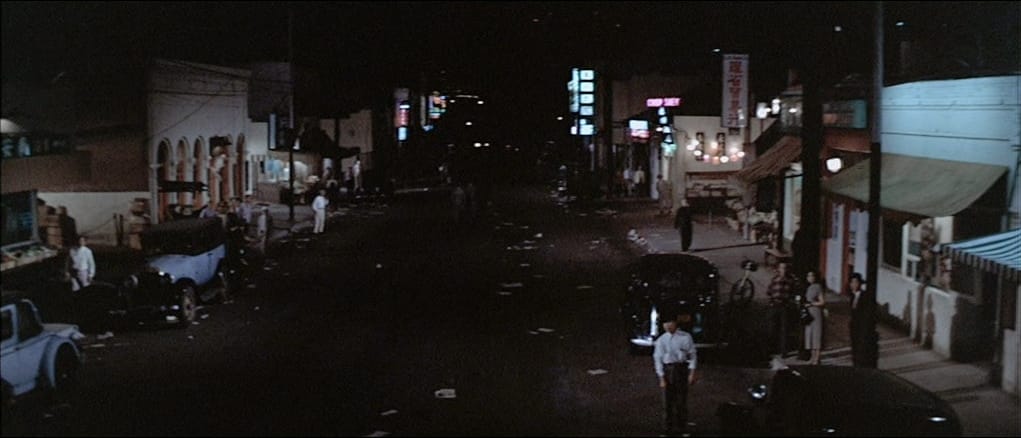
As the famous line goes: “Forget it, Jake. It’s Chinatown.” By contrast, who actually succeeds in Chinatown? Above all others, the conman does. Essentially a sophist who never says truly what he means, he instead dissimulates, constantly mixing truths and half-truths with lies, half-lies, and damned-lies. And the more complicated life becomes under modern conditions due to regulation, bureaucracy, and technology, there are ever greater areas to manipulate and opportunities to swindle.
In artistic depictions, outlaws like Billy the Kid and John Dillinger usually stay outlaws. Unable to adapt to society, their love of fame and itch for action mean they cannot give up the way of the gun. The outlaw needs to but cannot change, while the conman can but refuses to do so. Instead, he merely gains newer and bigger marks. What happens then when not just Chinatown, but the whole USA is his target?
Game Respects Game
Take spy agencies and show business. In Wag the Dog and Argo, we see confidence tricks—done through stage management, misdirection, props, and sheer performance—at the crossroads of both industries, as each one builds an illusion that the marks want to believe in, and finds in the other professional a likeminded fellow.
In Wag the Dog, Blain’s partner is Stanley Motts, a producer who thinks no job is too big, no credit unalluring. To stir the country, he can on the fly record a song about a fallen soldier, scout for actors and film a fake battle in a green-screened Balkans, and write a last-minute kitsch speech for the President to give. Not only do all the marks, from reporters and judges to civilians, have to be duped or persuaded; so do the players, from actors and musicians waiting for their back-end profits, to the President and CIA, which is running its own counter psyop that ends the war which never was.
The producer and the fixer work wonders together. Still, Motts wants the glory, while Blain has to regretfully order a hit on the mogul who refuses to stay quiet. After all, never tell this producer, “No.” As for Argo, Mendez was actually an amateur magician who partnered with Oscar-winning make-up specialist John Chambers—famous for his work on Star Trek and Planet of the Apes and later as a CIA contractor—to disguise the six diplomats stuck at the Canadian embassy. Together they set up a casting advertisement in Variety, a studio company in Hollywood, and a script reading all to give cover for the extraction.
Funny enough, both groups in each film are a bunch of eccentrics. They are the only people who could both pull this sort of trick off, and legitimately gel together solely in this type of enterprise. Like the many sleight-of-hand and con artists, thieves and spies, politicians and gangsters found in Wag the Dog screenwriter David Mamet’s films—from House of Games (1987) and Things Change (1988) to The Spanish Prisoner (1998) and Heist (2001)—all these men and women are fledgling or full-blown illusionists, a crowd of oddballs trying to sell you something as they lighten your wallet and find camaraderie in the only way they know how. They all share a commitment—for very different purposes—to putting on the most excellent illusion possible.
The Spanish Prisoner shows what that pursuit exactly entails. In the film, Joe Ross is an engineer with some valuable IP dubbed “the Process.” Enticed by a new rich friend named Jimmy Dell, he meets with him at various spots: a fancy members-only dining club, a swimming pool locker room, and a niche car dealership. After he learns he is being conned by Dell out of his patent and set up for the fall, Ross reaches out to an FBI agent who has him hand over “the process” to her team. When they also disappear, he sees they too were part of the con. Then finally in touch with real law enforcement, Ross retraces his steps with a cop at all of those former spots.
In a slow montage, he learns the club is really a plain restaurant, the locker room is a broom closet, and the dealership is a warehouse. He cannot explain how he was led to believe, just as we the viewers were, that all these places seemed more than what they were. And yet the same trick is what Mamet had just done to us, and what filmmakers do—or used to do before streaming, social media, and AI voided the business—every day. The audience never even finds out what “the process” actually consists of. Like the fake places, the artistic key lies in giving incomplete but telling details that suggest a complete, albeit unseen whole.
As for Langley and Hollywood, despite the distinct objects of human intelligence and ticket sales, the respective tradecrafts are oddly, eerily alike: making people look at what you want them to see, and disregard what you want them to ignore, while looking as natural and unassuming as possible. Where they truly diverge consists in letting the audience in on the joke. The filmmaker, like the magician, tacitly tells his audience, “This is an illusion.”
“What makes magic different is that it’s inherently honest,” so explains the late Ricky Jay—the sleight-of-hand extraordinaire and recurring Mamet character actor—in the documentary, Deceptive Practice (2012). “That’s the major difference between deception as crime and deception as performance. In the performance of magic, in sleight of hand, you tell someone you’re going to deceive them before you deceive them.” The implication is that criminal deception does not let you know. The deception, in this situation, is a secret put on the American people.
Many times the whole country, put bluntly, became its own Chinatown. Consider the historical irony that among the few documents that survived the destruction ordered by CIA-director Richard Helms in 1973 of all files from Operation MKULTRA—the agency’s midcentury illegal behavior-altering experiments with LSD and other drugs—are two manuals written by the legendary magician, John Mulholland, to advice covert operators on best deceptive practices.
Using principles going back to the days of Harry Houdini, as the editors note in the published version, “the magician’s craft” abounds in “espionage” through “stage management, sleight of hand, disguise, identity transfer, escapology, and special concealment devices.” Yet while modern digital technology has fundamentally changed the spy world’s toolkit, such new devices “provide only additional methods for creating deceptions and illusions,” which remain the purpose of agents and illusionists alike.
As cowboys became cops, they also became federal agents. And as the outlaws became gangsters, it turns out they had the same recruiters. In the genealogy of artistic depiction, one can find both sets of characters in secretive government services, at times the hero and at other times the heavy. But these types of agents cannot cover up political scandals or commit other conspiracies on their own. They need another character to design how to use and keep secrets. Enter the conman, stage left.
Blow It All Up
I still recall the gothic sensation I felt the first time I saw The X-Files. A graduate student at a niche great books college, I had been burning up the midnight oil finishing a modern western show when a voice chimed in the back of my head. It was from an old Shakespeare scholar, Paul Cantor, who had told me years before to watch the series. So I started the pilot, and was enchanted.
The plot was a mildly competent alien abduction story that introduces our two leading FBI agents: the alien-obsessed investigator, Fox Mulder, and the scientific-minded doctor, Dana Scully. The atmosphere of the series is what immediately drew me in, first with a masterful scene direction (often from Kim Manners) that rivalled most horror auteurs, and second by the portrayal of an early-1990s America that took for granted the institutional competency of everything—modern science, government agencies, Silicon Valley, the nation-state—and took all of them apart with local cults, government plots, hauntings and psychics, the men in black, alien colonization, you name it.
Modern science had fulfilled man’s conquest of nature, yet there were so many bizarre entities and strange phenomena it failed to notice. The U.S. government had won the Cold War, funded that science, and cultivated its technology, yet it was always scrambling to shroud its actions, had used ex-Nazi German scientists to win that war, and then gained advanced digital technology from occultic space beings.
If a television series can employ a tacit political theory, the show was a critique of the postwar American order—if not, as Paul Cantor argues, the very concept of the nation-state. It saw our science and technology as a Faustian bargain in an ethos that could well have fused the writings of Wendell Berry with the Bigfoot sightings of the National Enquirer.
Secondly, its reflexive skepticism was not of science but established authority, springing from an innate drive to follow any rumor of cryptid or conspiracy, no matter how foolish or flimsy, all in pursuit of one thing. Well, at least for Mulder. In the words of Ari Schulman: “His project is to draw on science’s legitimacy in order to explode it.” Mulder goes so deep excavating that abyss—indeed, he works in the basement office of the J. Edgar Hoover building—he effectively lives in it full-time, with or without electricity.
As the lead investigator, he is an Oxford-educated savant at forensic psychology who acts intuitively, both wanting to believe in any conspiracy, and willing to be sucked into a flying saucer before he’d fire his gun at it. On the other hand, Sculley is analytical, standing for common sense, but in contrast will shoot at a monster rather than catch it.
The first twist is the gender swap—the male going by his gut, the female by her wits—that also inverts the Watson and Holmes setup. However, a deeper, more fascinating twist is that Mulder is a Jungian who aspires to believe in all things—save for traditional religious claims, which he instead psychologizes on almost every occasion—while Sculley is a half-lapsed Catholic who usually affirms the supernatural reality of God, miracles, angels, and demons.
And just as the showrunner Chris Carter drew from decades of ufology and other weird subcultures, Mulder resembles pretty well a certain stock character: the researcher who believes in nothing traditional, and therefore (like Chesterton’s dictum) will affirm anything at all but that. It just so happens that Mulder is usually right and Sculley is typically wrong, save on the religion episodes, but her skepticism frequently would save him from strategic errors, such as multiple arrests for breaking into government facilities.
To be fair, he is also the show’s closest thing to the private detective. It is just that Spooky Mulder hunts aliens as much as criminals, all the while counterpoised with the show’s ever-tricky Syndicate spymaster, the Cigarette Smoking Man. Every time the show tried to have a series finale, they kill off the Smoking Man, whilst Mulder even turns into a temporary action hero, momentarily fighting bogies in every other scene and seeming almost indestructible. Why he often fails is a curse straight out of classic noir: he more often than not solves the mystery by his own lights, true, but a final proof still eludes him, and the government agent usually gets away.
On the side, Agent Mulder usually has an informant with a cliched mysterious name, like Deepthroat or Mr. X. He (and eventually, she) is a member of the Syndicate, that WASPish cabal of government and corporate leaders who out of lust for power long ago abandoned loyalty to country, species, or God. But there is always a question about why the dissenters of this group inform Mulder, often with hidden agendas that mix lies with truth at every other turn…almost as if to gain and manipulate his confidence.
Midway in the series, for example, Mulder finds a new informant in a Defense Department official named Michael Kritschgau. This new whistleblower tells Mulder the real history behind the government cover up of alien abductions: the public impression of an alien conspiracy is itself a deliberate ruse by the federal government to hide illegal, though entirely human, biological tests, as well as to turn attention away from the military-industrial complex. “But I’ve seen aliens,” Mulder objects. “I’ve witnessed these things.” To which Kritschgau responds: “You’ve seen what they wanted you to see.”
Like a former convert disabused of his newfound faith, Mulder becomes a UFO-skeptic with a zealot’s passion. He shouts at UFO conferences about how they have been all duped, and disbelieves in alien cadavers when put right in front of his eyes. That skepticism lasts for most of the season, anyways. The issue is less whether aliens exist, but who is feeding Mulder which bits of information and why they are leading him this way, then that. Is this new revelation—to be told you are in a con—itself part of the con? Sounds familiar, right?
The Devil You Know
Depictions of government conspiracies typically assume a few people somewhere understand the plot at work, whether the dogged reporter, the whistleblowing agent, or at the very least the conspirators.
This is true even when conspiracy theories are part of the cover-up. Amid public distrust following the JFK, MLK, and RFK assassinations along with the Watergate scandal, the 1970s paranoid thrillers that influenced The X-Files sometimes showed intelligence agencies tracking and manipulating counter-narratives in order to not only control propaganda, but also to check for leaks, recruit outsiders, and get new ideas.
“I work for the CIA. I'm not a spy,” confesses Joseph Turner in Three Days of the Condor (1975). “I read mystery novels, adventures, journals, everything published all over the world. We feed the plots—dirty tricks, codes, anything—into a computer, to check against actual CIA plans and operations. We look for leaks, or new ideas.” An analyst hunted by his own agency, Turner at one point wonders aloud, “What if there’s another CIA…inside the CIA?”
Everything it seems is a front, and everyone, even those specialists in putting on fronts against foreign adversaries, fall for it or are a part of it, but for what endgame? Maybe what William Goldman said of Hollywood can be said of the folklore known as conspiracy theories: nobody knows anything.
One longtime CIA counter-intelligence chief was James Jesus Angleton, a literary spymaster who allegedly helped cover up the JFK assassination, who could never believe his friend Kim Philby was a traitor to MI6, and whose own zeal for hunting moles nearly destroyed his own employer. He tellingly called this process “a wilderness of mirrors,” a phrase he took from T.S. Eliot’s poem, “Gerontion” (1920), which was meant to show the emptiness of a war-torn European civilization where everything was shown to be illusory, and nothing had any substance. It is also apt to describe the internet today.
Ultimately, a world of mirrors, wilderness or civilized, might as well be an empty one. And the illusions today are not the same ones as those from yesteryear. Who after all can tell what is real from generative-AI, deepfakes, and anything now coming out of that obelisk prophesied by Kubrick’s 2001: A Space Odyssey (1969), the digital screen? Large language models were built by putting “dirty tricks, codes, anything” into the computer: all of the internet and centuries of human knowledge, especially TV and film scripts, created bots that make no distinction between truth and falsity, just output to be cranked, and behavior to be simulated. It is the stuff conspiracy theories are made of.
Amid all this, the cowboy will always be needed: to love righteousness even when it hurts, to tell the truth even when no one believes, and to be heroically searching for it especially when the odds are against him. That faith cannot be faked by a god or an angel. But between the devil you know and the devil you don’t—or rather, the one we are all now just meeting—the old one can take my money any day of the week.
-- Ryan Shinkel is a writer, editor, and podcaster originally from the Midwest. He can be followed on X (www.x.com/ryanshinkel) and substack (substack.mortals.com).