The following essay is an excerpt from a longer essay, which itself is part of a collection of essays drawn from dramaturgical research for Thus Always Unto Tyrants, a play about Boston Corbett, the man who killed John Wilkes Booth.
Historical tradition gave rise to the French peasants‘ belief in the miracle that a man named Napoleon would bring all glory back to them. And there turned up an individual who claims to be that man because he bears the name Napoleon. – Karl Marx, The 18th Brumaire of Louis Napoleon
I
It’s in the 18th Brumaire of Louis Napoleon that Karl Marx makes his famous assertion, building on Hegel, that world-historic events and people appear twice— first as tragedy, then as farce. It’s a well known line, one that many people, even those generally hostile to Marx, quote without realizing the source. Less well known, however, is the following line, where he adds to that equation the idea of the “the nephew for the uncle”. First as tragedy, then as farce: first as uncle, then as nephew.
In the essay, Marx is discussing Napoleon III, nephew of Napoleon Bonaparte, President of the Second French Republic from 1848-1852, and Emperor (the last) of France from 1852-1870. In the essay— which analyzes the rise of Napoleon III, his 1851 coup, and the contradictory class characteristics of his base—Marx asserts that Napoleon III is a caricature of his uncle. It is a type of caricature that will occur again.
Certain names repeat. Kings, popes, Roosevelts, Bushes. It’s a natural consequence of the dynastic or quasi-dynastic transfer of power that persists even in democratic societies. Power is transferred from father to son, and so is the name. Father to son, or uncle to nephew. Nepotism, after all, derives from nepos, Latin for nephew. There is a certain nephew-ward progression to history, genealogical but not quite linear, generational but orthogonal, often with a slight degradation—the iconic black and white photos of the uncle on the boat are, 65 years later, replaced by the crude lines of a boardwalk caricature.
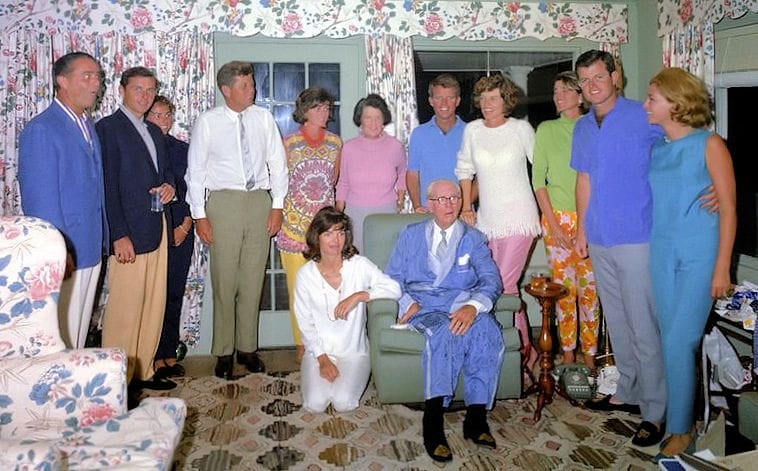
If there is one name, one series of uncles and nephews that most haunts the American political imagination, it is Kennedy and those bearing the name. Even as the family’s material political power has diminished, the name, the idea of the Kennedy, still holds power over the American psyche. Kennedys still run for office. Grandsons are able to mount political campaigns and get New Yorker interview profiles. The Kennedy name can still sell a prestige miniseries. Esquire and Tik-Tok and men's fashion advice forums still run tutorials on how to dress like John F Kennedy Jr. The assassination of JFK was a moment of definitive psychic rupture. The assassination—Dallas, the gunshot, his slumping body, Jackie Kennedy scrambling out of that convertible—still plays on loop in the Zapruder film at the back of the American psyche, even people born 30, 40 years after the event. Tragedy clings to the name. Tragedy and conspiracy and paranoia.
Tragedy, but one that is verging more and more into farce.
II
Tragedy: Jackie Kennedy, in her grief over the assassination of her husband, turning towards the works of the Greek playwright Aeschylus, specifically, The Oresteia, a trilogy of tragic drama about a cycle of murder and familial vengeance that culminates in the invention of the jury system, banishment of the Furies, and the triumph of law over vengeance. In turn, Jackie would recommend the work to JFK’s grieving brother. In 1968, five years after the assassination of his brother, while running for president himself, Robert F. Kennedy Sr. would quote the play to a simmering crowd the night day of the assassination Martin Luther King's assassination, imploring peace, “to tame the savageness of man and make gentle the life of this world”:
In our sleep, pain which cannot forget falls drop by drop upon the heart until, in our own despair, against our will, comes wisdom through the awful grace of God. Aeschylus, quoted by Robert F Kennedy Sr, April 4, 1968. Indianapolis, Indiana.
A powerful moment, somewhat undercut by RFK Sr’s own subsequent assassination two months later. A series of political murders that echo the cycle of murder of the Oresteia itself, tragic in the most literal, classical, sense. Assassinations would continue apace; America would continue to be the definitive engine of retributive state violence; Richard Nixon would go on to win the 1968 election and his personal paranoid neurosis would settle into the definitive psychic atmosphere of the country, eventually coming to a head in the other definitive post-war 20th century conspiracy, Watergate.
Farce: Robert F Kennedy Jr. strapping the head of a dead whale to the roof of his car: the image of theater masks replaced with one of a plastic bag, mouth hole cut out, over the head of his daughter to block the stench of the whale’s seeping fluids.
III
At the moment, the most prominent bearer of the Kennedy name is Robert F. Kennedy Jr., son of his father and nephew of his uncle. As good a symbol for the general depreciation of American life as any, he has most recently wheezed and brain-wormed his way back onto the national stage as a “candidate” in the post-fever sundowning that was the 2024 presidential election, running first as a Democrat in the primary and then as independent in the general election. His rightward turn culminated in an endorsement of Donald Trump, for which he was rewarded with the role Secretary of Health and Human Services. It’s an ironic appointment considering his own relationship to personal health: brain-wormed, mercury-poisoned, heroin-addicted, supplementarily-testosteroned, beeftallowed, with bed-tanned leather skin and sauna jeans. He refuses to eat seed oil but is fine eating roadkill bear meat and drinking raw milk.
His signature initiative, Make America Healthy Again (MAHA), is a political movement reflective of his own neuroses. MAHA starts from a reasonable place— concern over the catastrophic state of healthcare and food quality in America and a suspicion of pharmaceutical companies—but quickly devolves past the point of conspiratorial thinking and into an outright miasmic medieval mindset. Rollbacks of vaccines are the loudest cuts he has made as head of the HHS but he has made sweeping changes beyond that.
The loudest changes he has made have been rolling back vaccine requirements, but he made other significant changes, including large budget cuts. Here’s the thing though, getting artificial dyes out of food, for example, is only so useful when corporations have carte blanche to dump whatever other chemicals they want into the water supply. The HHS works in concert with other departments of the administration, the Environmental Protection Agency among them. RFK Jr. may have banned allegedly-autism-causing mercury-based preservatives from vaccines, but what good is that, even on its own terms, when the EPA, as part of what administrator Lee Zeldin has called the “biggest deregulatory action in U.S. history” has stripped back regulations against mercury pollution controls everywhere else.
This is ironic, and not just considering RFK Jr’s personal history of mercury poisoning.
He made his bones in the 90s as a lawyer known as an advocate for clean water, in particular a case about mercury levels. This is representative of the general path of RFK Jr’s career, throughout most of which he was known as an environmental advocate and staunch liberal, to the extent that when he was considered by Barack Obama for the position of head of the EPA, a prominent lobbyist criticized the possibility, saying “A Kennedy appointment is as liberal as you can possibly get. There is no one [candidate] based firmer in extremes.” A spokeswoman responded to this by saying “his positions and the organizations he’s aligned himself with are very mainstream America.”
The thing is, even as his politics become more fevered, even as the positions he aligns himself with become more mercury poisoned, they remain very much aligned with mainstream America. His contradictions are representative of a lot of people, the “motley mixture of crying contradictions” that Marx names in the 18th Brumaire.
This contradiction is evident in the MAHA movement, which has brought a number of formally liberal people into the general MAGA fold. When a politics is detached from material analysis and instead is mostly built around signifiers— natural diets for example—those signifiers can easily switch poles. Crunchy anti big-pharma shifts rightward. RFK Jr’s liberal-independent-fascist trajectory is representative. MAHA is an excellent example of how unmoored reasonable critiques of the political and economic reality can become, how badly one can take their eye off the ball, when not grounded by a serious materialist analysis. It shows the dangers of liberalism without a materialist backing. RFK Jr. is an avatar for a political moment where what passes for most people’s politics is really just a complex of poorly disguised eating disorders.
IV
Nephew for the uncle; farce for tragedy; secretary of health and human services for attorney general. RFK Jr is a caricature of the generation that preceded him. His aborted presidential run was a farce of his uncles’ and his father’s. His demeanor, his croaking delivery melting face, are a parody of the Kennedy charm.
Conspiracy defines the life, or rather death, of the uncle. The JFK assassination remains the Ur-conspiracy of post-war American life. The event opened up a level of distrust in the American government by its people that has not healed. It lingers, festers. As recently as 2023, 65% of Americans believe that the official report of the lone gunman is false. Whether or not Oswald acted alone is not the point here—the point is that the effect the event had on people, the distrust it engendered, the way it made people think seriously about the role of the deep state in American politics. The long term effects: The Warren commission gave way to the Church Committee, and whether or not Oswald acted alone or not, much of what the Church Committee revealed is true.
Likewise, conspiracy is a definitive part of both RFK Jr’s backstory and his message. He steps into a political and psychological landscape defined by the conspiracies around the death of his uncle and father. He is skeptical of the official narratives surrounding the death of his uncle and father—that is hard to hold against him. However, in general, his relationship to conspiracy plays like a parody of the proceeding generation. Rather than the tragic subject of the conspiracy, RFK Jr. is merely dabbles in the same lay-conspiracy theories everyone else does; in recent years he has become more fixated on both the stupidest boomer-bait or most hateful racist, anti-semitic, and anti-trans conspiracies. Rather than engaging in an epic struggle with the deep state, he is in a battle with fries that aren’t cooked in the right oil. He has endorsed chemtrail conspiracies, the definitive conspiracy for those who’ve taken their eye off the ball (especially misguided considering his earlier career focus on legitimate issues of corporate chemical malfeasance.)
Like his son, RFK Sr. also expressed skepticism over the official narrative of JFK’s death. He, RFK Sr, had a complicated relationship with the American deep state, a relationship that is made a farce of by his son who has taken a role in Trump administration, which has, despite the bold claims to bring a cleansing storm to the deep state, has basically taken hold of the deep state fascist apparatus and used it to sell testosterone supplements and do crypto rug-pulls.
V
Parallel to the renewed relevance of RFK Jr. is a resurgence in interest in his cousin, John F. Kennedy Jr. Contra RFK Jr, who hunts strange animals and bafflingly self-identifies as a redneck, JFK Jr. remains the apex of a casual American elegance to which fashion trends have once again bent back towards. Beyond that though, the figure of JFK Jr. played prominently in the tangled and lore-saturated Q-Anon mythos. The driving theme of the movement is a belief in a satanic cabal of deep state pedophiles, that various political, cultural, and economic elites have been engaged in secret ring of sex trafficking and pedophilia. Where things really lost touch with reality was the belief that Donald Trump would, in an event known as “The Storm” arrest and execute these pedophiles. One variation of the theory, believed by 20% by some estimates, was that, in one way or another, JFK Jr would return, assume the presidency, and wipe out the deep state. True believers went as far as to descend on Dealey Plaza on the anniversary of JFK Sr’s assassination, in the belief the son would return there.
Political conspiracy passing the point of conspiracy into religious belief. The revelation of the occluded Kennedy. Apocalyptic vengeance, an eschatology predicated on the belief that a man named Kennedy would return and bring back all the glory, would return from the dead, walk out of the ocean, and destroy the deep state. A fever-dream of the nephew. It makes sense that a Kennedy would figure into Q-Anon considering how foundational the assassination of JFK Sr. is to American conspiracy.
VI
These things repeat.
Q-Anon’s belief in the messianic qualities of JFK Jr and the subsequent rise of RFK Jr is similar to “the fixed idea of the nephew”, how Marx’s describes the messianic qualities certain classes had imbued Napoleon III with:
Historical tradition gave rise to the French peasants‘ belief in the miracle that a man named Napoleon would bring all glory back to them. And there turned up an individual who claims to be that man because he bears the name Napoleon […] The fixed idea of the nephew was realized because it coincided with the fixed idea of the most numerous class of the French people.
It is believed a man named Kennedy will return to bring all glory back, make the country great again; a man named Kennedy turns up. The contradictions and neuroses that Kennedy embody reflect the contemporary conservative movement: the alliance of the rural poor and petite bourgeoisie “who want to see themselves and their small holdings saved and favored by the ghost of the Empire”; the strange mixture of libertarianism and fascism, of deregulation and oppressive state control. The "most motley mixture of crying contradictions: constitutionalists who conspire openly against the constitution; revolutionists who are confessedly constitutional”, in borrowed “names, battle slogans, and costumes in order to present this new scene in world history in time-honored disguise and borrowed language”.
Q-Anon as a movement is not as prevalent as it was five years ago, but that’s not because it went away. Rather, it has captured the conservative movement. It has moved from the fringes to the center. Even the director of the FBI, as enmeshed with the deep state a role as can be, was a Q-Anon theorist. Q-ANON has become the center of the GOP. It lingers in the fog of the long COVID fever dream, especially now that the Epstein revelations show that Q-Anon’s fear of a pedophilic elite were not entirely unfounded. Nothing feels real.
It’s clear that JFK Jr is not going to rise from the dead or come out of hiding to take the helm of the republic and drive the pedophiles out of government, drain the swamp, bring the storm. Fortunately, there’s still a cousin hanging around to take up the mantle. Everyone is waiting on a Kennedy to come save them. Anyone bearing the name Kennedy will do.
-- Jacob Stovall