A bestiary of four fringe figures of American history, all with roles in the Civil War and/or the assassination of Abraham Lincoln. Taken from dramaturgical notes for Thus Always Unto Tyrants, a play about Boston Corbett, the man who killed John Wilkes Booth.
Boston Corbett
“Lincoln’s Avenger”, the man who killed John Wilkes Booth.
Born Thomas Corbett, Boston Corbett was a hatter by trade and driven crazy by a combination of the mercury fumes and personal loss. He began his career in Virginia, but his opposition to slavery and erratic behavior made it hard for him to secure work in the South; he eventually fell into alcoholism and homelessness. For a while he moved from city to city on the East Coast until he was saved, as it were, by a street preacher in Boston, the city he re-christened himself after. From that point on he dedicated his life to proselytizing as a street preacher himself.
Despite his devoutness, or maybe because of it, he was still deeply troubled by his sexual urges. In order to cure himself of those urges he took a drastic step: auto-castration.
Once the Civil War started, Corbett, still a vocal advocate of slavery, joined the Union army, initially under the command of Daniel Butterfield. Corbett remained fervent in his religious beliefs. His proselytizing became an issue, especially when he started reprimanding his commanding officers; his religiously inspired disobedience led to him sentenced to death, though this was later dropped.
A later unit of his was captured by Mosby’s Rangers, a Confederate unit led by John S. Mosby, and Corbett was sent to the Andersonville prisoner-of-war camp in Georgia, a notoriously brutal place. (Henry Wirz, commander of the camp, was the only Confederate soldier to be executed for war crimes.) While in the camp, Corbett caught a fever and nearly died: in addition to the psychological trauma, the effects of the fever would plague him the rest of his life.
The defining act of Corbett’s life is his shooting of John Wilkes Booth, American actor and assassin of Abraham Lincoln. After a twelve day hunt for Booth, Corbett’s unit surrounded him in a barn. Booth refused to surrender and the barn was lit on fire. Exactly what happened in the chaos would be litigated for the rest of Corbett’s life. What is clear is that Corbett shot and killed John Wilkes Booth. He did so against his commanders orders. Corbett claimed he hadn’t meant to kill Booth and that “providence directed him”; others disagreed, claiming he acted for his own personal glory.
Corbett’s post-war life was marked by increasingly erratic behavior. He devolved into conspiratorial thinking, believing a network of Booth’s sympathizers were sabotaging him, a belief not helped by the death threats and hate mail he received. Initially, Corbett tried to capitalize off of his newfound fame by hitting the lecture circuit, but his erratic behavior got in the way. For a time, he was given work as a preacher in New York City, but again his erratic behavior led to a falling out with the community. After a number of failures on the east coast, Corbett moved west, to Kansas, and tried his hand at homesteading, at which he was equally unsuccessful.
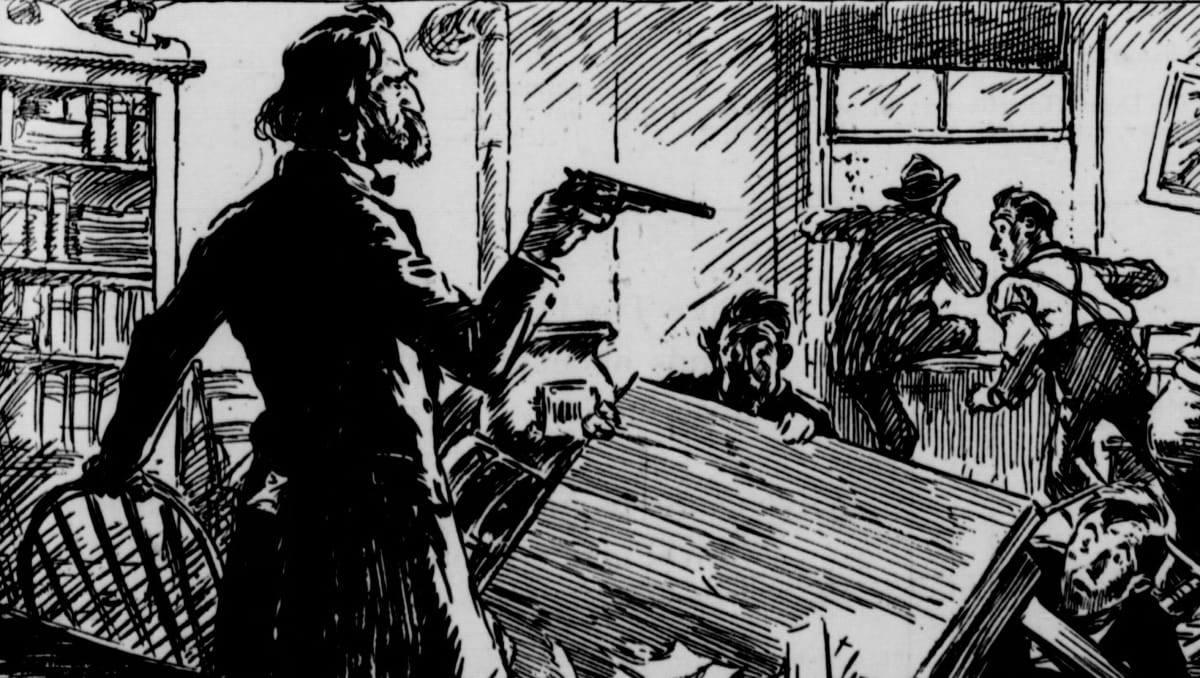
From the end of the war onward, he was involved in a number of gun related incidents. Immediately after the war, he pulled a gun on a police officer who rousted him from a horse stable he was sleeping in. While at a Civil War veteran reunion, attended by both Union and Confederate soldiers, Corbett pulled a gun on fellow attendees who were questioning whether Booth had been killed at all. The incidents only grew worse after moving west, where he became known by his neighbors for his gun-filled house. He fired warning shots at children crossing his property. At the trial for shooting at the kids he pulled a gun in the courtroom and backed out, gun still drawn, then met police at his door with a gun the next day. The case was dropped. Despite this, he was given a job as assistant doorkeeper at the Kansas State Courthouse, where he served as a sort of celebrity attraction. While working there, Corbett pulled a gun on a group of his co-workers, who he believed were conspiring against him.
Eventually, this behavior led to Corbett being sent to an insane asylum. He escaped and was never found. He is believed to have died in the Hinckley (no relation) wildfire.
Beyond being a fascinating character in his own right, Corbett is representative of a uniquely American type of psychosis. His mercury-poisoned, fever-damaged slide into paranoia, conspiracy, gun violence makes him an excellent avatar for the contemporary American psycho-political landscape.
Despite being involved in highly political moments, and despite holding strong convictions, his actual political beliefs are difficult to determine. Clearly a man of great conviction, though perhaps misplaced, it’s not accurate to say he lacks a politics. However, they are obscured by layers of both personal paranoia and history. The two defining things in his life—religion and guns—are, in the contemporary political landscape, coded as right-wing, but that doesn’t entirely track onto late 19th century politics. (After all, John Brown was also a strong proponent of guns and Christ.) Corbett was also a vocal opponent of slavery, and suffered for it. He is contradictory. It is difficult to map 21st ideology onto the past, and things like guns and religion are only secondary political markers, not politics in and of themselves.
In any case, Corbett’s political illegibility is representative. Corbett is both an entirely idiosyncratic figure and an avatar of the incoherence and violence of American politics. Action often proceeds ideology, which is then prescribed post-facto. Corbett falls into a long line of assassins and avengers driven by contradictory politics and personal paranoia. There aren’t so much politics in America as a fever of violent retribution.
Daniel Butterfield
Union General and Assistant Treasurer of the United States. Commanding officer of Boston Corbett.
Daniel Butterfield is another marginal figure whose biography nevertheless keeps intersecting with significant moments in American economic and military history.
Daniel was the son of Warren Butterfield, co-founder of American Express, which is today a major multinational bank and credit card company but was founded as a stagecoach, freight shipping, and money order company largely operating on the American frontier. His line can be traced into deep American colonial history: the first Butterfield to come to America arrived in 1638.
As a colonel, Daniel Butterfield was the commanding officer of Boston Corbett, the man who would go on to kill John Wilkes Booth. The two had a contentious relationship. Corbett once castigated Butterfield for taking the Lord’s name in vain; in response, Butterfield jailed Corbett. Butterfield was generally disliked by his men, one of whom once said “I don’t think I ever hated a man more in my life than I did Colonel Butterfield.” Despite this, he was promoted to brigadier general and became Gen. Joseph Hooker’s chief of staff, presiding over a unit notorious for the lax moral code, with one officer calling it a “a combination of a bar-room and a brothel.”
Butterfield composed Taps, a very well known bugle call used to signal lights out that is often performed at military funerals. He also invented shoulder patches denoting unit.
He parlayed his military success to the role of Assistant Treasurer under Ulysses S. Grant. His time in office was marked by financial scandal, including insider trading. He played a significant role in the Black Friday stock collapse of 1869. This crash was triggered by an unsuccessful attempt to manipulate the gold market by a small group of speculators, who had bribed Butterfield.
The Gold Ring plot and subsequent Black Friday crash was a significant economic event. It is representative of the stretch of history between the end of the Civil War and the New Deal, the so-called robber baron era, which was marked by government corruption and wealth inequality. Butterfield, and Grant’s administration more broadly are illustrative of the failures of the post-Lincoln Republican party and the inability to translate military success to effective government administration.
Henry Wirz
Confederate officer, commander of Andersonville prison
Like Butterfield, Henry Wirz’s career is marked by a mixture of financial crimes and military significance. However, unlike Butterfield, Wirz’s military career was not illustrious. While his financial crimes were petty in comparison to Butterfield’s, the severity of Wirz’s military crimes far outstrips the severity of Butterfield’s financial crimes. In fact, Wirz was the only Confederate officer executed for war crimes.
Wirz was born in Zurich, Switzerland, where his father was a member of the city council. In his 20s, Wirz was convicted of embezzlement and fraud, and after a brief stay in prison, he was exiled from Zurich. Following his exile he moved to the United States, first to Massachusetts and then to Kentucky. His initial career plan had been to become a doctor, but he was unable to afford medical school. Nevertheless, once in the United States, he again pursued, after a stint working in factories, a career in medicine. He worked as a doctor’s assistant in Kentucky before trying to start his own homeopathy business, moving between Hopkinsville and Cadiz, Kentucky and Northampton, Massachusetts, where he also worked as superintendent at a water cure clinic. He later moved to Louisiana and was employed as the overseer of a slave plantation. While in this capacity he continued to run a homeopathy business.
During the civil war, Wirz worked his way up to be the commander of Andersonville prison (formally known as Camp Sumter), a prisoner-of-war camp for Union soldiers in Georgia, where Boston Corbett was held. The camp was the largest Confederate prisoner of war camp, with four times as many prisoners as any other. It was known for its especially hellish conditions, with prisoners suffering from starvation and fever and a death rate of 28%.
After the war, Wirz was arrested and tried for a number of offenses, including 13 acts of personal cruelty and murder. These crimes included shooting prisoners and ordering them to be shot, beating them with a revolver, and kicking them. The intensity of his actions led Judge Advocate General Joseph Holt, prosecutor during the trials of John Wilkes Booth’s Lincoln assassination co-conspirators, to claim that "his work of death seems to have been a saturnalia of enjoyment for [Wirz], who amid these savage orgies evidenced such exultation and mingled with them such nameless blasphemy and ribald jest, as at times to exhibit him rather as a demon than a man.”
Wirz’s trial was significant in the development of war crime law, helping establish the precedent that merely following a commanding officer’s orders is not a significant justification for innocence. Likewise, the brutality of Andersonville, along with other Civil War POW camps, led to the establishment of codified rules for the treatment of prisoners of war. The Civil War is a moment of modern warfare as it came into existence; people were not prepared for the brutality of it. Though, as William T. Sherman said, “war is cruelty, and you cannot refine it”,the brutality of the Civil War led to early attempts to establish the parameters under which modern war could be fought.
Wirz’s pipeline from financial fraud to homeopathic medicine to war crimes is one that resonates with the contemporary political landscape. Though his biography is in many ways idiosyncratic, he also embodies a particular archetype. The fact that he moved between North and South shows he wasn’t that ideologically committed to the Southern cause and that his acts were committed more out of a sense of personal career advancement and sadism. The plantation overseer who runs a homeopathy company stands out in particular as a figure of a specifically American kind of evil. His combination of racialized violence and banal fraudulence is not unique.
John Surrat
Confederate spy and suspected co-conspirator of John Wilkes Booth
Questions remain about John Wilkes Booth and his co-conspirators, namely who exactly was involved and who had knowledge of the plot to kill Abraham Lincoln (along with the failed plots to kill Vice President Andrew Johnson and Secretary of State William H. Seward) as well as the exact political motives and aims of the plot. One alleged co-conspirator was John Surratt Jr.
Surratt’s mother, Mary Surratt, ran a boardinghouse in Maryland, a Union border state with many Confederate sympathizers. It was used as a safe house for Confederate spies and was the meeting place for the conspirators, many of whom were her boarders, when plotting the assassination. For her role, Mary Surrat became the first woman executed by the U.S. federal government.
John Surratt worked for the Confederate Secret Service as a courier and a spy. He was involved in Booth’s earlier attempt to kidnap Lincoln, a month prior to the assassination. He was the initial suspect for the shooting of Seward; the culprit was later revealed to be Lewis Powell, who was arrested, along with Mary Surratt, returning to Mary’s boardinghouse in disguise.
After the assassination, John Surratt initially fled to Montreal, Canada, which was a major hub for the Confederate Secret Service, and stayed there throughout the trial of the conspirators. He then fled the Western hemisphere, first to Liverpool, then to Rome. While in Rome, he briefly became a member of the Papal Zouaves, an infantry battalion formed by Pope Pius IX to defend the Papal States, in its last years, against the Italian Risorgimento (the unification of Italy).
Surratt was recognized and arrested in Rome, but he escaped. After escaping, he was taken in by supporters of Italian general and revolutionary Giuseppe Maria Garibaldi, known in Italy as one of the “father’s of the fatherland” for his role in Italian unification. Surrat was arrested in Alexandria, Egypt in his Papal Zouaves uniform.
At his trial, Surratt was found not guilty of murder, the only charge where the statute of limitations hadn’t run out. After a brief spell as a teacher and public lecturer, Surratt spent the rest of his life working for the Baltimore Steam Packet Company, a shipping and overnight steamship company, as an auditor and treasurer. He was married to the second cousin of Francis Scott Key, composer of the national anthem.
Though Surratt is ultimately a marginal figure in American history, and even his role in the assassination of Abraham Lincoln seems negligible, his is still fascinating. The role that intelligence and spy-craft played in the Civil War is often overlooked, as is the relationship between the American Civil war and broader international geopolitics. Surratt’s time in Italy coincides with a time of political upheaval and unification in Italy and is a reminder of the interconnectedness of international political and military action.
The assassination of Abraham Lincoln is often thought of as an act of random violence by John Wilkes Booth. However, it was a deliberate political act, one that involved many people. Though most historians doubt that anyone at higher levels of the Confederate government was involved, it is still worth noting that the assassination of Lincoln was carried out by former members of the Confederate Secret Service. Actions of the ideological movement continued to ring after the end of the war. Among other things, the assassination of Lincoln set the table for the failure of Reconstruction.
-- Jacob Stovall