Three Films of Carnivalesque Horror
A work of contemporary scholarship, Timothy Jones’s The Gothic and Carnivalesque in American Culture makes the claim that the American Gothic, as literature, film, and television, is marked by a deadly unseriousness. “Ballyhoo,” which is a neat word that summarizes the American penchant for camp, mockery, and gallows’ humor, is rife within American horror fiction. Jones makes the argument that American horror is about entertainment—it is about conjuring the sensation of walking through a carnival featuring a House of Horrors. Rather than the philosophical dread and incipient nihilism of classic European Gothics, their American cousins eschew contemplation and dourness for the immediate thrill of morbid excitement.
In other words, American stories about death and disfigurement are rather lively.
This brief essay will take only a small seed from Jones’s larger work. Like Jones, my interest is in American horror fiction and cinema, that most American of art forms. And just like The Gothic and Carnivalesque in American Culture, the carnival will figure prominently in this work. Indeed, the thrust of this essay concerns the presence of the carnival—the fairground, the traveling freak show—in three morbid movies produced between 1927 and 1962. Rather than well-known Hollywood blockbusters or genre-defining standard-bearers, these three films—The Unknown, Night Tide, and Carnival of Souls—are mostly forgotten and little studied. One (Night Tide) is not even considered a horror film by many, despite its supernatural elements and references to the occult. The carnival appears as a character in each film, and indeed the liminality of the traveling show is integral to all three films. The unusual culture of the sideshow and its performers is similarly a defining feature of The Unknown and Night Tide.
The carnival here is not just for entertainment. Rather, the ballyhoo is a mask for something more serious, more chthonic in American horror. Yes, Jones is correct that much of the gothic in American fiction is shot through with silliness and a self-aware sense of humor. But, as these three films show, carnivalesque horror in the United States is also about the primordial allure of the Other. In a culture that prides itself on individualism, yet frequently displays a preference for mass conformity, America has long been equally afraid and attracted to renegades [1]. Renegades of the flesh—the mutilated and maimed—and renegades of society (criminals, cutthroats, loners, and ghosts) populate the three carnivalesque horrors of our study.
The Unknown – Unnecessary Surgery in the Name of Love
Film director Tod Browning (1880-1962) is best remembered for two films made near the end of his career in Hollywood. The first, 1931’s Dracula, is the UR-vampire film that gave the Transylvanian count his look, accent, and mannerisms. Actor Bela Lugosi is so synonymous with the character that in real life, he was buried wearing the Count’s black cape [2]. The second film, 1932’s Freaks, prematurely ended Browning’s career in cinema. Although considered a groundbreaking classic now, Freaks was banned and censored in its time and was a severe box office failure. The alcoholic Browning was blamed for everything, and thereafter only directed four more films (one of which was uncredited) before becoming a veritable recluse in Southern California.
Freaks, which is based on the short story “Spurs” by Tod Robbins, tells the story of a group of sideshow freaks who enact a dreadful vengeance on the beautiful Cleopatra (Olga Baclanova) and her strongman lover Hercules (played by Henry Victor) for the crime of conspiring to steal the fortune belonging to the dwarf Hans (Harry Earles) via romantic subterfuge. The fact that Browning’s film features actual sideshow performers with real deformities was too much for audiences to handle in 1932.
Browning’s Freaks did not come out of left field. Carnival and sideshow spectacles can be found everywhere in Browning’s silent film period. This was a deliberate choice, for Browning knew the carnival well, having performed as the Living Hypnotic Corpse in a traveling circus that moved up and down the Ohio and Mississippi rivers [3]. Browning’s role saw him portray a somnambulist like Cesare in The Cabinet of Dr. Caligari, but instead of kidnapping lovely women, the “undead” Browning would lie as still as possible in a glass coffin for the amusement of paying marks [4]. This macabre spectacle, along with Browning’s itinerant and booze-filled lifestyle, would greatly inform his cinematic oeuvre. Browning’s other great muse was the actor Lon Chaney, Sr. (1883-1930), who made a series of outré crime and horror films with Browning beginning with 1919’s The Wicked Darling.
The first Browning-Chaney feature film to utilize the mise-en-scène of the carnival, 1925’s The Unholy Three, concerns a trio of sideshow performers led by the ventriloquist Professor Echo (Chaney) [5]. The trio, also including a midget (Harry Earles) and a strongman (Victor McLaglen), decide to pull off an elaborate jewel heist before disguising themselves as an old woman, her grandson, and a worker at the woman’s pet store. Love and a tenacious detective cause the scheme to fall apart, and in the end, Professor Echo is forced to return to the sideshow after confessing his crimes in court.
While all three crooks in The Unholy Three are carnival performers, very little of the film’s action takes place underneath the big top. This is not the case for The Unknown, which Browning and Chaney made together two years later. The Unknown might be the quintessential Browning film, as it touches upon all the topics that the auteur obsessed over: disfigurement, unrequited love, ugly or otherwise unsavory loners, the carnival, and revenge. All these elements, plus an outstanding performance by Chaney, make The Unknown required viewing for any serious student of American horror cinema.
The Unknown tells the horrific tale of a traveling circus in Spain that features a unique knife-thrower named Alonzo the Armless (Chaney). Alonzo uses his toes to fling sharp blades at his beautiful assistant, Nanon (played by a young and fetching Joan Crawford), who is the daughter of the circus’s owner. Alonzo is madly in love with Nanon, but he keeps this affection secret. There is another would-be lover, the strongman Malabar the Mighty (Norman Kerry), but his maneuvers are frequently rebuffed by Nanon owing to her irrational fear of human hands. Nanon is the great sensual rose of the carnival, and her refusal to be touched makes her allure even more powerful.
Nanon’s phobia of hands is the reason why she feels a strong, but Platonic connection to the armless Alonzo. The knife-thrower can never touch her, after all, and because of this, Nanon treats the older man like a fatherly confidant. The pain of sexual repression becomes too much to bear for Alonzo, who, along with his partner-in-crime, Cojo the dwarf (John George), journeys to the city and bribes a surgeon into amputating his arms. But wait? Isn’t Alonzo the Armless already…well…armless?
No. The truth is that Alonzo uses a tight, binding corset to pin his arms to his ribs during his performances. Alonzo is no masochist; he pretends to be armless to hide the distinctive double thumb on his left hand, which, if seen, would aid in the identification of Alonzo as the criminal responsible for a series of outrages, including murder. Indeed, early in the film, Nanon’s father discovers Alonzo’s secret and is strangled by the knife-thrower because of it. This crime has an eyewitness—Nanon—and because of it, Alonzo finally decides to become a true “freak.”
When Alonzo fully recovers from his lengthy surgery, he arrives back at the carnival to learn that Nanon has overcome her phobia and plans to wed Malabar. In the film’s most excruciating scene, Chaney laughs maniacally and his face shows a mixture of hatred and despair. It is at this moment that Alonzo plans to enact his deadly revenge. When Malabar sets about performing his new trick, which sees both of his arms tied to two horses galloping on treadmills, Alonzo interferes with the horses hoping that Malabar will become armless just like him. However, when Nanon tries to save her lover by running towards one of the frightened stallions, Alonzo shoves her out of the way and is trampled to death by the horse as a result. In the end, Alonzo is both the film’s villain and martyr—a cruel, but lovesick criminal who first mutilates himself, then dies all for a woman who loves another man.
The Unknown debuted in New York around the same time that Charles Lindbergh made his heroic return to America after his celebrated Transatlantic flight. [6]. The film became a major hit and managed to skirt by the censors despite its clear sadomasochistic themes. According to horror movie scholar David J. Skal, The Unknown is “a perfectly constructed torture machine and arguably Browning’s most accomplished film” [7]. It is hard to argue against this assertion, as this tour-de-force, which has a runtime under one hour, presents the epitome of Browning’s haunted carnival. Chaney’s Alonzo is both sadist and masochist, plus he is the romantic lover of ancient imaginations. In short, he is a figure of horror and tragedy in the same vein as Caliban in Shakespeare’s most occult-infused play, The Tempest. The Unknown, despite being primarily a character study of the twisted psychology of Alonzo, also raises tricky questions about the morality of mass spectacles and the audiences that enjoy them. The carnival of Nanon, Alonzo, and Malabar is a carnival that features dangerous animals, abused animals (one assumes that the horses in the film’s conclusion didn’t want to run on treadmills), and performers regularly put at risk vis-à-vis knife throwers and other such specialists. There is of course also the presence of “freaks” designed to appeal to the more salacious interests of audiences. And, if the focus is zoomed out, The Unknown poses that old chestnut of a quandary: what kind of sick individual likes watching movies about murder and unnecessary surgery anyway?
Some have suggested that the great devil of The Unknown was the man behind the camera all along. Browning, who was not only an alcoholic throughout his career, but also rather infamous in Hollywood for his inter-racial affair with underage actress Anna May Wong [8], was a notoriously sadistic personality. He may have taken an unnatural delight in filming Chaney for hours while the actor had his arms bound painfully at his sides. Then again, Chaney, the so-called “Man of a Thousand Faces,” was himself accused of machoism given his predilection for partaking in roles that required self-mutilation and torture. The pain of portraying Alonzo the Armless was presaged by Chaney’s portrayal of the legless crook Blizzard in Wallace Worsley’s The Penalty (1920). That role required Chaney to use a leather-and-wood apparatus whereby his legs were bound up with straps and a pair of buckets that housed his curled-up knees. The sadomasochistic dyad of Browning-Chaney may have fed off one another in the making of The Unknown, and thus the film was imbued with their shared perversity. All of this is conjecture of the worst kind (pop Freudian rubbish), but it is nevertheless true that The Unknown is a carnivalesque horror where the audience is forced to do two things at once: loathe Alonzo as a degenerate criminal and feel empathy for him, especially following his fatal sacrifice. The fact that Browning primed his audience beforehand during the run-up to the film’s premiere by insisting that such curiosities as Alonzo are not far-fetched [9], speaks even more towards the director’s desire for his viewers to sympathize with the visible “devils” in their midst [10].
The Unknown has very little ballyhoo, but a whole lot of spectacle. Viewers are forced to see and experience the heartbreak and insanity of Alonzo as he descends into his lovesick madness. Browning wants us to focus on the ugly and perverse instead of the beautiful, and yet because of its moralistic ending (Alonzo pays for his previous crimes with his life), The Unknown was lauded instead of excoriated like Freaks, which is even more about forcing mainstream audiences to look upon sideshow “monstrosities” without recoiling in disgust. Although Dracula remains Browning’s most enduring contribution to the cinema of the fantastique, the director is better remembered as one of the creators of a particular type of American horror film where ghosts need not apply. Rather than spook shows, Browning crafted bizarre freakshows where Otherness, both physical and mental, was centered against the backdrop of the traveling circus, itself the embodiment of perennial Outsidedness.
Night Tide – Twisted Paternalism and Occult Vibrations
Night Tide is a strange film that did not make much of a splash upon its initial and very limited release in 1961. When the film was disturbed to general audiences two years later, it was again met with indifference. Director Curtis Harrington, who also wrote the script, based his story on the poetry of Edgar Allan Poe, the weird fiction of William Hope Hodgson, and Val Lewton’s atmospheric horror masterpiece, Cat People [11]. Adding to this high strangeness is the figure of Majorie Cameron, who is credited in the film as the outré Water Witch. Cameron was the widow of Jack Parsons, the cutting-edge rocket engineer who helped to establish the Jet Propulsion Laboratory while also being an adept in Thelemite sex magick. Like her husband, Marjorie Cameron was a serious occultist, a fellow Thelemite and associate of Aleister Crowley, and a fixture in occult cinema, starring in such films as Kenneth Anger’s Inauguration of the Pleasure Dome [12]. Her presence in Night Tide, plus the visible inclusion of Aleister Crowley’s Magick in Theory and Practice in one scene, adds extra spice to a cinematic stew already bubbling over with paranormal suggestions.
Night Tide is set along the boardwalks of the Santa Monica Pier. There, among the many sideshow attractions of the oceanside carnival, U.S. Navy sailor Johnny Drake (played by a young and sweet-eyed Dennis Hopper) espies Mora the Mermaid (played by Linda Lawson). The smitten sailor falls in love immediately, and during the pair’s first date, he learns that Mora is an orphan originally from the Greek island of Mykonos. She further tells the all-American boy that she is the “ward” of one Captain Murdock (played by Gavin Muir), a former Royal Navy sailor who has become a carnival barker. The love affair takes its first dark turn when the family that runs the merry-go-round tell Johnny that all of Mora’s previous boyfriends either disappeared or drowned at sea. Undeterred, Johnny keeps up his courtship. However, during their second or third date on the warm sands of a Southern California beach, Mora admits to Johnny that she believes that she is a siren—one of the sea creatures from Greek mythology who beckoned sailors to their doom. Mora’s otherworldly quality is emphasized throughout the film: we see her dance herself into a frenzy during a firepit party, we listen as Captain Murdock regales Johnny about her odd backstory, and creepiest of all, we get occasional glimpses of an unnamed old woman dressed in black who follows Mora throughout the film. Johnny professes to be a disbeliever in this nonsense, but he too becomes the victim of disturbing nightmares involving Mora and her aquatic home.
The dark suggestions of the plot come to a head when, underneath a full moon, Mora severs the line to Johnny’s oxygen tank as the couple scuba dive together. Johnny survives and manages to swim to the surface. Mora disappears. A dejected and heartbroken Johnny returns to the carnival on the boardwalk. He finds Captain Murdock hawking Mora the Mermaid like always, but instead of a living woman, there is a floating corpse in the tank. The captain pulls a gun on Johnny, but misses. The shot alerts the police, who arrest Mora’s lover and surrogate father. In a moody, noir-esque final sequence, Johnny is led away by Shore Patrol so that he can face the music for going AWOL from his ship. The criminal charges against him have been dropped though, as Captain Murdock confessed to killing Mora out of a twisted sense of love. The old seadog convinced Mora that she was a siren and thus cursed so that she would avoid any romantic entanglements with any other man. When Mora did entertain potential boyfriends, Captain Murdock killed them both. He wanted his adoptive daughter to never, ever leave his side.
The Freudian themes of Night Tide are so obvious as to be inescapable. Of greater interest is the film’s closeness to noir, specifically William Lindsey Gresham’s near-horror novel, Nightmare Alley. Adapted to the screen in 1947 and 2021, Nightmare Alley is set amidst the show folk of a traveling carnival. Its main character, Stanton Carlisle, is an inveterate conman who contrives a phony clairvoyant act with his lover in order to fleece money out of a wealthy, yet guilt-ridden auto tycoon. Nightmare Alley is noteworthy for its bleak realism, graphic sex scenes, and frank discussions of taboo topics like abortion, alcoholism, and socialism. Gresham wrote what he knew, as the author lived the life of a permanent drifter—he sang folk songs in Greenwich Village during the Depression, was a medic for the Soviet-backed Abraham Lincoln Brigade in the Spanish Civil War, and wrote about such off-kilter topics as true crime, Spiritualism, and Scientology before committing suicide in 1962 due to worsening health caused by acute alcoholism. Like the later Night Tide, Nightmare Alley is a non-supernatural story that is swimming in occult imagery. Each chapter in the novel is connected to one of the cards taken from the Tarot, specifically the Rider-Waite Tarot Deck created in 1909 by famed occultist Arthur Edward Waite.
As for Night Tide, Captain Murdock’s confession solves all the riddles of the plot except for one: who is the witchy woman that stalked Johnny and Mora throughout their doomed romance? This unanswered question, plus the backdrop of the chronically empty carnival, further adds to the unreal sense of mystery that Harrington’s film exudes. Night Tide, with its mixture of Hitchcock and European New Wave cinema, defies easy categorization [13]. Some have called it a fantasy film, while others have cast it as an independent crime flick. However, the most common classification is horror. Aside from Johnny’s nightmare and Mora’s dervish-like dance on the beach, there are few scenes in the film that inspire fear, yet, the general mood is otherworldly, with the carnival being the gateway into a kind of dream landscape where sailors and sirens meet and make love. Night Tide connects back to Browning’s The Unknown in that both films see the carnival as the appropriate setting and source for abnormal individuals cursed with abnormal predilections. While nothing like the criminal Alonzo, Mora is as lovesick as the armless knife-thrower, and she similarly sees the Otherness in herself (I.e., Mora is the strongest believer in the faux curse of her blood). Mora is not physically disfigured, but her mind has been deliberately warped by her carnival barker father out of a perverted sense of covetousness. Again, as with the earlier performance by Lon Chaney, Linda Lawson’s Mora is at first a figure of slight disgust (she’s a suspected murderer for much of the film), but she ultimately ends up as a figure of empathy and the sacrificial victim of a love triangle involving her and two other men.
Carnival of Souls – Dancing Away from a Fate That Cannot Be Escaped
Carnival of Souls was a total passion project by writer, director, and producer Herk Harvey, a filmmaker from Lawrence, Kansas with a background in industrial and educational movies. Harvey, who also stars in Carnival of Souls as the mysterious ghoul who stalks the lead actress (Candace Hilligoss) throughout the dark and desolate confines of Salt Lake City, Utah, initially imagined the film as a riff on Ambrose Bierce’s short story, “An Occurrence at Owl Creek Bridge” [14]. In the Bierce original, which was turned into an Academy Award-winning short film by French director Robert Enrico in 1961 [15], Alabama planter Peyton Farquhar is hanged from a railroad trestle by Union forces for aiding nearby Confederates. Farquhar manages to escape the hangman’s rope by jumping into the Owl Creek and swimming to safety. Farquhar is haunted by disembodied voices speaking in tongues and the endless scrape of trees as he attempts to reach his family’s plantation. When he reaches the gates, a loud snap is heard and darkness follows. “An Occurrence at Owl Creek Bridge” reveals that Farquhar never escaped at all, and his journey home was the final dream of a dead man.
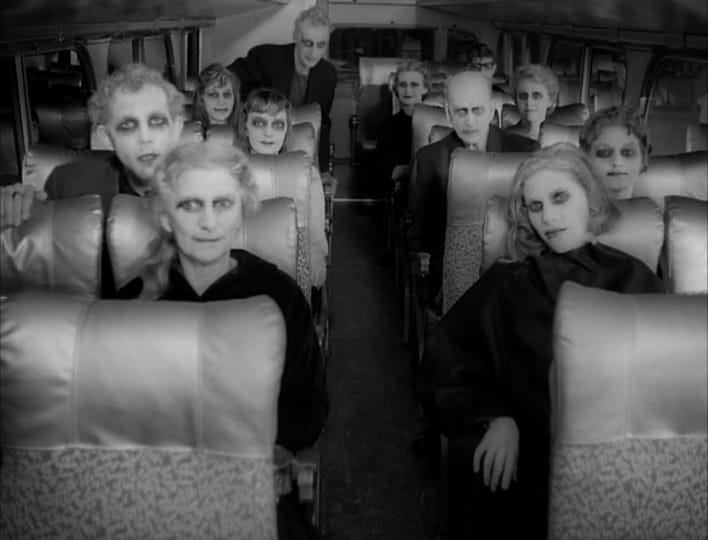
The influence of Bierce’s 1890 short story on Carnival of Souls is everywhere. The film tells the weary tale of Mary Henry (Hilligoss), a Kansas woman who miraculously survives a car crash in the film’s opening sequence. Haunted and probably wracked with survivor’s guilt, Mary moves to Salt Lake City to work as a church organist. The dread that is so pervasive in this low-budget masterpiece begins when Mary finds herself outside of the moody and abandoned Saltair Pavilion. A gas station attendant tells Mary that the edifice was a bathhouse and dance hall before becoming a carnival prior to closing. Seeing the gothic spires of Saltair does something to Mary—she begins having awful nightmares where a silent, pale-faced man (Harvey) stalks her every move. Mary sees these visions even when she is awake. The pale man makes it impossible for Mary to experience peace at work (she is sent home by the priest for playing sacrilegious music while having visions of the pavilion), peace at home (her lecherous neighbor casts her aside as a weirdo chick after trying and failing to get into her pants), and peace on the therapist’s couch (she sees that her therapist is none other than the pale man himself). Ultimately, after one final nightmare, where a horde of pale-faced ghouls chase after Mary and demand that she dance at the carnival with them, it is revealed that the entire plot has been a fabrication of Mary’s mind. Police back in Kansas pull a car out of a muddy river and reveal that Mary died alongside her friends. She never made it to Utah; she never made it to Saltair.
A perennial staple of horror DVD box sets owing to its status as a public domain property, Carnival of Souls is a disturbing, neo-gothic masterwork with a soundtrack that mimics the dizzying sounds of the carnival. Organs, calliopes, and theremins undergird Harvey’s first feature-length film, which, owing to financial constraints, feels at times like an unsettling documentary [16]. Gene Moore’s score, plus the lush black and white cinematography of Maurice Prather, turns what would be a rather pedestrian spook show script into a nightmarish Hall of Mirrors. Indeed, the reveal that Mary is trapped inside a haunted carnival alongside her fellow dead reflects the experience of the film’s viewers. Carnival of Souls conforms to Jones’s theory of the American Gothic as lawless and delighting in the “topsy-turvy” experience of seeing or sensing death within life [17]. This is what horror movie viewers want, especially in the United States, where the allure of the dark spectacle has been strong since the Pilgrims and Puritans first landed along the Massachusetts coastline.
In terms of mutilation, Mary is not visibly scarred, but she has been mentally lacerated by her traumatic experience. Even in her own dreams, Mary is the strange girl who, like Nanon in The Unknown, has an extreme aversion to the touch of another human being. Mary’s case is a little different though, as her suitor (played by Sidney Berger) is a greasy little man with purely puerile designs on the poor woman, and thus is worthy of being scorned. Yet, near the film’s climax, Mary tries to force the unwanted man to stay the night at her apartment because of her fear of the pale ghoul. He refuses owing to the ugly desperation in Mary’s voice and manners. Carnival of Souls, before its final reveal, is thus a story about a traumatized loner—a single woman who lives and works along the economic periphery—who tries and fails to escape her supernatural fate. The titular carnival is a synonym for death, but it is also a synonym for life. Mary’s desire to flee from the car accident forces her into a kind of un-life where she deliberately secludes herself in her apartment and the church, which, like Saltair, seems abandoned. Yes, Mary is dead throughout the film, but in the scenes where she is nominally alive, the traumatized woman cannot be said to be living much at all. Mary is an Other, even to herself.
Conclusion
The carnival is an apt metaphor for the uniqueness of American horror. There is no one defining ethos or aesthetic for American fright films. This large land is home to a bevy of creations that touch upon the gothic, folk horror, supernatural-slashers, and all manner of variations and permutations. However, as with other native-born geniuses like Edgar Allan Poe and H.P. Lovecraft, Tod Browning created a type of horror fiction that is distinctively American. Specifically, the best in Browning’s oeuvre deals with the chiaroscuro of the mind and body, with the anatomy in question belonging to members of the Othered underclass. Browning’s subjects are circus freaks, disfigured crooks, and other denizens of the debased demimonde who are motivated by love, jealousy, and revenge. His best films, such as The Unknown, explore the depths of depravity that lurk within the souls of those already damned by society. Alonzo the Armless is one of the thrice damned: an outlaw, naturally disfigured, and a voluntary cripple. The followers in Browning’s wake, such as Carrington and Harvey, also looked to the carnival and its riff-raff citizenry for inspiration. Mora and Mary are not the physical Other like Alonzo, but they are the mental Other owing to a criminal conspiracy (in the case of Mora) and a kind of supernatural post-traumatic stress (in the case of Mary). All three cases see the permanent presence of calliopes and organs churning out dirges for the damned who must forever exist within the world of the carnival—the land where mirthful ballyhoo is a cover for a deep darkness where the misfits of American civilization live and commit their own brand of atrocities for the amusement of a horror-hungry public.
Works Cited:
[1]: In the context of American history, a “renegade” was either a white colonist or a mixed-race “squaw man” who, while living on the frontier, became members of Native American society. Some renegades in seventeenth century New England participated in murderous raids alongside the Narragansett and Wampanoag, while on the Plains, white renegades, both male and female, frequently fought to stay as members of various tribes rather than return to American civilization. For more information, see “Neither White Nor Red: White Renegades on the American Indian Frontier” by Colin G. Calloway, Western Historical Quarterly, Volume 17, Issue 1, January 1986, Pages 43–66.
[2]: Shelby Lin Erdman, “the Iconic Way Bela Lugosi Was Buried,” Grunge, Oct. 23, 2023, <https://www.grunge.com/605719/the-iconic-way-bela-lugosi-was-buried/>.
[3]: David J. Skal and Elias Savada, Dark Carnival: The Secret World of Tod Browning—Hollywood’s Master of the Macabre ( New York: Anchor Books, 1995): pg. 25.
[4]: A small hole and a clear straw allowed Browning to breathe and thus stay alive during his grueling performances.
[5]: The Unholy Three is based on a novel by Tod Robbins. It would appear that Browning was a fan of the other Tod.
[6]: Skal and Savada, Dark Carnival, pg. 110.
[7]: Skal and Savada, Dark Carnival, pg. 112.
[8]: Skal and Savada, Dark Carnival, pg. 74.
[9]: John T. Soister, Henry Nicolella, Steve Joyce, and Harry H. Long, American Silent Horror, Science Fiction and Fantasy Feature Films, 1913-1929 (Jefferson, NC: McFarland & Company, Inc., 2012), pg. 606.
[10]: The use of the term “devils” here is deliberate, not only because of its obvious reference to “Sympathy for the Devil” by The Rolling Stones, but also because of the medieval tradition of seeing visible deformities and blemishes as outward manifestations of inward vileness.
[11]: Curtis Harrington, Nice Guys Don’t Work in Hollywood: The Adventures of an Aesthete in the Movie Business (Chicago: Drag City Incorporated, 2013), pg. 95.
[12]: Nikolas Schreck, The Satanic Screen: An Illustrated Guide to the Devil in Cinema (Creation Books, 2001), pg. 81.
[13]: Mark Clark and Bryan Senn, Sixties Shockers: A Critical Filmography of Horror Cinema, 1960-1969 (Jefferson, NC: McFarland & Company, Inc., 2011), pg. 310.
[14]: Will Godfrey, Jill Good, and Mark Goddall, Eds., Crash Cinema: Representation in Film (Cambridge: Cambridge Scholars Publishing, 2009), pgs. 17-18.
[15]: Enrico’s An Occurrence at Owl Creek Bridge was shown in full as episode twenty-two of the fifth season of The Twilight Zone in February 1964.
[16]: Brad Weisman, Horror Unmasked: A History of Terror from Nosferatu to Nope (New York: Quarto Publishing, 2023), pg. 97.
[17]: Timothy Jones, The Gothic and the Carnivalesque in American Culture (Cardiff: University of Wales Press, 2015), pg. 5.
-- Justin Geoffrey