So it is to sit and to balance things
To and to and to the point of still,
To say of one mask it is like,
To say of another it is like,
To know that the balance does not quite rest,
That the mask is strange, however like. – Wallace Stevens, “The Man with the Blue Guitar”
Lori Erica Ruff (1968-2010), née Kennedy—a.k.a. Kimberly McLean—a.k.a. Becky Sue Turner—a.k.a. Jane Doe—had bamboozled the Social Security Administration, flummoxed the Department of Homeland Security, stumped the Federal Bureau of Investigation and confounded the military; neither her face, nor her fingerprints, nor any of her personal affects produced a lead on Lori’s true identity; for almost six years after her death, she was, in the words of the SSA investigator who worked on her case, a “body looking for a family” (or an “unidentified decedent” in legalese). Lori had spent twenty-two years, viz., more than half of her life—had applied for student loans, earned a degree, financed a green Honda Civic and started a family with a son of oil money—in a state of incognita. What bête noire drove her as far as identity theft to cut off her past completely? Who or what was she running from?
The revelation that Lori was, in fact, not Lori followed her suicide. She shot herself outside the East Texas home of her estranged in-laws, Jon and Nancy Ruff, on the morning of Christmas Eve 2010. (Her husband Blake and their two-year-old daughter were staying over grandma and grandpa’s at this stage of the divorce.) Apparently, nobody heard the gun go off; when Jon Ruff, in quest of his morning paper, raised the garage door and saw a black Tahoe idling in the driveway he called the police.
Jon perhaps recognized the car. Blake was always emulating his twin brother David; after David bought a black Chevy Tahoe, Blake did the same. But Blake was sleeping inside, so it had to be that Lori critter coming around to cause more trouble. Since Blake filed for divorce—thank God he didn’t need David to divorce her first—that Lori critter had been harassing the Ruffs with threatening messages by email and text, which usually blamed Jon for turning Blake against her. Jon was on an “ego and power trip,” she claimed. Takes one to know one, little lady! Why, that Lori critter raised so much Cain at the last custody exchange, it forced the Ruffs to request a cease-and-desist order on’er. Subsequently, they couldn’t find one of their housekeys. Now, nobody’s accusing no one, but they changed their locks all the same. And maybe in the nick of time, too. Nancy said she heard the backyard gate squeeeak in the dead o’night only the other week. (Good thing the gate’s got hinges ’cause that Lori critter’s lost hers.) So, being under this affinal cloud, Jon Braswell Ruff did not strut down the driveway in his paper-fetchin’ slippers to inquire politely, if firmly—as yuletide hospitality might demand—how he could help a stranger whom providence showed to his door. Nosir, the old man spun on his heels and called the cops, immediately!
Police identified the driver, now the body, as Lori. Blake was in pieces. Inside the car there were also practice targets, month-old receipts for ammunition and two letters, one addressed to “my wonderful husband” consisting of eleven pages; the other, to their daughter, not to be opened, said the envelope with a certain coming-of-age storybook flourish, till her eighteenth birthday. Neither document, however, after perusal by authorities, shed any light on Lori’s behavior nor admitted glimpses into her guarded past. (Lori had often snapped back at the weakest curiosity with “it’s none of your business!”) The police didn’t bother releasing the letters to the public; the incident report simply concluded, “These were the ramblings of a clearly disturbed person.”
It must have been a miserable holiday.
That January, Blake’s brother-in-law Miles Darby gathered together a few of the Ruff men for a field trip to the couple’s old place in Leonard, Texas, where she had stayed on with Baby after Blake moved back in with his folks. Purpose of visit: “scrub that house down to see if we can find out who she was,” said Darby. Blake, meanwhile, stayed behind at the family nest.
From the beginning the Ruffs couldn’t get Lori to open up about her past. When Blake began “courting” her—which he insisted was the proper Christian nomenclature for “wooing”—Jon and Nancy invited themselves to lunch with the young couple for introductions. Lori was a vegetarian, a rarity outside of Austin, and chose a Chinese restaurant. At first glance, Nancy found her attractive but frumpily attired; one imagines Lori enjoying a bowl of smoked tofu and garlic chives, maybe dressed like she is in a 2010 calendar which she DIY’d from pictures of herself and her daughter, in a pink paper-braid sunhat and a matching top with an uneventful neckline, accessorized by a bared row of teeth that will do for a smile. (She was a mystery shopper with no visible sense of style.) Nancy tried to interview Lori about her personal life but received clipped, terse answers. She did volunteer that she was from Scottsdale, Arizona (which factoid remains on her obituary webpage) but refused to elaborate much further. Her parents were dead. Car wreck. Only child. No living relatives. And so on. That afternoon of smalltalk gridlock set the precedent for the next six years between Lori and her in-laws, although not even her friends—investigators found two in all of Texas—knew her any better. It was like Lori had just appeared out of thin air one day; some called the trick “a backward poof.”
Miles Darby was also baffled by Lori. He later recalled how, when quizzed on her Christmas list at her first Thanksgiving with the Ruffs, Lori unsettled the whole table with her request for an Easy Bake Oven. “The kind where you bake cookies with a light bulb,” Darby clarified for a reporter; “Who in the hell are we sitting next to? This is cuckoo for Cocoa Puffs!”
Leonard is a town with a population of 2,000 and, according to its Chamber of Commerce, ten churches. The former Mr. and Mrs. Blake Ruff bought a home there after they married in 2004. (Blake, Lori—who wore a white suit—and the preacher were the whole wedding party. No guests. Later, when dejected traditionalist Nancy urged the newlyweds to at least stick an announcement in the paper—which would require the names of the bride’s parents too—Lori chided her, “We don’t do things like that.”) Their house was probably one or another of many ranches with hip-and-valley roofs and stone veneers which, in addition to the barns, garages and dirty machines of farmers, scarcely blemish the cleared landscapes along Leonard’s one-lane roads. It sat on a two acre lot whose perimeter Lori sometimes paced at twilight, shunning eye contact with and banter from chatty neighbors.
Before the Ruff men barged into the place, Darby actually phoned the police to ascertain if Lori’s lair was “booby-trapped.” This, apparently, was a privacy protection that she had neglected, and Deputy Terence Burnside, joined by another officer, led the party indoors safely.
Burnside had been the couple’s neighbor; he thought Blake was a friendly “IT nerd” and Lori, an ordinary “little hausfrau,” and therefore, couldn’t understand Darby’s wariness until the impromptu renovators got a load of the filth: stacks of dirty dishes, heaps of unwashed clothes, and trashbags on trashbags abulge with shredded paperwork. The baby’s crib was soiled. And from room to room, Lori had left behind scribblings in surplus on newspapers, cereal boxes and other scraps, often blacking out her words to illegibility by scrawling more words over them and repeat. Finding any material in this mess relevant to her past was surely impossible.
However, Darby had gotten a tip from Blake; in the guest bedroom, she kept a private closet in which she demanded he never go. And Blake never did. Darby and the others, though, ransacked the Bluebeardesque nook. At the bottom of the forbidden closet, they found a very heavy banker’s box which was unconvincingly labeled “crafts.” The boys schlepped their plunder into the foyer and sat around it on the floor. It did contain some crafting supplies, but underneath the pom-poms and pipecleaners, or the gluesticks and googly eyes, there was another box; a fireproof strongbox.
The discovery so excited Darby that suddenly he got over his fear of potential IEDs. “I took a flathead screwdriver and broke that thing open,” he later recounted.
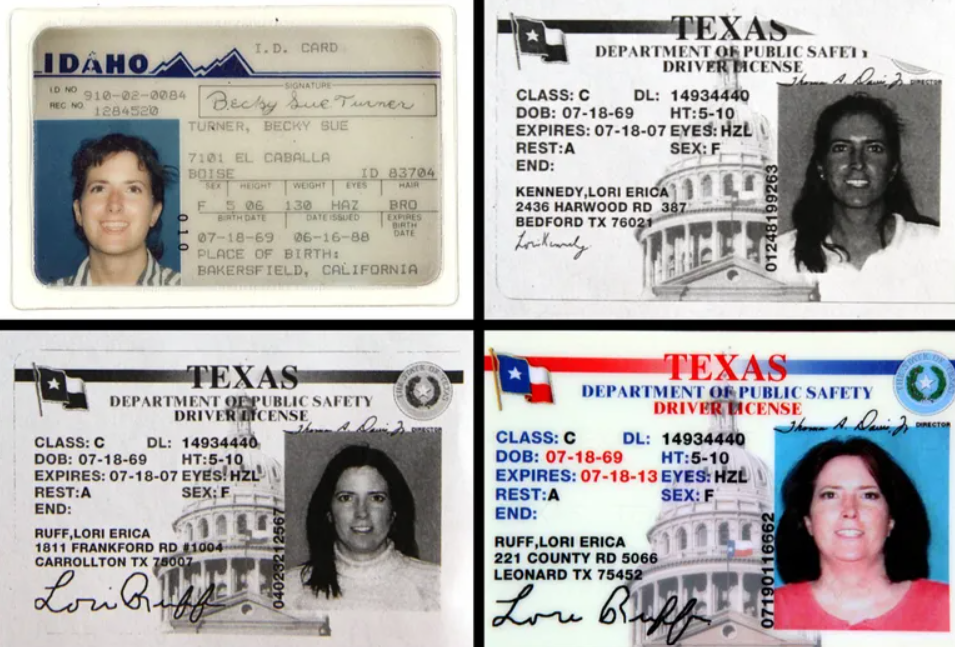
Lori’s strongbox contained, among other items, a Change of Name Decree from a Dallas courthouse that began, “Be it remembered that on July 5, 1988 came on to be heard the application of Becky Turner, to change her name to Lori Erica Kennedy…” To follow up this startling leaf of paper, there was a birth certificate for “Becky Sue Turner,” and more conclusively, an Idaho ID card that featured Lori’s much younger face matched with that same name.
“Bingo,” said Darby. “She’s Becky Sue Turner.”
Shortly thereafter, Burnside applied his PI chops to researching Becky Sue Turner at Darby’s request and what he rooted out turned the revelation upside-down. As it happened, Becky Sue was prominently mentioned in a sensational bit of news from The Seattle Daily Times of 1971, “Fife House Fire Kills 3 Sisters.” Becky Sue, the youngest of the girls, had only been two years old when she died. Becky Sue Turner’s identity, meanwhile, had simply been stolen by Lori, whoever she was, as a means to start over fresh.
The strongbox was a trap all along—it was a bottomless pit in disguise.
-- Fletcher Peppers