It was recorded in a Sutra collected by the venerable sage Nagodaya the story of a certain bodhisattva who lived during the time of Kassapa Buddha. In Pali he was called Thavitvā, which means “having praised.” In the company of his Master, he praised a worm which had emerged from the soil to hear Buddha Kassapa deliver a sermon on a rainy Spring afternoon in Uttar Pradesh. Hearing this, the Enlightened One bestowed upon Thavitvā his name, and laughed. When Thavitvā heard the very mouth of Dharma laugh—such was the laugh of a god—the mendicant was enlightened. In a fit of inspiration, he leapt and murdered the Buddha where he stood, then quickly succumbed to an epileptic shock. The disciples who witnessed the unanswerable act promptly delivered recompense on the assassin as he lay; thus they forsook their holy vows. And as for the Radiant Jewel, he tarried no longer in the cycle of death and rebirth, murdered but attaining parinirvana. The people wondered: why did he laugh? A rumor was spread that he had reflected on the transmission of his dharma through a vessel as low and base as a worm.
Thavitvā was reborn as Kuruveśtra, a mercenary soldier under the employ of the King of Sri Lanka. During a siege of a coastal city in the southwest of the subcontinent, he murdered a young mother and exposed her infant in the wilderness. He received his salary and lived many years in the countryside unmolested. Kuruveśtra was reborn as Bhimu, a reputable goat breeder and cheesemaker from the Northern tribes who grew to disdain his wife. He complained that she spent his income without relent and engaged in vulgar gossip with ranchers, farmhands, and other discreditable peasants. One day, he poisoned a glass of goat’s milk and fed it to his wife, and she doubled over after intoning a rebuke: “it is too sour.” Bhimu was reborn as Ananiśna, a courier who embezzled goods from his creditors for more than a decade before he was discovered and slain by cunning bandits.
Ananiśna was reborn as Suppiyā, the daughter of an evil brahmin who burned a temple filled with devotées of Lord Indra. The baroness lived in her husband’s house, which stood erect on a hill overlooking the family’s modest fiefdom. When a Grand Acharya visited the baron’s castle as a supplicant for a small land grant, he discovered the notorious brahmin hidden in the maiden’s chamber. Wishing to save her father, Suppiyā attempted to kill Acharya with a dagger, but was untrained with weapons and was quickly disarmed. Her husband, when he discovered the scene, cried out and begged the Vedic teacher to spare her life, but the tumult of finding a criminal in his wife’s chamber was so great a shock that his heart stopped. Suppiyā and her father were also killed.
Suppiyā was reborn as a dog, the most intelligent of the beasts, and though a mangy cur, he retained more wit even than some men. He was treated well by his owners, but stole away and mauled the newborn son of his master. Needless to say, his beating exceeded the point of death. He was reborn as an ox who fed freely on sheaves of rice and waded calmly through brooks of slow falling water. He gored a peasant who sought to pet his hide, and he was stoned by the people of the village. He was reborn as a camel entrusted with carrying a party of pilgrims across the long desert in Rajasthan that they might seek the Buddha’s shrine. Spitefully, he drank the pilgrims’ canteens and dumped whatever else water rations they had kept, for he was, in his camelid opinion, overworked. The pilgrims died of thirst and he followed not long after. He was reborn as a black bee who toiled hard and ate his fill of nectar and honey—nay, he ate more than his share, for he was a fat bee indeed. But he labored for his queen, the much-beloved of the hive, until one day he struck the opportunity to suffocate and sting Her Highness before her liegemen, and the royal guards executed him in turn. The reader will forgive the grand respect owed to Her Majesty of the Insects, for the proximity of this latest sin to the great act which inaugurated Thavitvā’s descent compels one to address her even as a Buddha ought to be addressed. The reader will also forgive the omission of countless more fleeting lives—we need not mention that when he was a jackal, he robbed the graves of saints for dusty bones, or that when he was a rat, he gnawed the ropes of a merchant ship which sank in the Arabian Sea—as Nagodaya saw fit to redact these episodes in his Sutra.
Then, we will pick up when he who was once called Thavitvā was born as a hungry ghost, called a preta. The pretas in the Garuda Purana cried as if one body, so similar were they in their suffering. Brotherhood was the one decency allotted to these pitiful creatures, and they sounded loud laments in chorus. “Vomit, waste, cough, urine, and tears—these we eat and drink!” Thavitvā, though he shirked the company of his fellows, felt deeply these mortifications. One day, a ghost thinner even than his brothers went to the river to beg in front of the more fortunate ghosts (yes, even the most wretched divide themselves into castes according to their stations), but while he was distracted by a deer passing through the woods, Thavitvā stole and ate the few provisions of waste he had in his begging bowl. The thin one did not witness the theft, and in his ignorance, imagined that the deer’s own brethren had stolen the meal of feces to gorge themselves at his expense. He cursed the whole race of deer! During this time, the worm who awoke for the Buddha’s final sermon many lifetimes ago—yes, that same worm, the praising of whom gave our protagonist his name—lived among the deer. He had ascended to deerhood due to his karmic merit. A portion of this merit was gained from the righteous actions he had performed in his subsequent lives, but the greater part was due to the praise lavished on him during that afternoon in Uttar Pradesh. Thus the righteous former worm, whose name even the greatest sages failed to record, suffered a karmic demerit along with all the innocent race of deer.
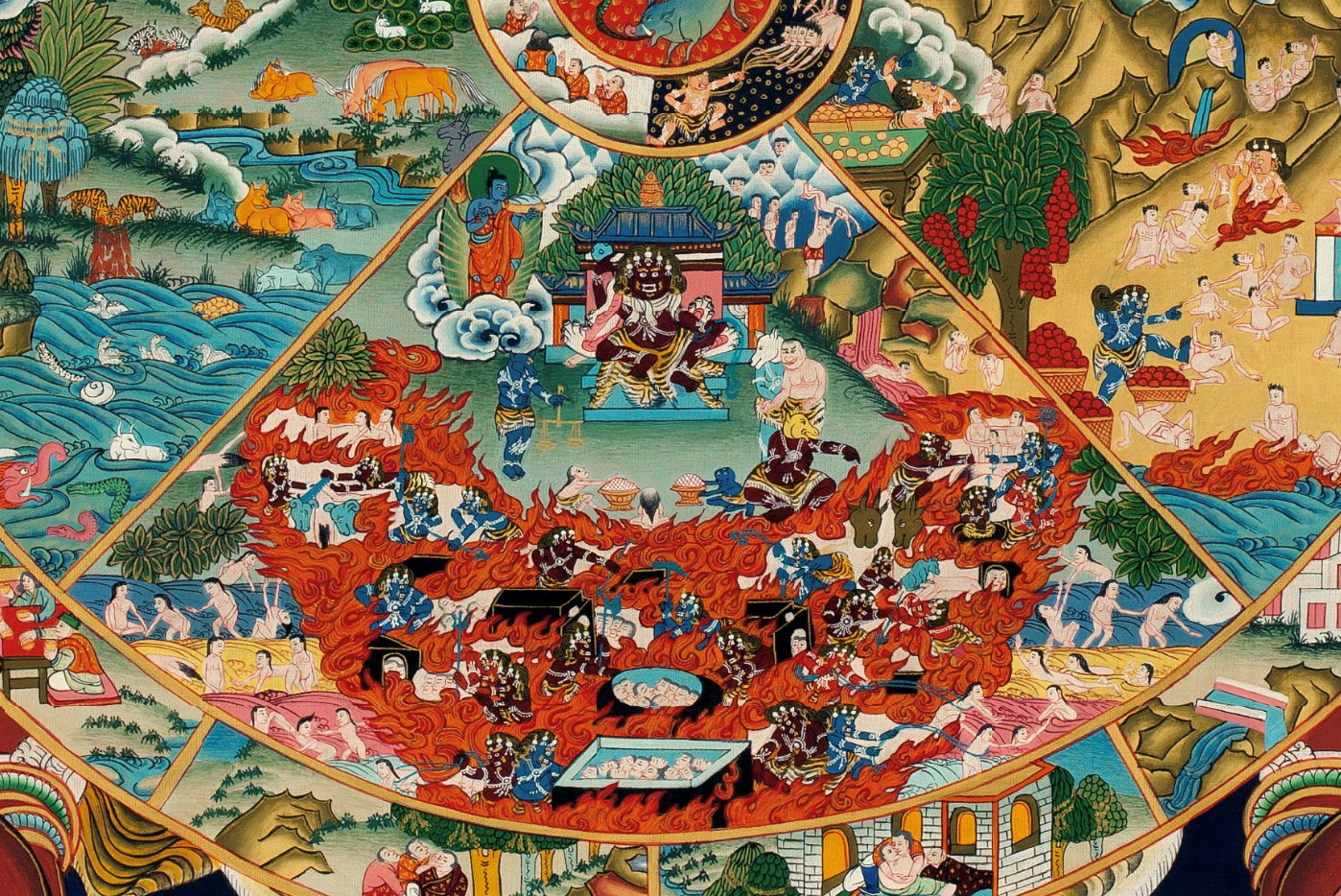
After this unfortunate incident, Thavitvā lived for many long years as a preta, and during this period, he regained memory of his past lives. He recalled the great sin he had committed when he was a vow-keeper in Uttar Pradesh. But eventually his years ran to completion, and he passed into an even lower realm, which was the first circle of Hell. Here he suffered for some years, and passed on to the next lowest ring, then the next in procession still. Finally, when he reached the eighth and final circle (Abandon all hope, ye who enter here, of not double-counting a level of Hell), he weathered his torments with a stout heart and endeavored to meditate on his concentric descent through samsara. He recalled his existence as a preta but esteemed the luxuries of this past life even as a low-born Dalit esteemed the luxuries of a Kśatriya King. Thavitvā considered that his existence, called his bhava, was not a stable nor independent thing, and he realized that he was not-being. His descent over those many past lives was unwavering, his elliptical movement was steadfast, and his conscious mind was always in motion. Here, however, there was no lower rung to descend, and his body no longer experienced decay or destruction. He had completely forgotten about aging and death.
After some time in this state, a new visitor arrived in the eighth circle of Hell. He was no other than the future Buddha who would be called Śakyamuni! The visitor clawed through his lofted chamber of brimstone and fell a distance into a rocky field. This was the very field in which Thavitvā had spent many recent lifetimes in meditation. “What place is this?” cried the Thus Come One who would be called Gautama. Thavitvā laughed, and the future Buddha understood that his question was absurd. This was no-place. To commemorate the achievement, he uttered a verse:
‘A worm ascends in Spring
to hear a Buddha’s lecture.
Hearing him laugh so great a thing,
it caused the student’s indenture.
A pilgrim digs a grave,
and finds a monk praying.
What a confusion has he made
with all his ignorant braying.’
This song was a great boon to Thavitvā, and he immediately quit his existence there and began ascending again the circles of Hell and all the bestial lives which precede the folly of men.
Many years later, a copyist appended an additional verse:
‘A visitor comes upon a monk,
“What place?” asks the visitor, and the monk laughs, “What place?”
No place, yet both are free.’
…and concluded: I, Nagodaya, testify to the truth of this tale, as I am in fact the righteous worm who was praised by Thavitvā so long ago. What’s more, this story of his descent was the veritable content of Kassapa’s sermon.
-- Ricardo Quiñones is a critic and poet from New Jersey but now living in Maine, USA. His weekly book reviews can be found on Instagram @bookinglit.