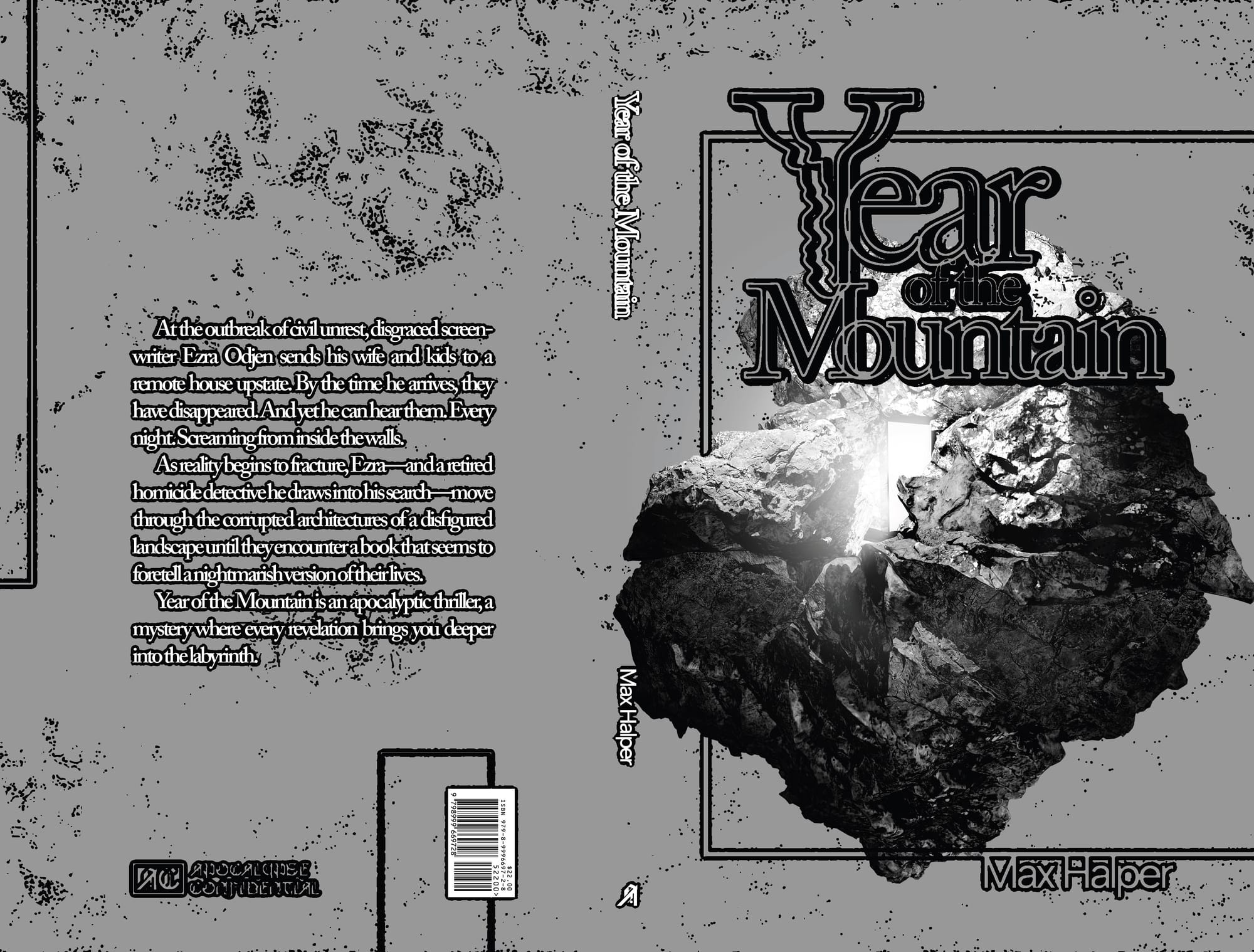
Excerpted from YEAR OF THE MOUNTAIN by Max Halper, via APOCALYPSE CONFIDENTIAL PRESS. Available now.
In time the windows harden with frost and the house darkens, tucking itself into the burrow of its own hide, a naked hibernation, the rooms beating slowly, preserving the essence of the house but not its function, conserving themselves for some collapse of melting snow that will come at some unimaginable moment, the reintroduction of footsteps, human voices, petty griefs, but not this moment, this adjourned moment, the radiator drumming from beneath the pink floors like fingertips along the knee of an anxious and brilliant thought, the occasional groan of the boiler, little shrieks from the old wood contracting on the stairs and in the doorways, other inscrutable, oracular sounds, maybe not sounds at all but movements, where the pink walls meet the pink ceilings, or where the pink curtains graze the windowsills like secret affections, the corners receding into blankets and shadows, eleven spiders—one spider in each room—toiling at their hoary webs with the same temerity one might change the sheets on a bed, starving and yet never dead, for animals cannot die, death a star in the sky, or a small tree on another continent, which is the same for the mice, though there is food for the mice if they can reach it, food in the pantry and in the refrigerator and food hiding in the counter’s seams, a feast for the mice, who, emboldened by the stillness, scutter from their hidden city, steal from doorways everywhere, like a child’s fable, to get to work on the paper and plastic impediments between them and their meal, easy work if it is not disrupted, disruption itself a distant memory, an early dream, the fevered musings of someone you’ve never met, dust settling in the dimples of the dressers and rolling off the knuckles of the tub, soft dust, precious, flowing dust, folding into the creases of the carpet and rushing like smoke along the banister, like time itself, all fainting together toward the drain of the world, or the daylight bending its way up from beneath the door and collapsing from cold on the flinty floor, little strands of light that strayed from their bulk, little lost souls, while the rest—all the good light—storms by outside, bleaching the air, exposing the secret warrens between the frozen stalks of the mint and nettle, the lips of icy stone, the eyes in the trunks of the pines, the joints of dirt and sand, the flexing snow, the flank of wind-fallen lindens, the great ache of boulders and the hazards borne from their incongruities, indignant traps, deep falls of the Christs of the soul, hard mouths, the wounded sky an apparent great vault, the stunned lake, a brace of dark birds, a lock of wind, distance, the atoms turning in their vast, silent world, doing the impossible work of manifesting it all and holding it all together, a trillion trillion thrumming gods, bigger than you think, bigger than you can possibly imagine, here, look, as I unfold myself into the sky, shedding snow at my great windy height like a spray of hair, a noble child, none of it real, no path up my sides but tenebrous slopes like solemn hands bidding you wait, reconsider, there is nothing here for you, go home if you have a home and rest, or rest there, among the flank of trees or the soul of boulders, or among yourself, young thing, no different than the rest, your body baked free from the earth and taken like a nub of gold cleaned in the mouth, spat out, retrieved, discarded, not gold at all but quartz, or a gray berry, or some nameless dross, you, no better than me and no worse, no larger and no smaller, no younger, condemned to count in the field of numbers near the middle, condemned to the sightless middle, all of us children of the hot, crushing middle, the roomless gut of the mountain, the airless chamber of low seats and secret debate, here inside, giant painted faces, the only animals horror and sweet, pained love, a rumble from the deep earth like three screams at some nautical distance, as if from the moment of an astounding nightmare, or simply the sleeping turn of a rock against another, where the pressure squeezes truth to paper and the dark into full white, all completely natural.
Go on.
-- Max Halper is the author of the novels Lamella and The Meadow and the Misread. His work explores systems of intimacy and violence. You can find more at max-halper.com.