I first learned of the ekranoplan in the winter of 2023, when I was invited to spend a few days in Malibu with Alex Gardner (the folk singer, not the figure painter) and several of his friends and bandmates. The purpose of our retreat was to write—to immerse ourselves in the sacred discipline of songwriting and produce the beginnings of our next great works, with our rented labyrinth of sofas for comfort and the fog on the coastal range for inspiration. For three nights all we really did was drink whiskey. We drank on the sofas, in the hot tub, wandering the sagebrush trails, sitting fully clothed in the showers. On the fourth night we also drank tequila.
The final morning, scraping unseasoned scrambled eggs onto paper plates, we mourned our squandered holiday with a kind of ironic satisfaction, bemoaning the hedonism that afflicted us as it must have all the great tortured artists of old, and resigning ourselves to putter down the mountain with nothing but gastritis and the echoes of Silver Jews singalongs to show for our efforts. But Alex would have none of this. He called us to attention with a G7 on his Gibson and revealed that he had, throughout the weekend, been secretly accumulating all the necessary components of a fresh creative outburst, the chords and melody and strumming patterns constructed from what had at the time appeared as aimless revelry, via some internal process of poetic genesis whose nature was mysterious even to him. As he played he would scat little half-words to himself, meandering around an opening lyric that never quite emerged. He almost threatened to lose us, but then, as if touched by an unseen muse, he dropped to an F power chord and unleashed a full-formed chorus:
You can’t be that sure
That I am the captain of a sinking ship—
He stopped there. “That’s all I got,” with a wry smile. He pushed up his glasses and latched his guitar in its case. “I’m thinking the first verse will be about the Titanic, and the second about the South China Sea Monster. Maybe the Queen Mary for verse three? Although that one hasn’t sunk.”
Everyone offered claps and whoops of encouragement. Alex’s bassist suggested some tweaks to the approach (“what if it was all downstrokes, more emo?”), and someone else drew comparisons to “The Wreck of the Edmund Fitzgerald” which Alex may have found boorish. I seemed to be the only one with the obvious question on my mind. I waited until after we checked out, for a calculated moment in the driveway when Alex and I were alone, to ask.
“What’s the South China Sea Monster?”
He looked at me for a moment before replying. Alex is tall, thin, somewhat Brazilian, with kind eyes and a careful, professorial way of speaking. “I’m surprised you of all people haven’t heard of it,” he said. “It was one of those gigantic Russian planes—well, they’re not really planes. You know what I mean?”
“I tried googling it and nothing really came up.”
“Huh. Well, my guitar teacher has a whole thing on it. I can show you if you’re curious.”
I told him I was. And a week later, he produced the document.
As it turned out, Alex’s mentor (a certain Russian-American bluesman of some renown) had, prior to his musical career, worked as a designer of gyroscopic devices for the U.S. Air Force. He had amassed a huge library of research papers, engineer’s reports, and technical memoranda, which now lay strewn about his home studio. The ever-inquisitive Alex, perhaps awaiting a lesson on the fingerstyle approaches of Blind Blake or Reverend Gary Davis, must have gone leafing through the binder, drawn by the creative title of SOUTH CHINA SEA MONSTER in classic white-on-black labelmaker text, and found it so interesting he assumed it was something known to the general public. In reality he may have been the only human being under the age of 50 who had any idea about it. I was to become the second.
The two of us sat in a dive bar on Temple Street where someone played Scott Joplin on the piano, drinking pilsners and Underberg bitters, joined at times by various friends whom we largely ignored as we increasingly became enraptured by the document.
The report is a typewritten transcript of an internal Vietnam People’s Navy memorandum, translated (poorly) to English by the typist and heavily redacted. The date of transcription is given as July 14, 1999. On the title page, under a blacked-out list of sources and recipients, lies the subject line:
REGARDING THE PLEASURABLE, LOW-PROFILE DISASTER ABOARD THE ZM-9039 FAETON
What follows is a synopsis of the report, along with some supplementary research, as read and discussed by Alex and myself. The document fell out of our possession soon after our meeting, so none of what appears below should be construed as direct quotation. I have preserved parts of the original text where I’d happened to take notes, or where certain features of the botched translation resulted in phraseology I find unforgettable.
- Background -
After the Fall of Saigon and the reunification of Vietnam, General Secretary Lê Duẩn signed a treaty granting the Soviet Union access to the naval facilities in Vịnh Cam Ranh for 25 years. Situated in a deep, sheltered bay, well-protected from typhoons and free of the winter ice that harried Russia’s other Pacific ports, Cam Ranh proved extremely useful to the Soviet Navy and quickly quadrupled in size. It was used to retrofit and resupply warships and submarines, stockpile weapons, provide logistical support to covert naval operations, and even carry out mock bombings of U.S. bases in the Philippines. Despite this rather conspicuous state of affairs, Soviet and Vietnamese officials consistently denied that the Russian navy was present in Vịnh Cam Ranh, or anywhere in Southeast Asia. (Amusingly, the report’s authors affirm the party line that Cam Ranh Base did not exist, even while relaying a detailed account of something that happened there.)
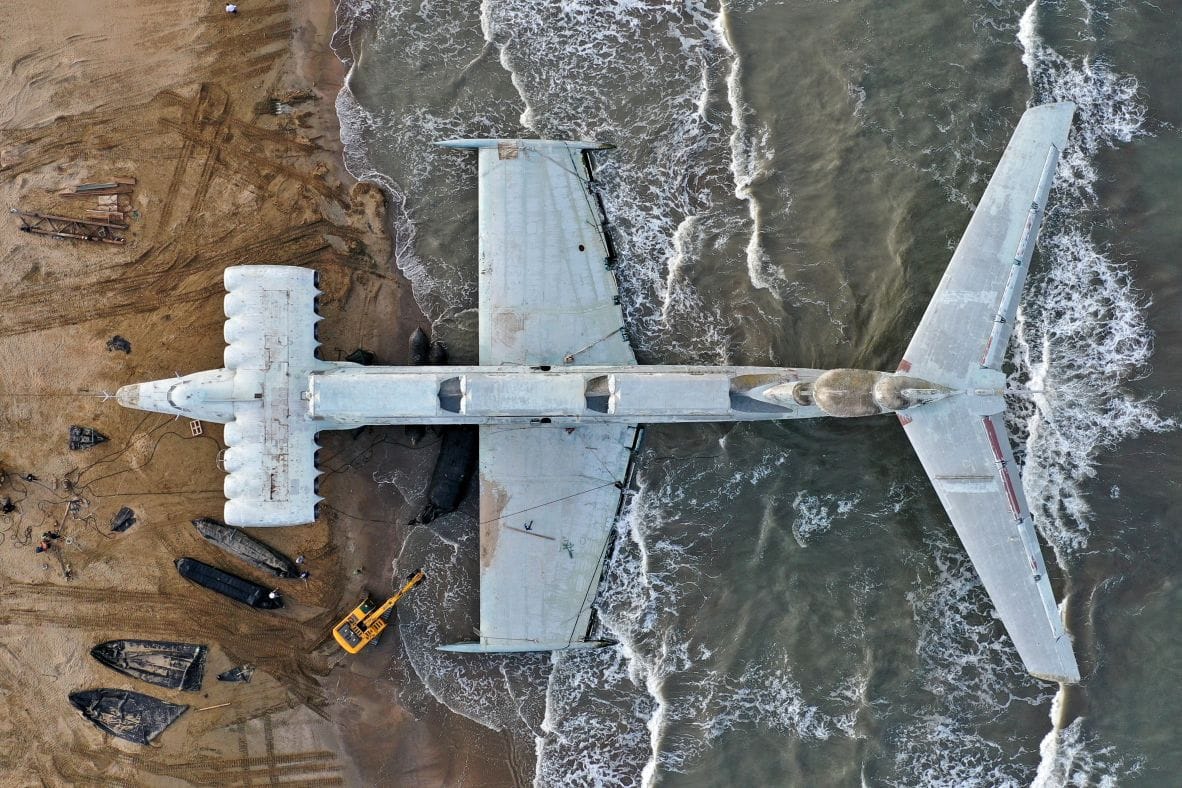
In addition to military and logistical functions, Cam Ranh served as a shipyard for certain projects of the Central Hydrofoil Design Bureau (CHDB). This was the agency behind the ekranoplans, experimental seagoing vehicles developed by the Russian Navy at great expense, with only a handful of models brought to operational life. The ekranoplans flew a few meters over the surface of the ocean, undetectable by radar and sonar alike, with payload capacities comparable to small warships and cruising speeds approaching those of commercial airliners. They achieved this by leveraging the ground effect, a marked reduction in drag that occurs when an aircraft’s wings are brought close to a parallel surface (pelicans use this effect to great advantage when gliding over the surface of the ocean in search of fish). Some ekranoplans were designed as transports, others as cargo freighters, and at least one model was outfitted with P-270 supersonic cruise missiles and deployed as a warship. But the engineering challenge was immense, and the budgetary commitments were met with increasing skepticism. Researchers desperate for funding descended into infighting over increasingly esoteric questions at the frontiers of aerodynamics: how to predict reductions in downwash, the degree to which pressure fields produced by the wings were imposed on the fuselage, whether a 2-D model even existed that could explain such a complex 3-D phenomenon. . . The ground effect, it seemed, was being utilized before it was really understood, and like all forms of magic, its use came at a cost. As the Cold War plodded on towards the 1990s, the Ekranoplan Era languished in perpetual predawn. By the breaching of the Berlin Wall most of the CHDB’s projects had been canceled altogether.
But in Cam Ranh, unbeknownst to the world, one survived.
- Technical Specifications -
The ZM-9039 Faeton-class ekranoplan was designed by a team of CHDB engineers as a transport and mobile field hospital capable of rapid deployment and extraction throughout the Pacific theater. Building on earlier designs that had been deployed in Dagestan, the Faeton dwarfed its Caspian cousins by a factor of 2-to-1, powered by twelve Kuznetsov NK-87 turbofans with 30,000 pounds of thrust each. It was painted in a mottle of royal blue and Easter green. Its name was inspired by its loud, ambulance-style klaxons, which recalled the shrill cries of the tropicbird (Phaethontidae spp.). The prototype was completed in 1991 and cleared for testing the following summer through an extremely convoluted chain of command that bridged the institutional transition between the Soviet and Russian Navies and included senior officials of the Commonwealth of Independent States, the Vietnam Inland Waterways Administration, and other agencies with no clear affiliation.
Quickly: the craft’s aspect ratio is given at 4-to-3, with a 290-foot wingspan and a hull length of 386 feet. Its maximum weight at takeoff was 1.2 million pounds. Its spacious cabins could accommodate up to 400 passenger seats and 35 hospital beds. It carried a flight crew of five, including the pilot and co-pilot, along with two enlisted Navy seamen, two commissioned officers, six doctors, two nurses, and (this will be important later) a psychologist.
- Test Voyages #1 and #2 -
After a delay due to Typhoon Bobby, the Faeton launched on July 2?, 1992 (the specific launch date, while not redacted, had been overtyped multiple times and was nearly illegible). It took as its pilot an experienced ekranoplan captain from Nizhny Novgorod, and a local People’s Navy man as first officer (both names redacted). The craft executed a flawless takeoff, engaging the ground effect at 11 meters above sea level and accelerating to a cruising speed of 490 kilometers per hour. Though the plan was for a quick out-and-back going no further than Nha Trang, the officers elected to put the Faeton through its paces, taking her several hundred miles down the coast before turning southeast, rounding the islands of Côn Đảo, and returning to Cam Ranh over open ocean.
A second test cruise launched on August 2nd, this time with the full complement of medical personnel aboard. They followed the same route south, looping counterclockwise around the archipelago. On this trip the weather was fair, with wave heights ranging from 6-8 feet (well under the threshold where flying via ground effect becomes problematic). No other ships were encountered, with the exception of some small fishing boats near the islands. (Alex wondered aloud what the fishermen must have thought, dropping their squid nets and looking up from their wooden canoes to see a huge metal behemoth gliding over the surface of the water, its passage unnaturally smooth, its dozen engines roaring like the furnaces of some deep and angry place. . .) Again, the Faeton returned to Cam Ranh in one piece—but this time, an incident was noted.
Here the report refers to an Attachment, which we found appended at the end of the ream. It was a carbon copy of an original Russian report, and was left untranslated. It bore a title page of its own, the Cyrillic doubletyped for boldness. Alex reads Greek, German, and Portuguese, and if the two of us worked together we could hack our way through Spanish, but against the indomitable script of Tsar Simeon we were helpless. The only way to read the Attachment was to auto-translate it on my phone, which rendered the sub-title as:
- Not Able to Explain Incident -
The Attachment is an account of the Faeton’s second voyage as described by one of the nurses aboard. The nurse’s name is given as “Elitsa.” Elitsa states for the record that she has been asked to document “the first time something happened.” She reports that at 10:17 in the morning she was looking out one of the large windows in the aft medical cabin, “watching the sea run under the starboard wing,” when suddenly she was overcome with a strange sensation: first she felt very cold, then as if her whole body had gone numb, and finally there was a feeling translatable only as “northwest of normal.” Fearing some type of cardiac event, she consulted the lead doctor, who informed her that he had felt something similar. Soon, all eighteen crew members were gathered in the passenger cabin, where they all reported the exact same experience.
The highest-ranking Navy officer, identified as “S.L. Valery,” took charge and went to speak with the pilot. He remained in the cockpit “for some time, if there was any.”
While awaiting Valery’s return, and with no particular emergency on hand other than the fact that everyone felt a bit odd, the crew began milling about the cabin, talking amongst themselves. “The window!” someone shouted. Elitsa again gazed out over the wing and the ocean below, and gasped. The scene appeared perfectly still. The waves did not break, no clouds drifted by. Soon everyone in the cabin had seen it too, and they began to exclaim things like, “We stopped! We’re not flying! We’ve completely quit moving, and so has the sea!”
The lead doctor checked his watch. It read 10:17 AM, and its second hand was no longer ticking. Others reported similar findings. They began investigating the phenomenon using equipment in the cabin. Digital clocks similarly refused to progress forward in time. The radios blasted static. The roar of the engines had quieted to a crackling hum. More alarmingly, the electrocardiogram returned a flatline when hooked up to a perfectly healthy seaman—but this turned out to be due to a faulty wire, and the mood lifted somewhat as everyone verified that their pulses, at least, were still functional.
In fact, although this turn of events should have been disturbing, Elitsa reports that the crew remained in positive spirits. The general feeling that overtook them was one of curiosity and good humor. Though the situation was extremely unusual, they felt a sense of familiarity in its midst, as if the ekranoplan was some secret society they had all suddenly been initiated into. At some point Valery returned—along with the pilot and co-pilot. Over their shoulders, Elitsa glimpsed the open cockpit: the altimeter, compass, fuel gauge, gyro horizon, and all the other indicators on the flight console were still. The clock read 10:17. No one was at the controls, yet the craft hung forty feet above the surface of the sea.
Elitsa then claims that “a new mood ascended” in the cabin, and the crew started pointing at each other and laughing, gesturing out the windows at the unmoving world and hooting “like drunken owls.” There was an atmosphere of jubilance with an increasing clarity of purpose behind it, everyone endowed with a ridiculous wisdom, the proper course of action becoming more obvious with each unpassing second. Someone brought out drinks and they all toasted to their predicament. Someone hooked up a cassette deck and adventurous German dance music came pumping out the cabin loudspeakers. She even found herself kissing someone—it was the first officer!—right there in front of everyone! And Valery was up on a gurney, dancing with his shirt off, the old hooligan! To say nothing of what the doctors were getting into down in the cargo hold, or how the psychologist was carrying on with the leading seaman. . .
Later, after an indeterminate period, things settled down. The crew tidied their mess and drifted toward their usual stations. The pilot and first officer returned casually to the cockpit. The next thing Elitsa knew, they were moving again. The clocks found their way to 10:18. The rest of the voyage was uneventful and they arrived back in Cam Ranh earlier than expected.
This was the end of the Attachment.
- Test Voyages #3 through #8 -
Returning to the main report, we found the next several pages contained abbreviated summaries of additional voyages undertaken by the Faeton, including the dates, planned and actual trip coordinates, takeoff and berthing times, weather conditions, performance metrics, and a list of crew with all names redacted (though the number of personnel appeared to remain constant). Each entry included a NOTES section, mostly logging radar echoes of Chinese or American ships, or the locations of unmapped islets. However, every entry included at the end of its NOTES a phrase in Russian, curiously left in Cyrillic script, the text instantly recognizable from the front page of the Attachment. On every voyage: Not Able to Explain Incident.
The trip logs ended after voyage #8. Alex and I turned the page, frenzied now. We had stopped speaking, were barely still drinking. Ragtime piano, crowd chatter and clinking glass surrounded us like an ocean, and in the submersible of our booth we plunged into. . .
- The Psychologist’s Theory -
The following section contains a transcript of a recorded conversation between the Faeton’s shipboard psychologist (name given as “Doctor M____”) and a woman named E____, whom I assume to be the same Nurse Elitsa from the Attachment.
The section includes some brief front matter stating that the recording “was made in response to the pattern of incidents noted in the logbooks.”
ELITSA: Thank you, the coffee is fine.
DOCTOR: And we haven’t experienced anything odd while on dry land.
ELITSA: Valery told me that he has. But who’s to say if what’s odd to him is odd to the rest of us. You know, it’s really changed him. He hardly acts like a military man anymore.
DOCTOR: Several of us have reported these sorts of changes.
ELITSA: (Sipping coffee loudly) I think it’s for the better. I used to be so worried all the time. Now I notice the humor in everything. For instance, all the able seamen in the Navy wear the same shirt—the exact same shirt!—and no one ever thinks to mention it, because uniforms are understood to be normal military policy. But suppose one able seaman were to ask another, “Hey, man, are we wearing the same shirt?” I think of things like this now.
DOCTOR: Or when we discovered that the radios actually worked so long as the signal was sent and received within the vessel.
ELITSA: (Laughing) So funny.
DOCTOR: Why do you think it happens?
ELITSA: I could hardly guess. Do you think it could be due to the ground effect? Some quirk of the aerodynamics that causes things to stop. I suppose that’s very silly.
DOCTOR: It’s not. I don’t think any of us have a solid explanation. But any explanation has to defeat the null hypothesis: that we are the subjects of a mental rather than a physical aberration. Distortions in time perception are common among drug users and those who experience religious visions. What if some hallucinogenic aerosol leeched into the air conditioning? This would also explain our shifts in mood.
ELITSA: (A long pause) I don’t think so. Last time, we opened the emergency doors and walked out on the wings, remember? If we’d actually been moving, that would have killed us!
DOCTOR: Unless it never happened. It may be that all of our experiences on the ekranoplan are delusions, false memories generated by spontaneous errors in the brain. (Another pause) I have a plan to more thoroughly evaluate how the phenomenon relates to our psychological state during our next voyage.
ELITSA: But it was so beautiful out there, wasn’t it? Our drinks in midair, floating in the glow of the half-risen sun, and muffled synthesizers in the cabin, with no enemies or open wounds to speak of, and all the time in the world to ourselves?
DOCTOR: Well, yes, of course it was beautiful. . .
(The transcript ends here.)
- Test Voyage #9 -
This voyage log is superficially similar to those which appeared before the transcript. The Faeton was to make a close pass of the contested Paracel Islands before continuing north into the open ocean between Taiwan and the Philippines, where it would meet a Russian tanker for refueling and journey back to Cam Ranh. It was the first test of the craft’s long-distance capabilities and likely of her radar evasion as well, given the close proximity to known Chinese and American patrol routes. The vessel took off at 6:06 AM on November 18, 1992. No return time was recorded. The NOTES section, rather than listing a series of observations followed by Not Able to Explain Incident, includes only the word Lost.
- Investigation -
An introductory paragraph provides some basic details. The ZM-9039 Faeton-class ekranoplan was lost sometime after 10:00 AM en route to a rendezvous point in the Luzon Strait (coordinates redacted). All eighteen crew members are missing, presumed dead. Search and rescue efforts are hindered by poor oceanographic conditions and the geopolitical situation. It is unknown whether the loss is due to mechanical failure, human error, a direct attack by hostile forces, or some other factor. Analysis of the available information is ongoing and will focus on several key factors.
Here, the report is swallowed by a long redaction which begins after the word “factors” and continues, with all text completely blacked out, for about thirty more pages. At the end of the redaction, there is a single section header:
- Conclusions -
This section is also completely redacted.
By the time we finished reading, the bar was closing. Somewhat delirious, I asked Alex what he thought of the report overall. He simply shrugged, said, “I should finish that song,” and got in his car. I wouldn’t see him again for several months. He went off to work on a new album, to be entitled Highly Attainable Dreams, and returned the binder to his guitar teacher’s office, which led to it being repossessed in a more secure manner or disposed of permanently.
So far I have yet to encounter any evidence that the investigation into the loss of the ZM-9039 ever published results. In fact, there’s no evidence I can find of the vessel existing at all. Assuming it did exist, and the SOUTH CHINA SEA MONSTER report describes events which in some form really occurred, then the involved power structures must have taken great pains to keep the whole thing low-profile after the wreck, with all records of the project hidden from the public eye (at least until Alex’s guitar teacher came sniffing around on his hunt for aerohydrodynamic minutiae). The project managers must have felt disquieted at the behavior of the crewmembers, and bereft at their loss, not to mention the loss of a machine they’d labored so tirelessly to animate. One wonders if the incident factored into the eventual retirement of all other ekranoplan models in operation, or into Vietnam’s decision not to renew the Russian Navy’s lease on Cam Ranh after its expiration. But these are only conjectures.
In the course of my search, which I now consider futile, I have learned a great deal about ekranoplans in general. I fear the Faeton may have been their last chance, a final desperate grasp at a meaningful place on the arc of human progress. The Russians have conducted wind tunnel tests of at least one modern design, a massive 310-foot ekranoplan that could serve as a containership, but the war with Ukraine seems to have interrupted any meaningful progress. The U.S. Defense Advanced Research Projects Agency recently solicited proposals for a scalable “ground-effect seaplane,” but the project was unceremoniously canceled in 2025. It appears the ekranoplan is a creature unfit for the 21st Century, doomed to pass into history as a minor relic of aimless wars, the magic of its ground effect returned to the albatross and flying fish, its fuselages converted to low-budget museums. And soon a day will come when no one alive can remember the sight of the sea at a few hundred miles per hour, viewed through the quivering glass from a height of oh say forty feet, passing so fast it almost appears perfectly still.
-- Karter Mycroft is a writer, editor, and musician from Los Angeles. And don't worry--he's a certified Rescue Diver. You can find him on Twitter and IG @karterAKA.