Allen stood at the podium, gripping its chipped wooden sides with both hands, older now and back on stage. He’d turn 70 next month in October and it had been years since he was in front of a crowd. A banner hung behind him on the wall of the Best Western Inn: “Southeast Virginia UFO Fest”. Allen looked out at the audience—more people were flocking to the conventions with all of the UAP talk these days, which also had brought Frank, his cousin and business manager, out of the woodwork. Frank had pressured Allen, still technically under contract, to do one more tour and tell his story about the Navy ship that officially never existed, a submarine that only Allen seemed to remember.
Allen’s heart might not have been in it, but Frank was fully invested. Capitalizing on the new wave of interest, he was re-printing Allen’s tell-all book, The True Story of the USS [REDACTED]: The Submarine Lost in Space. An old video of Allen from the early days of YouTube had resurfaced and was doing numbers. This had caught the attention of the streaming companies, with whom Frank was negotiating terms for a documentary. They’d have money and fame, Frank liked to repeatedly promise. But as he stood ready to address the crowd, Allen started to feel physically ill.
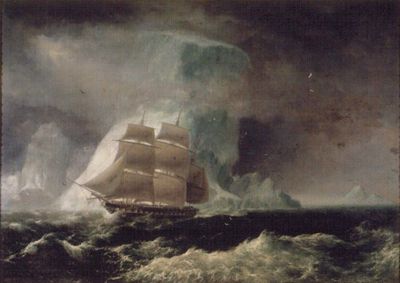
It had been 45 years since the incident, but Allen still had nightmares, especially before he gave a talk. In his dreams he was a phantom, floating through the decks of the submarine whose name he could not recall. Remnants of the crew were scattered throughout the ship. A sailor hung in the landing of a stairwell, decapitated by the deck above, having materialized in between. Indiscernible cuts of limb drifted weightless through the corridors. Trails of feces and blood were smeared across the floors and walls, drying in the dim emergency lights. The stale air grew increasingly hot. Lone survivors wandered the halls, glowing grey-green, viciously fighting whenever they found another cursed crewmember. If they did not kill each other, they slowly succumbed to burns that gnawed their discolored skin like a smokeless fire.
In his dream, Allen was searching for his own body. He knew They were keeping it somewhere. Where were his friends who had disappeared? He floated over to the control room, below the conning tower, and looked out through the periscope and saw oceanic snow drifting through the depths, snow that upon closer examination, turned into fields of stars in the blackness of space. The submarine had become one of these stars, a sun in its fury, unable to cool itself in the vacuum of the cosmos, a nuclear reactor raging in the void. Each time, Allen failed to find his body or his friends and woke up coated in sweat.
“Excuse me, everyone,” said Allen as he eased back from the podium and descended the stairs.
“Hey, what are you doing?” asked Frank in an angry whisper from the side of the stage.
“I’m not well,” said Allen, as he headed toward the emergency exit. He pressed the crossbar on the door and stepped outside. If the door had an alarm, it failed to sound.
“Sorry ladies and gentlemen, my brother needs some air,” said Frank as he followed Allen out back, slipping a rubber doorstop in the crack.
“We’re not brothers, Frank, we’re cousins,” said Allen, as they stood behind the hotel convention center in an empty parking strip that smelled of wet cigarette butts and old motor oil. Beyond the asphalt, a grassy ditch dotted with plastic cups and Styrofoam food containers ran alongside the highway. A cornfield grew on the opposite side, a wall of green awaiting the setting sun.
“So what? Being brothers is better marketing,” said Frank.
“Well, it’s not the truth,” said Allen.
“Truth? This has never been about the truth,” said Frank.
“Ever since I came back, all I ever told was the truth,” Allen said.
“Came back from where, exactly? Outer space?” laughed Frank. “You never even joined the Navy. You failed basic training in the first week,” he said.
A feeling of claustrophobia overtook Allen. A memory of a bright light narrowed his vision; his head ached severely behind his eyes.
“If it weren’t for me, you’d be out on the street,” continued Frank. “Everyone else thought you were crazy. Aunt Connie and Uncle Bill basically disowned you,” he said.
Allen eased himself down onto a folding chair next to the emergency door, its legs ringed with ash and pockmarks of burnt tobacco. Frank slipped inside the hotel for a minute, coming back with a bottle of water.
“This is what we’re gonna do,” said Frank. You’re gonna sit here and get your shit together while your medication kicks in, and then you’re gonna come back in and talk, just like we used to,” said Frank, as he pulled an orange pill bottle from the front of his jeans pocket. He unscrewed the white lid, shaking out two, pale yellow pills and placing them in Allen’s palm.
Allen swallowed the pills with a swig of water, covering his eyes with his hand. The gentle evening light was too intense for him.
“We’ll be millionaires from the documentary,” said Frank.
“No,” said Allen. “I’m not going back in,” he continued. “You’re never going to pay me back, you’ve been swindling me my whole life,” he said.
“Brother, I’ll pay you back with interest,” said Frank. “Get your shit together, and we’ll go on with the show,” he said as he went inside to stall the audience with a story of his own.
“We’re not brothers,” said Allen, but Frank was gone. The emergency door clanged on the doorstop, bouncing until it came to rest.
Allen held his hand over his eyes as he waited for the medication to take effect. He was only taking the migraine meds these days—the anti-psychotics were no longer necessary, his doctor had said. A breeze came along that rustled the cornstalks, nudging more litter from the roadside down into the ditch. A few cars passed on the highway, coursing gently as if propelled by the wind.
Allen listened to the whooshing of the cars as he thought back to his time on the submarine. Why couldn’t he remember the name of the ship? Why did his emails sent to the murky network of departments in DC always go unanswered? He told himself that his experience was real. He remembered their mission: to patrol around South America. Back in ’81, they had originally departed from Norfolk, Virginia—he remembered the hangover he got at the oceanfront the night before shipping out. He remembered the months at sea, making port on Andros Island, lingering off the coast of Venezuela. Waiting, watching. Eating midrats and jerking off. Long periods of nothing. Long periods of cleaning on his hands and knees. 18-hour days, as if he lived on a planet that spun faster than the Earth, a crowded, suffocating planet that roamed the universe without a sun. He remembered the excitement as the ship approached the equator. Finally, something different. He and his friends, Carlos and Morris, thought they’d have some fun before the line-crossing ceremony. This voyage was special—Carlos had brought peyote on board.
“Eat it, you pussy,” Carlos said to Allen, who sat on the edge of his bunk in the torpedo room. Carlos held out his hand—within his palm, the desiccated body of a peyote cactus, shriveled like the severed nose of a goblin.
They were submerged in the Atlantic, cruising at about 500 feet, not far from Brazil. The ship was on course to cross the equator in six hours and the boys wanted to get a headstart on the festivities.
“You sure this is peyote?” asked Allen as he examined the plant.
“Yeah, man. I didn’t bring it all the way from Arizona for nothing,” said Carlos, as he passed the bag of dried cactus to Morris.
The three young enlisted guys sat hunched on their bunks, among the constant buzz of the submarine’s ventilation system. Securely fastened above and below them hung long, dark green tubes of explosives strong enough to break the hull of an aircraft carrier. The torpedo room was cooler than the rest of the ship and the best place to sleep. Allen and his two friends reserved their bunks with the merchandise they smuggled onboard: cocaine, LSD, sometimes heroin if they were in the Pacific. They ran a nice little ring, small and discrete, but kept the truly fun stuff mostly for themselves.
Morris grinned wide, his mouth full of masticated cactus, green and grey like old avocado. “If you hold it in your gums, you absorb it faster,” said Morris, sounding like a kid in a cafeteria.
“It’s about being a warrior, man,” Carlos said to Allen. “You want to walk on the warrior’s path or not?” he said.
Allen ate the peyote. Tough, bitter. It took a long time to chew, like steak with too much sinew. He finally gave up and swallowed what he couldn’t break apart.
Carlos was going on about the path of the warrior. Morris listened, mesmerized, occasionally wiping the spit that leaked out of the corners of his mouth.
“A real warrior battles with infinity,” said Carlos, as he stood and squared his stance. “You have to walk the path with heart,” he said, as he began doing strange movements in the main aisle of the room, ducking under the racks that held the torpedoes, shifting his hips around electrical control panels, movements that resembled a cramped tai-chi.
“Wow, Carlos, you know karate?” said Morris, his mouth still full.
Carlos motioned over towards Morris, flowing awkwardly, like someone who had only learned his art by watching video tapes, and brought his hand down in a firm chop, striking Morris on the shoulder.
“Ow,” said Morris, scraps of soggy cactus slipping from his lips. He caught them in his hands and tucked them back in like pouches of tobacco.
“It’s not called ‘karate’,” said Carlos. “It’s ‘tensegrity’, from the deserts of Sonora,” he continued as he pivoted, sweeping his arms in long arcs. “The shamans learned it, from the extraterrestrials, two-thousand years ago,” said Carlos, swooping as he spoke.
“Wow,” said Morris. “Older than karate,” he said.
Allen watched as Carlos moved through the congested room, spinning like he was fighting underwater ghosts in slow motion between the bunks and torpedoes.
Suddenly, the ship shuddered and stopped abruptly. Allen and Morris slammed into a control panel, while Carlos was flung down the aisle.
“Shit,” said Allen as he got up slowly. Morris seemed all right. Carlos did not get up.
The ship began to tilt aft, at first 10 degrees, then 20 degrees. Allen held on to the torpedo rack as Morris stumbled into the aisle, trying to grab Carlos as he slid unconscious down the floor.
“Morris, hold on!” yelled Allen.
The ship continued to tilt. 40 degrees, 50 degrees. Emergency surface, thought Allen. They must have blown the ballast.
Morris reached for Carlos with one hand as he grabbed the bunk with the other, but lost his grip as the ship tilted further. 60 degrees, 70 degrees. The two of them fell back, slamming into the door to the torpedo room.
Jesus Christ, thought Allen. They’re really pushing it, as he nervously held on.
The ship shuddered once again and then whipped down violently. Allen hit the ceiling before crashing hard onto the floor. The ship leveled out and became still.
“Are you all right?” said Allen.
“I’m OK,” said Morris. “But I think I started tripping.”
“Yeah, no shit,” said Allen, looking down the aisle. “Where the hell is Carlos?” he asked.
“He’s right here,” said Morris as he pointed to the empty space between them.
“Did he slide under a bunk? Where the fuck is Carlos?” repeated Allen.
From outside of the torpedo room rang the sound of a brass bell. A distant voice boomed. It was singing a country song, lazily sounding out each word.
“Fuck,” said Allen. “It’s J.G.”
The bell clanged louder, in between absurd lyrics about doing everyday activities with animals in impossible places.
“Shit man, J.G. is a prick,” said Morris, his eyes following something invisible. “I hate when he sings that Roger Miller song,” he continued, the voice and the bell reverberating outside the bulkhead door.
“Morris, where the fuck is—,” said Allen as he turned towards Morris and saw him vanish. There and then not there: gone.
The door opened and in walked Lieutenant Junior Grade Christopherson.
“Petty Officer Allen Furuseth, you are being subpoenaed!” said J.G. as he laughed, ringing loudly the brass dinner bell in his hand. J.G. was a big guy, chest hair bursting from his V-neck undershirt, but he was also wearing a turquoise-sequined bikini over his tan uniform. Beneath his officer’s hat, a wig of golden hair sat frumpily atop his head, slightly obscuring his face.
“Report immediately to the Court of King Neptune!” said J.G.
“But where in the fuck—,” said Allen as J.G. grabbed him by the collar and hauled him out of the torpedo room.
Chaos unfolded around Allen as J.G. dragged him through the corridors of the ship. The floor became slick, but slick with what, Allen wasn’t sure. Men crawled past him on their hands and knees, soaking wet and covered in a viscous brown liquid. There were cries and laughter. Some men were not wearing pants. There were eggs. A lot of eggs. Eggs broken on the floor, broken over men’s heads, running into their ears and eyes. As Allen was dragged around a corner, he slid past one sailor who was scurrying through black bags of garbage, trying to avoid the lashings of a wet rope. Allen briefly locked eyes with the terrified sailor, whose mouth was crammed full of eggs, as if he held within his jaws a clutch of spiders ready to hatch.
The line-crossing ceremony was already underway. How long were we in the torpedo room? Allen thought to himself, as he watched the soiled hallways coil behind him like the foul entrails of a mechanical sea-beast.
J.G. entered the mess hall and made Allen stand. In the center of the hall sat a large plastic tub, like an altar about the length of a person. Behind the tub was a row of chairs, with tennis balls fixed to each foot, and in which sat the highest-ranking servicemen on the ship, wearing costumes like they were about to perform in a fifth-grade musical.
In the middle chair sat the CO, dressed as King Neptune with a fake Santa beard and a pitchfork for a trident. To his right was the XO, in a sparkling dinner dress bursting at the seams, as Neptune’s wife, The Lady of the Deep. To his left was the highest-ranking Master Chief, purportedly Davy Jones, but looking more like a budget Halloween pirate. Ten officers stood to the sides, dressed like J.G. in various styles of wigs: pig-tailed, long-haired, and bob-cut in blonde, brown and red. Swimsuits fashioned from faux fish scale, coconut, and American flag print.
“Speak, O concubine of Neptune!” said the pirate to J.G. “What have you for your King?” he said.
J.G. gave Allen a shove as he moved closer to the court seated behind the tub.
“I have brought you a pollywog, the uninitiated!” said J.G.
“And do you believe this pollywog is worthy of the secrets of the deep?” asked King Neptune in a growling tone.
“I do, my king!” said J.G. as he bowed.
“How does the court find the uninitiated? Is he worthy?” asked the Lady of the Deep, failing to mimic a woman’s voice.
“Worthy! Worthy!” chanted the harem of men in bikinis and wigs.
“Bring him forth,” declared King Neptune, gesturing to the tub with his pitchfork.
J.G. pushed Allen towards the tub. Two wigged bikini-men approached from the far ends of the court and picked up Allen by his armpits and feet, lowering him into the tub.
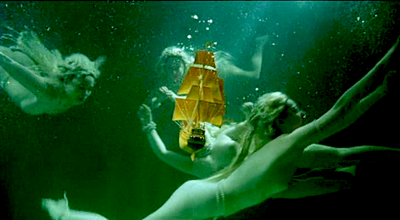
“The great Jacques Cousteau once said that man, from birth, bears the weight of the Earth, but slips free once he descends beneath the surface,” declared Neptune, trying to sound official, as the men brought a firehose over and began to fill the tub with water. Another pair of men brought bags of green dye and salt and emptied them into the frothing water.
“Cousteau also said that underwater, you can move as you please: within the sea, you become an archangel,” said Neptune. The waterline rose up to Allen’s ribcage. Neptune leaned over and whispered to Allen. “Relax, kid. Just float,” he said, clapping Allen on the shoulder as if he were sending him out to the pitcher’s mound from the dugout.
From against the wall, two men carried a cover for the tub and slid it over the top. Allen tried to get out but the men held his shoulders down as the cover slid into place, locking down and sealing him in.
Allen briefly panicked, but finding that he could not thrash about without water splashing into his nose and mouth, quickly calmed himself and laid flat on his back. With all of the salt in the water, he floated easily.
“Worthy, worthy!” he heard the men chanting from outside the tub. His tub, an altar. A coffin.
The voices of the chanting men faded. Then Allen heard laughing and crying. J.G. singing again. Morris and Carlos, their voices faint but near.
Suspended in the darkness, Allen lost sense that he was floating and saw something in what felt like the distance. Dancing shadow-men, two of them, darker than the void of which they were made. They danced like Carlos in the torpedo room, but were smooth and fluid in their movements.
The darkness split open above the two shadow-men, as if someone had taken a blade to the sky and slit an artery of the cosmos. Stars spilled out, radiating rainbow light as they splashed in the black water and gravitated toward the shadow-men.
Allen wanted to get closer and, no sooner than he thought it, had joined them in their dance. Encircled by the stars, they orbited each other for what felt like eons. When he had finally grasped the intricacies of their movements, Allen found that he was standing on top of a bulkhead door. He knelt down and, with the help of the shadow-men, turned the lock. The door clicked open, and as Allen walked through, he felt that space had rotated again, or that he had rotated, but rotation was irrelevant here. I’m everywhere and nowhere, Allen thought.
The stars swarmed in behind Allen, illuminating his path as he walked through the halls of a grand architecture, as if the ship had grown to fill the entire universe. There were bodies strewn throughout the halls, bodies that the stars clung to and brought to life—but not the kind of life that Allen knew. As the bodies reanimated, Allen asked himself what governed this life and he found himself transported into a chamber of crystal that ascended into infinity, a throne room where a council of beings sat on chairs of otherworldly metal. The beings looked like they were once human long ago, or had taken the form of what they remembered humans to be. In front of the council, the shadow-men stood still. Allen called out to them, but as the shadow-men turned towards him, the truth of what they were blinded Allen in a burst of light.
Allen felt himself sucked out of the room, as if he had been slurped up and spat out. Saltwater was pushing its way into his sinuses: he was back in the darkness of the water coffin, suspended upside down, his head completely immersed. Had the submarine attempted to surface again? Allen felt an empty pocket of air at his feet, which were now pointed upwards, nearly 90 degrees. He struggled to turn himself, but the tub wasn’t deep enough. He heard the muffled sounds of screaming men. The water was becoming hot; the sides of the tub scalded his arms and legs. He frantically kicked his feet—he had never yearned for something so simple and so close, yet out of reach, this final pocket of air. As he thrashed about, losing consciousness, Allen wished he was back in the crystal chamber, but no matter how much he willed himself to move, he remained trapped. The last thing that Allen remembered was the type of fear that only water and darkness can bring, as he disappeared along with the submarine into depths that went beyond the ocean floor.
“What happened next?” Allen heard a voice say.
Allen looked up from his chair in the parking lot behind the hotel convention center. The sun was slipping beneath the top of the cornfield, melting along the horizon. Had he been talking to himself?
“After you lost consciousness, what happened?” said the voice.
Allen noticed that his pain was gone. He looked over to see a man standing two parking spaces away, his hip resting against the body of an ice blue 1978 Lincoln Continental. The man looked around Allen’s age and wore wide, prescription sunglasses and a dark blue ballcap with gold letters. He was listening attentively, waiting for Allen to continue.
“I woke up in a marsh, naked, near my parents’ house by the Chesapeake Bay,” said Allen. “They were standing over me with flashlights. Someone had called the police, thought I was a body dumped there,” he continued.
“I imagine that was hard to explain,” said the man.
“No one’s ever believed me. Well, no one in their right mind,” said Allen. “I’ve lived my whole life this way, wondering what happened,” he said. “But I feel that they’re still out there,” said Allen as he watched what remained of twilight disperse beyond the field in streaks of orange and purple.
“The experiment on the Portunus, it wasn’t supposed to have gone that way,” said the man.
Allen felt a surge of electricity zap between the hemispheres of his brain at the sound of the name.
“What did you say?” asked Allen.
“You had an alternative mission on the USS Portunus. Based on the success of the Philadelphia Experiment, the ONR wanted to see if ships could jump farther. Then, they wanted to see if submarines could do it,” said the man.
“What are you talking about?” said Allen.
“With the Portunus, the plan wasn’t to go around South America, it was to go through it, to jump from the Atlantic to Pacific along the equator while submerged. Except, something went wrong—you tried to emergency surface while still phased and Earth’s rotation shot you out of the atmosphere. By the time the jump stopped, your ship had become the newest moon of Jupiter,” said the man.
“If that’s true, then how was I sent back?” asked Allen.
“They could only send one. The mescaline had protected your mind. You and your two pals, at least—everyone else on the ship had gone insane or suffered physical side effects from the jump. The line you crossed wasn’t planetary, it was cosmic. Our Friends used the ceremony to return you, something with symbols you’d recognize. They tried to shield you from the worst of it, but no one expected that the timeline would alter this significantly,” said the man.
“How the hell do you know all this?” asked Allen.
“Because I was there,” said the man as he removed his sunglasses.
Allen recognized his face. It was Morris. The gold letters on his hat became clear: USS Portunus, SSN-173. Allen rushed to embrace him.
“Where have you been?” asked Allen, on the verge of tears.
“I’ve been up there waiting with Them. Want to go see Carlos?” asked Morris.
“Of course, but why did you only come now?” asked Allen.
“Because you walked away,” said Morris. “When you let go, a door opened,” he said.
“You’re not going anywhere without me,” a voice said. Allen turned to see Frank standing in the exit doorway.
“If you think you can break our deal, you got another thing coming,” said Frank.
“I’m done, Frank,” said Allen as Morris opened the driver-side door.
Frank walked quickly over to the car as Allen and Morris got in. No one stopped Frank from getting in the back.
“I don’t want you coming with me, Frank,” said Allen as he turned to face Frank.
“Like hell you are ditching me. We got money to make,” said Frank as he fumbled with his seatbelt.
“He really shouldn’t come with us,” Morris said to Allen.
“Well, I’m not getting out,” said Frank. “Let’s see it, show me that ship of yours,” he said as he laughed.
“All right,” said Morris, as he started the car and pulled out of the lot and onto the highway.
As they drove, the road seemed to elongate and stretch upwards into the night sky.
Morris whistled a tune that Allen hadn’t heard in decades, the same one J.G. loved to sing. As he whistled, the highway got longer and thinner, the sky wider and brighter, rimmed by a contracting darkness.
“What the fuck,” said Frank as he looked at his arms, which were glowing grey-green. His skin was coming apart, disintegrating like a burning film reel in a movie theater. Frank looked up at the rear-view mirror and caught Morris’ gaze: a face full of eyes—where there were once two, there were now thousands, piercing into Frank, seeing things within him that he long knew were there but had ignored.
Allen heard a faint scream but when he turned to look in the back seat he found it empty. He felt lighter, as if a great weight had been severed. His vision seemed different, like he was looking through a kaleidoscope of pure light. For the first time in his life, he had his bearings straight.
“Man, that Lieutenant J.G. sure was a prick,” said Morris as the car vanished from the space that was neither road nor sky, coursing towards a ship that had transcended the depths of the watery Earth, a wreck that connected the ends of infinity, harboring souls unsaved but salvaged in its stellar heart, for what purpose, Allen did not know, but felt that he was beginning to see.
-- Ronald Plumber is a writer from the US based in China and is currently working on a collection of weird short fiction. He can be found on twitter @ronaldxplumber and substack @ronaldplumber.