Who are the defenders of the text? They are a motley band of heroes, one to be remembered and revered. And so they deserve a real exordium, in the style of Milton’s orations: A lavish introduction. Perhaps though it is a funeral oration, for their time is now past. So we are in a better position, perhaps than ever before, to survey the work of those scholars who defended the text—that is, those who discovered the text; who preserved it; who learned to read it; who transmitted it; who studied it; who understood it; who edited it; who published it; who revised it; who expanded it. In short, the whole clockwork mechanism by which the debris of the past is sifted into history. Far from being invisible, the defenders of the text proclaim themselves, and imprint themselves quite indelibly onto its edifice, through their critical activity, which binds it all together as superstructure. No wonder that so often in the history of the English language, the defenders of the text have been heralds. Those men who attended on the knights of olde, and trumpeted about their fame. Camden; Dugdale; Peter le Neve; Elias Ashmole. Heralds all. Officers of the College of Arms. Let us then assume for a bit the role of herald’s herald, and recount their past triumphs a bit.
There is a continuity through the ages, which the antiquaries; historians; and critics have perpetuated through their tireless excavation of the past, which itself is the lower substratum of the very structure they are erecting. And so debates resound through time; they repeat, unrelentingly. The pattern of discourse is both continuous, and discontinuous. Its continuities are hallucinations. Its discontinuities are reaffirmations and reconciliations. The question I mean to pose has to do with how we are to continue/salvage/reinvent a modern textual criticism in the age of large language models. It may now appear as if the culture of textual criticism has reached a definite historical end, is that really the case? Opinion essays lament the end of literacy, perhaps rightly so, as now machines do all the reading and writing for us. But is this truly a dis-continuity, or an ever deeper one? If this is true, if text-bound literate culture is coming to an end, then it presents us the perfect object of antiquarian investigation. The antiquary dwells on graves to inspect the tombstones—a certain melancholia prevails among the defenders of the text as a result of this.
To see this one must only imagine Aubrey while at Oxford—which coincided with the King stationing himself there during the Civil War. Melancholia was in the air. Burton had not long since done away with himself. Hobbes was in the midst of the students and regaled them with tales of his conversations with Francis Bacon. Likewise William Harvey was with the King as physician, and injected a current of scientific and experimental excitement. The past came under the microscope of reflection as an object of science in this laboratory, as Harvey demonstrated experiments on chicken embryos to the students. Yet the impending doom of Charles I hung over the whole procession as the young students consorted with the officers engaged in the king’s lost cause, who in turn became enamoured with early Freemasonry and formed secret ambulatory lodges—cells loyal to the soon to be deposed King. Aubrey recalls how he and his companions rode out one day, from the city, to make drawings of a cloister outside the walls, fearing that it would be destroyed by the king’s besiegers. Surely enough, his foresight was correct. He had captured the monument at just the right time. This is the melancholia that pervaded the generation of antiquaries following the Restoration. The melancholia of a Civil War—just as the melancholia of the Reformation loomed over and pervaded the first-generation of antiquaries. The shadow cast by the accumulations of the past were so black as to drown John Leland in darkness—who was driven mad by a kind of record fever trying to collect and catalog the material that had been put up on the chopping block of time. To further underscore this, we might note that the Academy of Antiquaries which formed around William Camden met on All Souls’ Day, the day of the remembrance of the Christian dead.
History begins with the grave marker; the inscription; the monument, and this doesn’t end with physical artifacts, but carries over to textual ones as well. Documents are often described not just as “records”—but as memorials and monuments. This is further conveyed in the term “muniment,” which refers to documentary proofs of title that were archived in a specially outfitted vault that every great family had installed in their home. So while the antiquary etches the epitaph, he or she also erects the monument—and it is from the monument that we learn literally everything—because everything else about the past is gone. We may bury the defenders of the text, and pen their eulogy; but, in that very act, of melancholy reflection, we also extend them, and we continue their effort anew. We remember here a textual culture now being driven to extinction—but we cannot even contemplate that extinction without thereby inverting the discontinuity. Is, therefore, the current moment really a rupture at all? I was struck by the provocative closing lines of Jonathan Goldberg’s Writing Matter, following his final survey of the work of twentieth-century theorists on the oppositions of handwriting and typewriters, where he writes:
But now the fantasy is that somewhere there is (or someday there will be) a program, and rather than having to write oneself, the machine will be able to do it.
Goldberg recognizes that the supposed dichotomy between handwriting, as something personal and individuated; against the typewriter, as something mechanical and anonymous—is critically untenable. Handwriting, as it was taught in the seventeenth century, was also a mechanical, anonymizing system where expert secretaries moved seamlessly between various hands—between secretary and italic scripts; between court hands and the signatures of their masters, which they learned to forge—which they controlled. Perfection was in the perfect copy of the forms distributed by the writing masters—some of whom were zen-like gurus of the hand capable of incredible feats of automatic dexterity. The typewriter and the word processor, therefore, are not discontinuous with the individuating authenticity of handwriting; but rather a reentrenchment and reaffirmation of it. The original large language models are the scribes and secretaries who copied and recopied the text. The scribe made fair copies of authors’ manuscripts for use by the typesetters. The scribe was a scrivener in a law office, copying out the textual legal instruments through which the state perpetuates itself—through which it manifests its authority. The scribe copied works for manuscript transmission, like newsletters. The scribes were the secretaries of powerful men—of the King’s favorites—even the King had his own secretaries, who wielded immense power acting as the monarch’s own hands. By assuming his authority to write—by writing on his behalf. To write for the monarch, or the state entailed depersonalization—the secretary gave up his identity, and assumed the identity of power itself—of the state. They thereby participate in this power, and perpetuate it. These men (and less occasionally women) were educated in a kind of rhetoric, handwriting, and textual culture that was often very mechanical. Secretaries kept books of model epistles, which could be refashioned to serve any official circumstance. Secretaries produced and reproduced those texts through a discipline of handwriting. This textual culture—whose passing away we are in the midst of lamenting—it was a generative language machine. The rupture between past and present is perhaps just another hallucination generated by this machine.
This essay will invoke a rather expanded concept of the public textual domain—as the historical corpus of text produced by this same machine; the text that has been generated by it. There is something public about all text—as text is a social performance of common language—and that extends across all paper and digital communications—past & future—as everything ultimately reverts to the public domain; which is the reservoir of the English language, and contains all its forms and resources. All contemporary linguistic and textual utterances are rooted in this same soil; every remains of every crop harvested from it ultimately are mulched back into the soil—restoring it. This extends to the code of computer files we create. This is the same soil out of which LLMs are grown—it is their training data as well as ours—it is our common literary and linguistic property. Every paperback edition of every literary classic is ultimately based on a manuscript or early printed edition which is an object in a library or archive somewhere—and these objects are studied and reconstructed by the bibliographer and the textual scholar to create the basis of millions of copies across an untold number of printings and editions. The text is not something abstract, or without body—it is manifest in physical objects—in autograph manuscripts, legal documents, corrected proof-sheets, annotated copies, commonplace books, correspondence—and those objects are often the real property of public institutions. This essay will mostly focus on the English experience, until the early twentieth century, and will therefore focus on institutions like the Public Record Office, the British Museum Library, the College of Arms, the Stationers’ Company. But the analogies to the American case can be easily drawn, and there are further parallels to be drawn between England and Prussia. So, even though we confine ourselves to particular historical examples, we should not limit the consequences of our discussion to only a single particular time and place; rather the implications extend to the entirety of our shared English language and the textual corpus in which it’s rooted.
The public domain of writing is the storehouse of precedents upon which English language diction and usage is based. It includes those documents harkening back to Anglo-Saxon times. English, as a language, has been reared up on this material. It is not just a dead record, but also the precondition of literary communication in our language, the fountain from which it flows, or is generated. In the same way creations of Large Language Models are generative and presuppose this textual corpus, so is all literary production generative, and based on the public record. This public record includes lives of saints, medieval chronicles, state papers, court records. All literary work is based in the community of language, which is collective and historical.
Previously a class of men and women lived who defended this textual domain, for the public good. They were bound, as Knights are by their code of chivalry, to an ideal of textual criticism, and they fought bloody critical conflicts with one another over those ideals. Large language models have now come to defend the text themselves, through their own mathematical, anonymizing, mechanical process. The Public Record Office has been replaced by the data center. And instead of textual criticism being a public rhetoric of controversy, the algorithms which generate and extend the text have been locked away, and become a corporate property and trade secret. The public is shut out of the text in more ways than one. Copyright laws work against the public’s right in its own communal legal and linguistic existence, denying and restricting individual use, while those same repositories are plundered with impunity by AI companies and the entertainment consortium. The discourse of the antiquaries and critics and bibliographers was a machine by which the debris of the past was sifted and deployed to various ideological ends. The rhetorical modes and genres of discourse regulated the operation of the defenders of the text—deindividuating them and bringing their discontinuities into alignment as part of the textual structure of social power. Much of this can also be said about Large Language Models and their function within the text. But is this continuity an hallucination? What separates the kind of textual criticism that we now see passing away? What can be preserved or reaffirmed from it?
This essay will move through three eras of criticism, beginning with the invention of English criticism in the early eighteenth century by Richard Bentley and Alexander Pope. In this section is considered the relationship between the development of authorial copyright and the grounding by the editor of his interventions in the authority of a generalized rationality. Here the text becomes the property of its creator or author; and it obtains its integrity as a piece of property through the authorizing force of that Rationality’s internal generative/creative power. The following section considers the development of ballad criticism and ideas of collective authorship in the later part of the same century. In cases where a textual tradition—such as ballad poetry—was authored by a generative process; rather than an individual, a form of corporate ownership developed. Finally, the next section deals with the professionalization of textual criticism by records scholars employed by the state. In the conclusion, some implications and lessons of this history are then considered. The purpose of this essay is to introduce the reader to a wide array of characters involved in this history, and to do some justice to them as a herald should. Though we may lament the passing away of this culture of textual scholarship in our own brave new era, we may still learn from it, as good antiquaries always must learn from the funeral pyre; or mound; or funerary inscription; or decayed monument. What can be known, first must be buried.
This is an excerpt. To read and receive the full experience of Defenders of the Text by William Clark, click HERE.
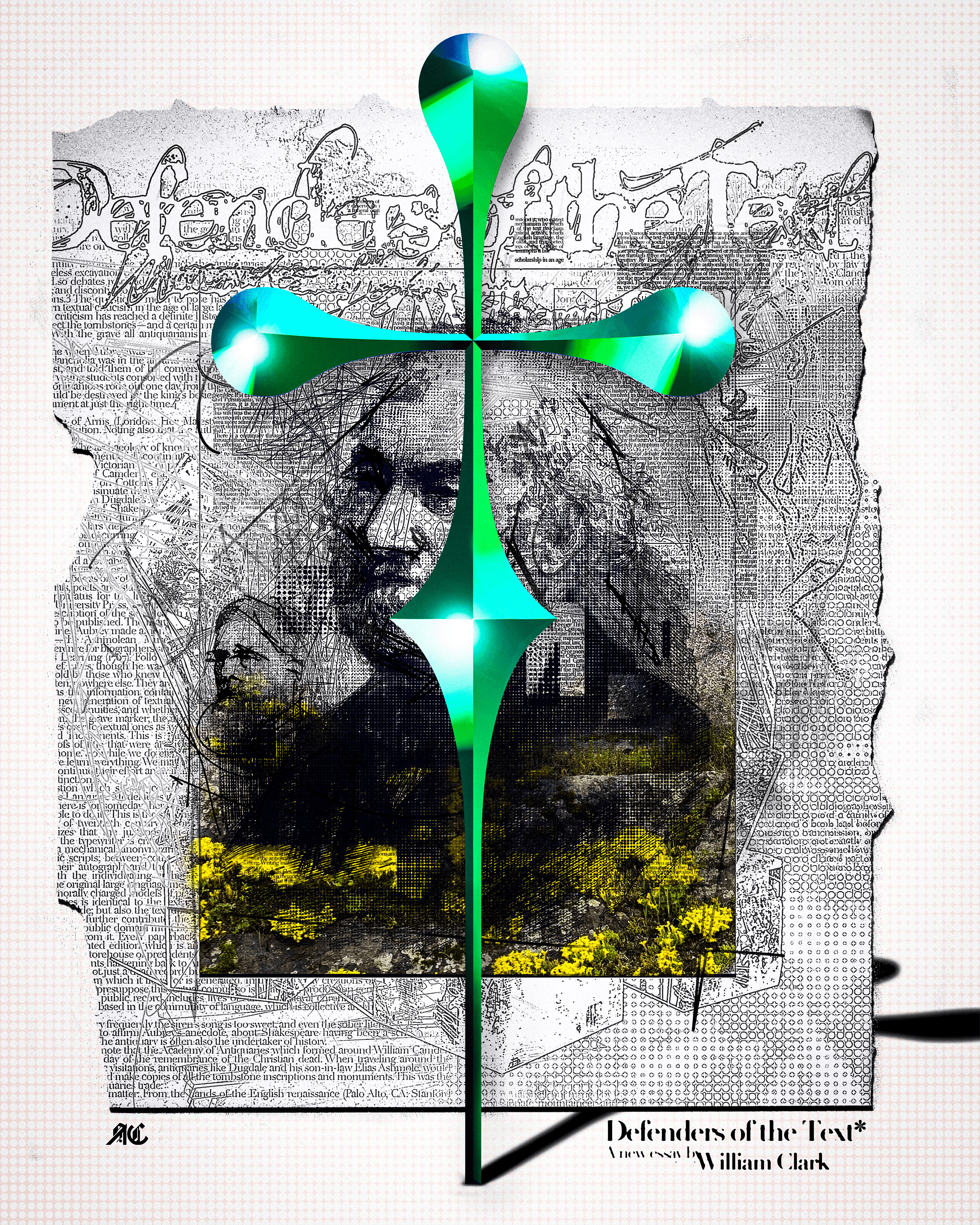
Artwork by Robert Voyvodic