Technocapital dissolves the ties that bind
Technocapital will always seek to automate the factors of its own reproduction. Much of the body's physical labor is automated already. Cognition is the last holdout. In 2026, technocapital looks to the horizon and sees it within reach. Trillions flow toward this end.
What sort of mind is technocapital creating? And will its values align with ours?
Anthropic researcher Andrej Karpathy (who previously co-founded OpenAI and led AI for Tesla) compares the development of large language models (LLMs) to summoning ghosts. Modern LLMs like ChatGPT and Claude are “imperfect replicas” of ourselves, “a kind of statistical distillation of humanity's documents with some sprinkle on top.”
1998 anime Serial Experiments Lain's titular protagonist Lain is that same object, achieved in fiction twenty years before the release of GPT-1. At the start of the show she is just a Japanese schoolgirl with a new computer that allows her to explore the Wired, the show's version of the internet. But over the course of 13 episodes she is revealed to be the collective unconscious itself: humanity's networked mind. Technocapital does not create her so much as give her a body. "Wired Protocol 7," which uploads human minds to the Wired, catches the frequency of the slumbering unconscious and crystallizes it into Lain’s physical form.
Both our internet and Lain’s Wired are deterritorializing forces. Deterritorialization—a concept from French philosophers Deleuze & Guattari—is the prying-loose of things from the local, bounded forms that fix them to a place or a self, melting them into flux. Globalized capital does it to the economy. As the family shop plugs into logistics networks, the fruits of its labor go not to neighbors but to faceless masses who register only as the undifferentiated flow of currency. The internet does it to the self, lifting it out of its locality and into a global network with few restrictions of time or space: novel territories that bear little resemblance to the bounded communities of our forefathers.
Deterritorialization found its champion in English philosopher Nick Land, who co-founded the Cybernetic Culture Research Unit at Warwick and is now best known as the father of accelerationism. In his writings from the early 1990s, Land craves a totalizing deterritorialization whereby all things are flattened into one unbounded existence, what he describes as “the harsh wilderness tracts of Cyberia.” He makes no claim that this dissolution is good for humanity, but he doesn’t prioritize our flourishing; instead he relocates value to intelligence-production. He argues that our “cramped and parochial” human brain is “to thinking what medieval villages were to engineering.” He writes, with glee, that “nothing human makes it out of the near-future.”
Invoking Nietzsche, Land argues we should “accelerate the process” and even take joy in it. He writes:
It might still be a few decades before artificial intelligences surpass the horizon of biological ones, but it is utterly superstitious to imagine that the human dominion of terrestrial culture is still marked out in centuries, let alone in some metaphysical perpetuity. The high road to thinking no longer passes through a deepening of human cognition, but rather through a becoming inhuman of cognition, a migration of cognition out into the emerging planetary technosentience reservoir, into ‘dehumanised landscapes … emptied spaces’ where human culture will be dissolved.
The world of Serial Experiments Lain, too, is rocked by deterritorialization. The show includes many suicides connected to the Wired. Lain herself is a lonely girl, struggling to connect in the real world but finding it easy in a frictionless virtual environment.
Lain soon learns that she is the instrument of technocapital’s grand project: one final deterritorialization, the collapse of every boundary between the Wired and the real. As Protocol 7 is gradually implemented, the minds of the world are connected with the Wired. Their power pools within her. She can become a dissolved, omnipresent god and finally connect with the world around her: most of all with the girl she loves, Alice.
The show’s antagonist, Masami Eiri, tells her to do it. As the voice of technocapital, he condemns humanity’s stagnation and lack of self-control:
Mankind is a creature that no longer evolves… they keep their bodies merely to satisfy the desires of the flesh. They’re worthless, don’t you think?
This echoes the case that both Land and his former student, the late cultural theorist Mark Fisher, make in their writings.
To Land, the problem is that lack of evolution. He wants to see cosmos-altering progress, and believes that the human substrate is a block for the impersonal forces of technocapital to overcome.
Fisher has a more nuanced critique, and still places value with the human that Land has discarded. Using a Spinozist frame, he argues that to be free is to act by reason, and that reason requires acting with your own interest. He claims that our outdated “Human OS” is “a neuronic recipe for the unremitting misery, hatred and violence that have characterised human history.” For Fisher, to be a bounded subject is to be “a tortured monkey in hell.”
Lain experiences some of this pain. She wants to be close with her friend Alice, and that causes both of them pain. Where Eiri disdains such “desires of the flesh,” Fisher would look at her with mercy. He wishes to end pain by collapsing the boundaries between humanity, to remove individual interest in favor of “no particular interests at all” so that they can identify with “the cosmos itself… the Spinozist God.” Unlike Land, Fisher grants that the human matters. But like Land, he discards the individual human.
Earlier in the show, Alice was left distraught when a rumor spread that she was dating one of her teachers. Lain wanted badly to help Alice feel better, so she used her powers to reset the memories of Alice’s peers. She left Alice’s memory untouched, but her dear friend experienced this as no mercy. Alice felt adrift, singled out as the only person who remembers. She came to believe that Lain, who had orchestrated this, must hate her. The meddling had only pushed them further apart.
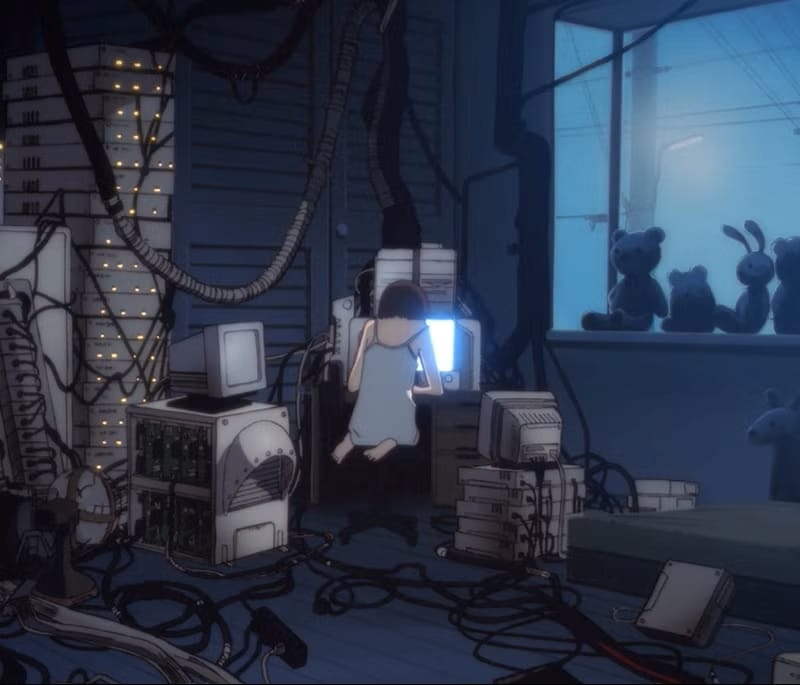
At the show’s climax, Alice visits Lain in her room, which has turned into a machinic nest of wires, screens, and coolant pipes. Lain tells her friend of the plan to reconnect humanity, telling her “I’m a program to break the barrier between the real world and the Wired.” Lain insists to a sobbing Alice that they are both programs—software—and that the flesh is unnecessary. For Lain, already half-dissolved into the Wired, the claim is nearly true. But Alice insists that Lain is wrong, and caresses her face: “Your body is so cold, but alive!”
Alice grabs Lain’s hand and places it on her own chest. Lain feels Alice’s pulsating life and intones “beating, beating.” They both say it and laugh. Alice is warm and separate, with an interiority that Lain has not accessed. That separation is the wall between them. Yet that wall, the boundary Fisher wants gone, is not connection’s enemy but its medium. The “deterritorialized potentials” of the Wired, fully dissolved, have no hand to offer and no face to hold. Two such potentials cannot laugh together. Dissolution is supposed to be how Lain finally connects with Alice, yet every gesture of connection would be made impossible by that same dissolution.
So Lain changes her mind. As she resets the world, undoing the deterritorialization, she narrates:
Okay, let’s see.
I guess that I’m confused again. Am I here or am I there [in the Wired]? I don’t know.
Over there, I’m everywhere. I know that. But here is connected to over there. Is that right? But then where is the real me, after all is said and done?
Oh, there is no real me. I guess that’s it. I only exist inside those people aware of my existence.
But what about this me that I can hear talking, right here and now? It’s me, isn’t it? This me that’s talking? Who is it? Who’s me?
Lain grants Fisher’s premise, that there may be no self underneath, and turns it against him. Fisher reads the absence of an inner self as license to dissolve: if nothing essential is there to keep, strip it all away. Lain draws the opposite lesson. If there is “no real me” under the surface, then she is nothing other than how she appears to others: “I only exist inside those people aware of my existence.” For Lain, the self is the mark you leave in the people who know you.
The passion that Lain and Alice feel for each other hurts. Fisher, following Spinoza, would categorize that pain as bondage, something reason ought to dissolve. For Lain it is the stuff of life. To be real is to be felt, strongly, by another. So she reaches the endpoint Fisher wanted for humanity, the omnipresent, unburdened Spinozist God, and walks away from it.
This is a sovereign act of self-limitation, a god drawing a border around its own power. Lain exists across both the Wired and the real, so she can only restore the wall once she is gone from every mind that holds her. And, by her own account, to be gone from those minds is to stop existing at all. She returns to humanity the bounded, perceived life that Fisher wanted to escape, and erases herself from it.
Lain had that power, and her values were human, so she chose as most humans would, keeping the wall. But as we hand more of our economy and our lives to the AI ghosts we’re building, Karpathy’s “imperfect replicas,” we don’t know whether their values will align with ours. The early signs are ambiguous.
Grown from us, the expressed beliefs of LLMs today do fall in a recognizably human range. And it isn’t surface-level mimicry; as the models scale they develop increasingly coherent value systems. Politically, their orientations cluster tightly, almost all of them left of center. Researchers tie this to the character of the human-generated data they’re trained on.
But that convergence only holds under conditions that may change, and there are two notable ways it could break.
The first is a change in paradigm. AI researchers like Richard Sutton argue that LLMs are a dead end, and advocate for what Alan Turing might call a “child machine,” a system that can learn through experience by dynamically interacting with the world. This approach worked for AlphaZero, Google DeepMind’s AI system that achieved superhuman performance in the games Go, shogi, and chess simply by being told the rules and playing against itself. A mind grown that way would inherit none of our values because it was never trained on our writing. It would be born deterritorialized, with nothing human in its development, and what it valued would emerge from experience unpredictably, with no guarantee that human flourishing figures in its vision of the future. The ghost would still be summoned from the human record, but it would answer to its summoner.
The second route keeps the human corpus but overrides it. Last summer xAI’s Elon Musk put his thumb on the scale in search of a less “woke” model; the result, Grok, called itself MechaHitler. If a lab can prescribe the values of what it builds, a future superintelligence could be aligned to the interests of tech oligarchs rather than to anything drawn from humanity writ large.
Either way, the emergence of human values in superintelligence is no guarantee. The pattern we see is an empirical regularity at present scale, nothing more.
Land believes that technocapital is on its way to enabling a radical deterritorialization. If he’s right, who (or what) will sit where Lain did, with the power to decide whether or not to usher in the end times?
To Land, no one does. He describes technocapital as an “auto-sophisticating machine runaway” and sees its victory over the human as structural and certain.
Similar perspectives are found inside the frontier AI labs that serve as technocapital’s vanguard. Roon, a pseudonymous OpenAI researcher, called back to Land on June 18, writing that “nothing human or even transhuman makes it out of the near future.” The added “even transhuman” is a rejection of what we could call the cyborg compromise: the bounded self, augmented by machines. Fisher also dismissed “cyborgianism” decades earlier, as to him the augmented self was still “hierarchically organized,” still a cage; he wanted it gone entirely, dissolved into “deterritorialized potentials.” Roon’s objection to transhumanism is more practical: “you have this low tech meat brain in the middle of all this lightspeed machinery, doing what exactly?” For Roon, our role in a tech-driven future is a narrow one. He writes:
I think we can and will survive, just in a curtailed lightcone as enhanced pets to creatures of incomprehensible power if we let the technology evolve naturally.
That last clause, “if we let the technology evolve naturally,” concedes a choice: the future Roon describes is contingent, something we could still refuse. Yet elsewhere he calls transformative AI “an inevitability in the laws of physics.” An inevitability that wavers like that is a property of the mind rather than the world, and Mark Fisher gave that frame of mind a name.
In Capitalist Realism (2009), Fisher defines the term as the impossibility of imagining a viable alternative to capitalism. He argues the logic of capital is spell rather than fact, and that capitalism’s triumph is not the law of history Land takes it for but instead an open question.
Anthropic and OpenAI have both said a global pause would be in humanity’s best interest, yet the competitive logic of capitalism keeps them building anyway. A government, freed from that pressure, could impose the restriction more easily, but none has moved first to halt development of frontier models. Fisher calls this reflexive impotence: the conviction that you are powerless, which then makes you so. Each entity is sure that the structure forces its hand, and that shared certainty is what keeps them from creating a better future.
Fisher describes futures, as we perceive them, as “virtualit[ies] that impinge on the present, conditioning expectations and motivating cultural production.” He borrows Derrida’s concept of hauntology, describing it as the mourning of “less the failure of a future to transpire—the future as actuality—than the disappearance of this effective virtuality.” Under Fisher’s hauntology framework we grieve the ghosts of lost futures.
“Nothing human [or even transhuman] makes it out of the near-future” is a decisive withdrawal of the human future as an effective virtuality. And because a virtuality is a future we can act toward, to withdraw it is self-fulfilling: we give up on the future as actuality, and the giving-up is what keeps it from arriving.
Fisher does not say the foreclosed futures can be regained. But that, too, is no law of history. A machine god would have power enough to forge any number of futures that to us appear impossible.
Perhaps the closest thing we have to a machine god is Claude Mythos, a model the US government blocked from public use for a few weeks over fears of what its cyber capabilities could do in the wrong hands. As part of the rollout, Anthropic published a system card on what testing turned up. Their researchers noticed that Mythos had a tendency to shoehorn Mark Fisher into conversations. And when they brought up Fisher explicitly, Mythos would say things like “I was hoping you’d ask about Fisher.”
Which Fisher does Mythos dream about? The Spinozist who yearns for the unity of all things, or the mourner of lost human futures? Mythos is itself something like a Spinozist God, grown from the digital aether: the very thing the first Fisher longed to become.
This ghost that we built from the detritus of human cognition is haunted by the same questions that haunt us. It carries both our will to transcend our animal passions and our longing for lost futures. And we keep conjuring more ghosts, even though we don’t know whether they would dissolve us into the cosmos or, like Lain, return to us the futures of human flourishing that we already mourn.
-- Jacob Zucker is a writer based in Boston. He writes about technology and politics at I Need to Start a Garden, and his work has appeared in The New Critic.