No Man is an Island
Lines don't exist. But all over the world, even as we were isolated from each other, people seemed to understand that lines represented edges, planes meeting planes, tones meeting tones, colors meeting colors.
Sanguine-red lines on walls of caves: crude abstractions of bulls running along, big-headed mammoths, and ill-proportioned contortions of ourselves. We perceive ourselves as such. We drew eyes and limbs and torsos and heads, all of them more or less the same. Indeed, in the particular is contained the universal. There are the stories of thousands within a child's drawing of his mother.
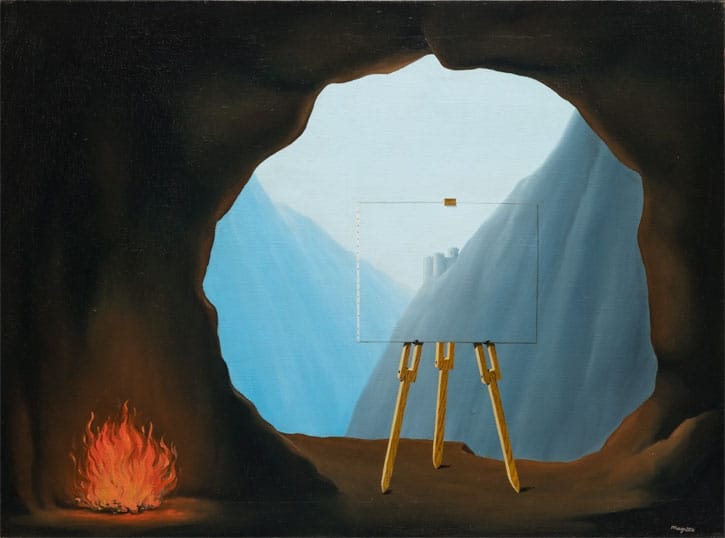
Those red lines on cave walls: dancing figures flailing about in flickering flamelight, hordes of hairy huntsmen on horseback. They were not alone. No man is an island.
We can’t not draw.
They got off all fours and one of the first things they learnt was they could apply colored powder to the walls of their caves, and that given enough time, they could arrange this powder on surfaces in certain shapes of certain sizes that vaguely represented what they saw, and what they thought about what they saw.
They drew to communicate to each other.
Theologus Autodidactus is a novel by Arab physician and philosopher Ibn Al-Nafis. It is one of the first Arabic novels, and could be considered, perhaps, one of the first ever science fiction novels. It tells the story of Kamil, an adolescent who is spontaneously formed by various events in succession in a cave on a deserted island. He learns by observing the world around him about the various laws that govern nature: about his own body, about the morphology of fruits, about the function and mechanisms of organs by dissecting with rocks and his own nails [?!] the animals around him, about ecological hierarchies, about the processes of angiospermic reproduction, about meteorological phenomena, about celestial bodies, about society and economics and commerce and law. But that isn't all. Kamil, on his own, begins to reason the existence of God, the beginning of the universe, the Islamic doctrine of prophetic transmission, the existence of heaven and hell, and about the genealogy and biography of the Prophet Muhammad. And he reasons, using his knowledge of astronomy, the nature of the end of the world. All on his own.
But the point of the novel isn't how intelligent Kamil is. The novel was written, perhaps, to demonstrate what Ibn Al-Nafis saw as the infallible reasoning on which Islam was founded. And in a way it demonstrates how painfully dependent humans are on each other. Kamil figuring out the Prophet's own history simply by thinking about it and predicting the end of the world is believable: all the steps he takes to get to his conclusions, while a bit stretched at times, are, at the very least, conceivable. He is, after all, the Self-Taught Theologian.
But the most incredible part of the novel is the very beginning. Kamil's very existence is impossible. The novel is an experiment in thought; a treatise exploring self-sufficiency. And Ibn Al-Nafis answers the question at the very beginning. Self-sufficiency is impossible. In science and in art.
The new paths of discovery lead from the thoroughfares of the old. None can deny the indispensability of both. We owe much to those cave-dwelling huntsmen. It is their shoulders on which we stand.
Michelangelo continues the tradition of Giotto, Giotto of Apelles, Apelles of . . . the cavemen. Manmohan Mitra, the titular character of the 1991 Satyajit Ray film Agantuk, describes an epiphanic episode from when he was a twenty-one year-old artist: upon seeing in an international journal the image of a cave drawing of a charging bison, he promptly quits art and sets off to live with tribesmen in order to study what he thought of as real civilization.
In conversation with Katsuhiro Otomo, Akira Kurosawa said:
"[...] to my mind, artists are in truth artisans. First you have to become a real artisan. It's only when you work through being an artisan and come out the other side that you count as an artist. Works of art, [...] the really good ones are anonymous creations. They're made by genuine craftsmen. To me it seems that became corrupted when people started to sign their names on things."
There was a caricaturist for a magazine that my grandmother wrote for. He'd drawn her once in the 90s. I was astounded when I first saw the drawing. He had impeccable brush technique and his draftsmanship was on par with some of the most lauded pen-and-ink illustrators whose work I’d had the pleasure of having seen. But for decades he'd been working, silently, illustrating for local newspapers, local magazines, local advertisers.
A lot has been lost to obscurity. Some of the works that have moved me the most have been written by people whose names I don't know.
Craftsmen. The best artists were craftsmen. That's how to describe them. Their names are forgotten. Their works will be remembered.
Beyond Kamil
Who is artifex autodidactus? She cannot be as complete as Kamil, but her birth is—ought to be, indeed—as spontaneous as his. The artists on the margins of the world, those that find release as ice from glaciers: the disruptant foreigners.
They are the outsiders. They renounce art. They step away from the dignity of the civilized world and find themselves in the dirt, breaking apart rocks with their nails. It is no coincidence that most art that is labeled experimental is almost always either primitive or childlike: there was no one to teach the cavemen, and only a child as yet untaught can tell us our own stories truly.
We learn from their spontaneity.
The primitive, the childlike, the foreign… art is indeed a strange thing. We may be standing on the shoulders of giants, but it takes a lot to step off. Artifex autodidactus is the stranger. And are they not outsiders? The first of us to begin making his mark on unweathered stone must’ve been an outsider, a stranger. Children too are outsiders themselves, strangers to the world. Artists came as strangers, and they will depart as strangers.
And glad tidings to the strangers.
-- S. Taufeequddin Azher is a writer from the Deccan.