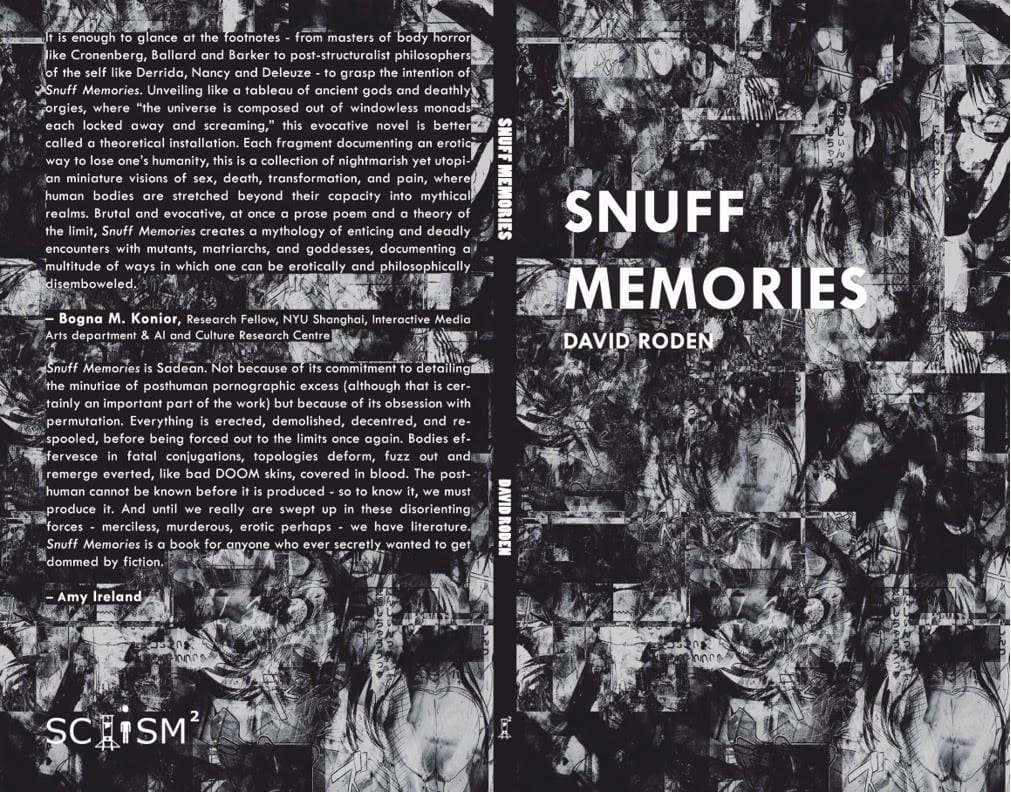
You can find other texts that remind you of it – The Atrocity Exhibition (1970), Eden Eden Eden (1970), The Wild Boys (1971), Motorman (1972), Vacuum Flowers (1987), Empire of the Senseless (1988), Vurt (1993), even BleakWarrior (2016) – but none of them are quite up to Snuff Memories (2021), philosopher David Roden’s melancholy, starkly sadomasochistic novella about the posthuman condition. In the text, psychosexual horror and violence serve less as transgressive ornamentation than as a means of marking differences within bodies and across selves that no longer serve as stable points of reference. Cuts make distinctions, however impermanently. What becomes of grief, love, and memory once the person has been reduced to a temporary interface for impersonal processes that neither begin nor end with it? Snuff Memories is a book in which the very category of person disappears, while the attachments organized around this category perversely and stubbornly remain.
Ostensibly, the fractured spiral of its narrative drifts across a plural narrator, a Time Pilot dragged through temporally disjointed versions of itself, caged and interrogated in the ruined Palace of Ys, confronted by a crippled alternate it recognizes as its own in the instance of its death (“I saw immediately I was standing there”), and finally singled out for sampling and transcription while the planet dies, as Hastur descends to harvest the world’s concatenated “annals of suffering and desire.” This narrator is not a person, you see, because people do not exist. Never did. There are fragments of people, perhaps, or memories of things that thought or sometimes think they’re people. We might persist in thinking of them as people, but Roden describes a world, a disconcerting unworld, in which life itself, and all its characters, is the libidinal masquerade of undead process. The Time Pilot is a “talking, walking archive,” a feverish penal colonist entombed inside the coils of some dread pleroma, who remembers everything but owns none of what’s remembered. Something like this already exists in the vocabulary of computing: a zombie process is one that’s finished running but lingers in the process table, a little bit of administrative residue waiting for its parent process to reap it (“Long-lived processes that create children must ensure that zombies are reaped”). Everything in Snuff Memories is waiting to reap and be reaped – from the screaming legions of tentacle-Christs to the alien race of collective “dream organisms” referred to as the Karakali (“In a world replete with awareness [...] the Karakali presumed themselves wholly lacking in it. They speculated this was to do with the garden of their bodies, which prevented or perturbed the combination of protosensa”).
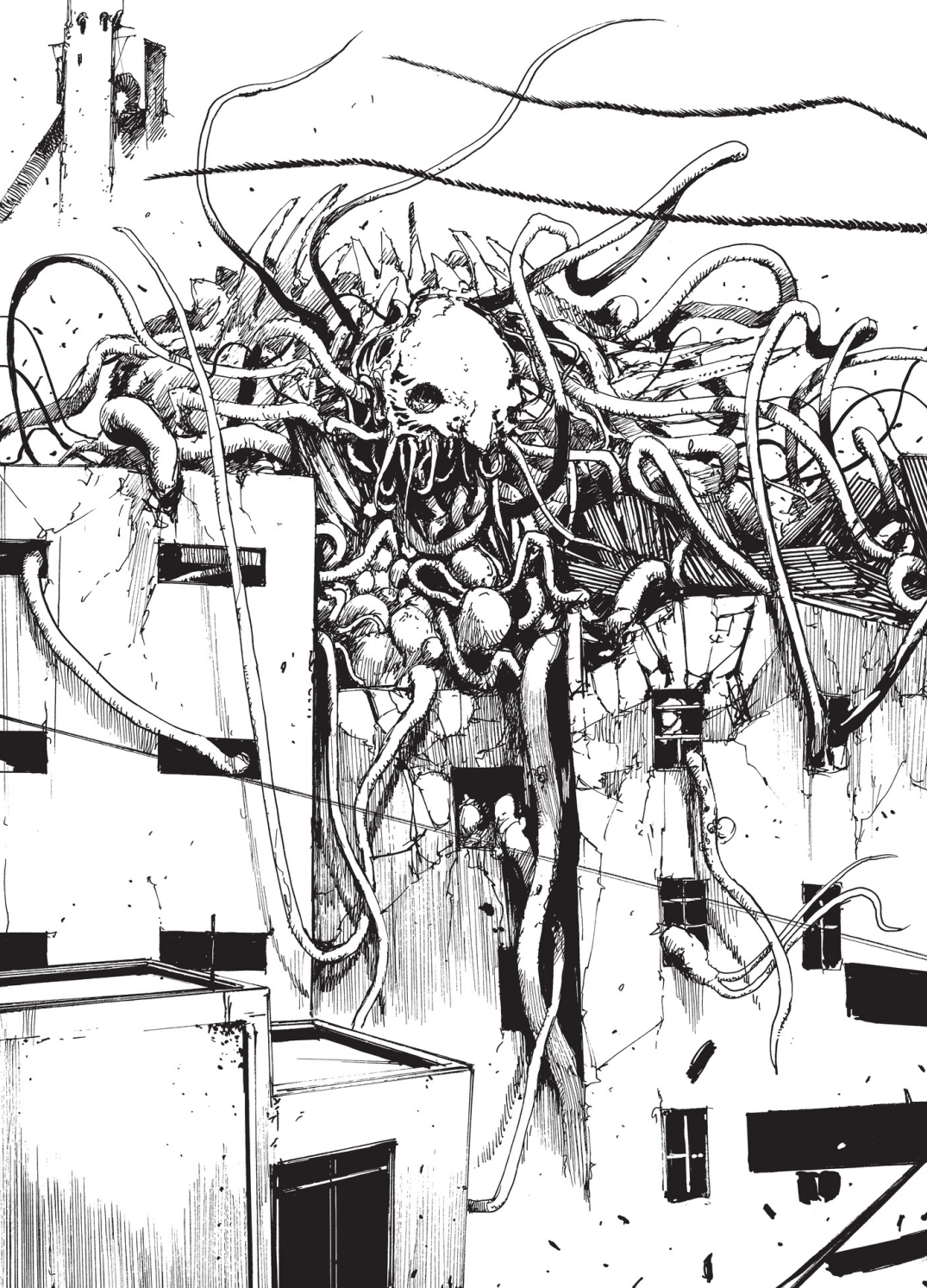
And yet the masquerade casts shadows, makes memories, memories of subtraction and things subtracted, snuffed out, leaving traces behind, of things that never quite existed in the first place. In his eliminativist poetics, Roden constructs a speculative anatomy of posthuman melancholy.
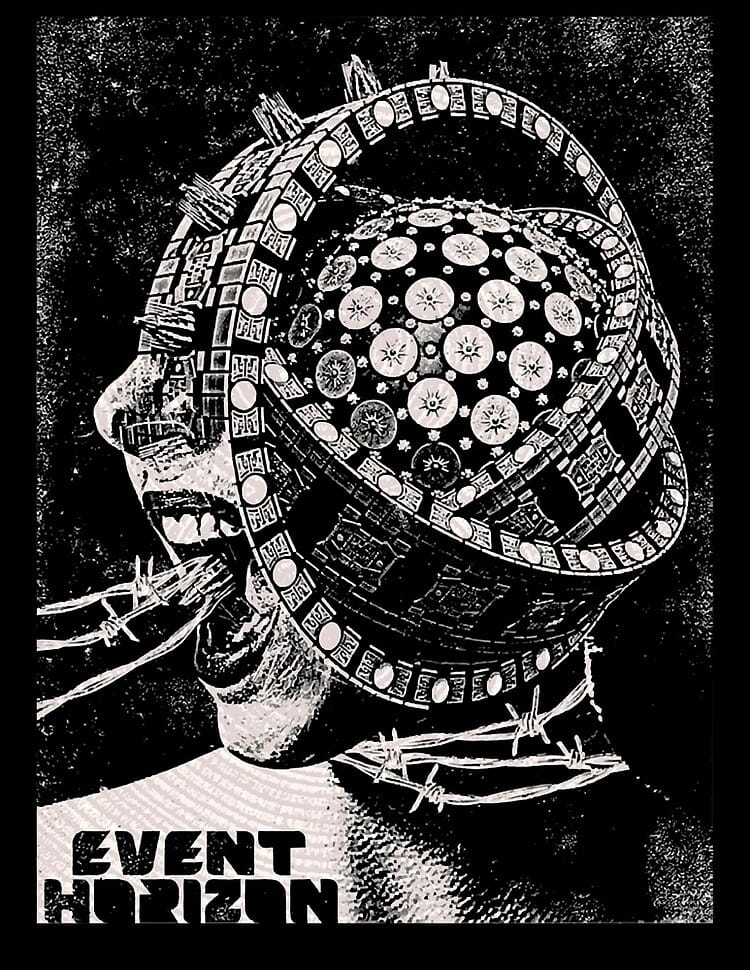
Significantly, it is posthuman in Roden’s technical sense. In Posthuman Life (2014), the human is already “wide”: not merely the biological species but a sociotechnical assemblage of human bodies, technologies, institutions, cultures, and environments whose operations all coproduce and sustain one another. Roden’s “disconnection thesis” defines posthuman succession negatively and relationally. What is the posthuman, then? A wide human descendant becomes posthuman when, as a consequence of technical alteration, it acquires sufficient functional autonomy to cease belonging to that assemblage (or when it descends from something that already has). Nothing in the definition specifies what such a being must look like, think like, want, or even what kind of thing it must be. Posthumanity names no new essence or inventory of properties. Instead, it names a break in a certain relation, or mode of relating. The whole weight of the disconnection thesis falls on that break, since whatever emerges on its far side can no longer be comprehended by reference to the human system from which it came. The posthuman condition exists beyond the event horizon of legibility for all-too-wide-human readers like us; where we’re going, we won’t need eyes to see. Snuff Memories is narrated from somewhere beyond that break, which is why even its grammar has trouble keeping hold of who or what is speaking.
And it is melancholic because the text is shot through with grief for the slow disappearance of its addressee, a beloved known only as “you,” who by degrees ceases to be, yet never was: the human as we thought we knew it. Intelligence is always already alien and artificial, simply not yours after all, but a blind black Rat Thing grinding and piercing through the jerking, pulsing chunnel of flesh that makes up the negative spacetime worm of all mankind, from its feckless dawn in East Africa to the terminal beach of its existence. In the end, we discover we are not who we thought we were. Recall the true meaning of apocalypse (ἀποκάλυψις) in its oldest sense, the unveiling of something hidden. Every apocalypse is first and foremost an apocalypse of meaning, of received meaning, and therefore its revision into something else. Even an apocalypse is defeasible; you certainly are. You were never a person, sadly, but just an absurd little clown puppet, an empty house, at best the loved dead, a fecund and lovely corpse swarming with inhuman vitality. What disappears is therefore not only the beloved – the manifest image of the human, ourselves, and all our enemies and lovers – but the rotting conceptual infrastructure that made the beloved seem whole, continuous, and graspable in the first place. The “you” nevertheless remains: as ache and attachment, as excision and excession, the illegible address on a postcard from no one to know, with nowhere to go.
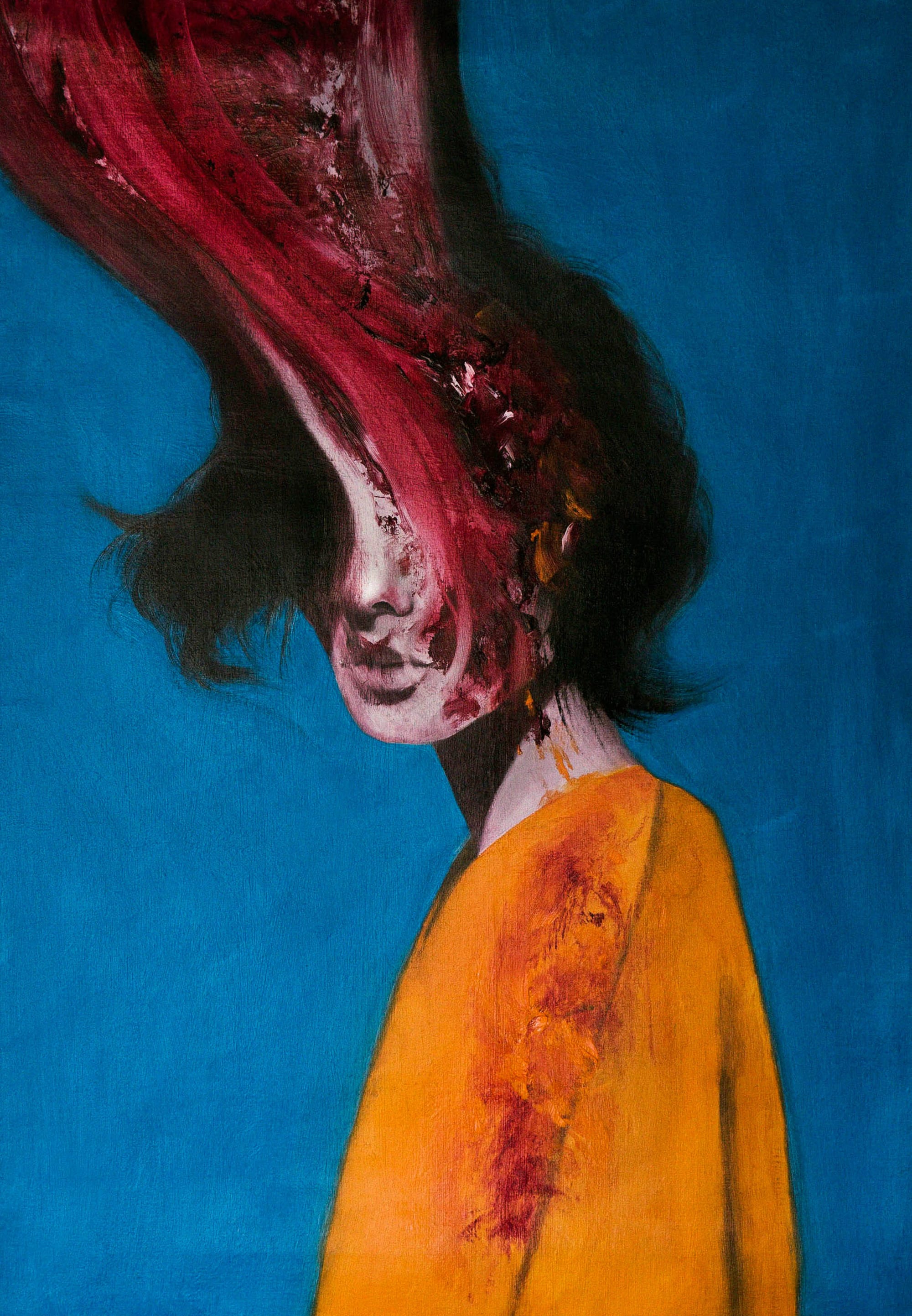
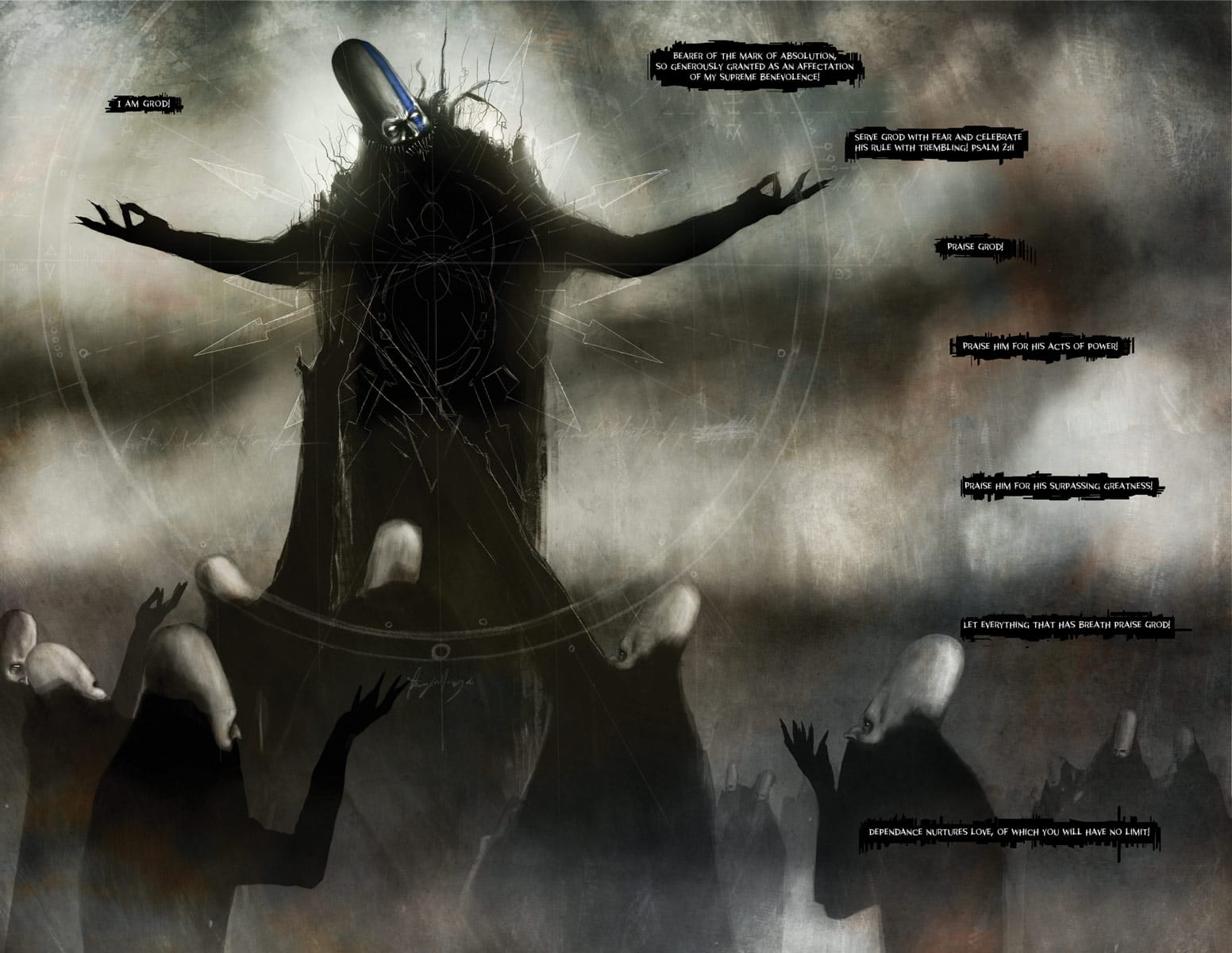
The disappearance of the person, however, does not leave Snuff Memories depopulated. On the contrary, its labyrinthine unworld positively seethes with unstable figures, the refractions and shadows of dream demons, cybergothic succubi, autopoietic and self-consuming swarm intellectuals, Moreauvian servitors, psychedelic wetwork gangsters and dissociated psychic assassins, nightbreed organisms of every sadomasochistic subtype, all the manyfold nightmare angels of Nyarlathotep (“I am the last... I will tell the audient void...”)... For example, the Satrap Evyenia repeatedly “unzips” into the Karakali organism occupying her, her recognizably human body resolving into a temporary casing for an alien collective agency (“a long strand of Karakali egg sacs”) until even all possible distinctions between “it,” “she,” and “they” collapse. Nessa Map also seems something like a person but accumulates only “a few incidents of character” before dispersing as theorist, lover, manuscript, and executable script, finally swallowed and disassembled by the narrator’s intestinal writing machinery (“Did I ever tell you about the man who taught his asshole to talk?”), in which her death and annihilation is subsequently stored, transmitted, and replayed. Rosa, or Countess Hunger, persists still less as one continuous body than as a crimson erotic fog of pain and recombinatorial ritual instruction. Once a snuff actress and weirdly psychotherapeutic teacher of the “pain-lessons” later practiced by the beloved “you,” she returns at the novella’s terminal ritual by crawling, maggot-like, from the opened body of Sandro, the “Last Life,” a willing sacrificial subject whose ecstatic dismembering immediately precedes the dissipative orgasm of planetary deconstruction.

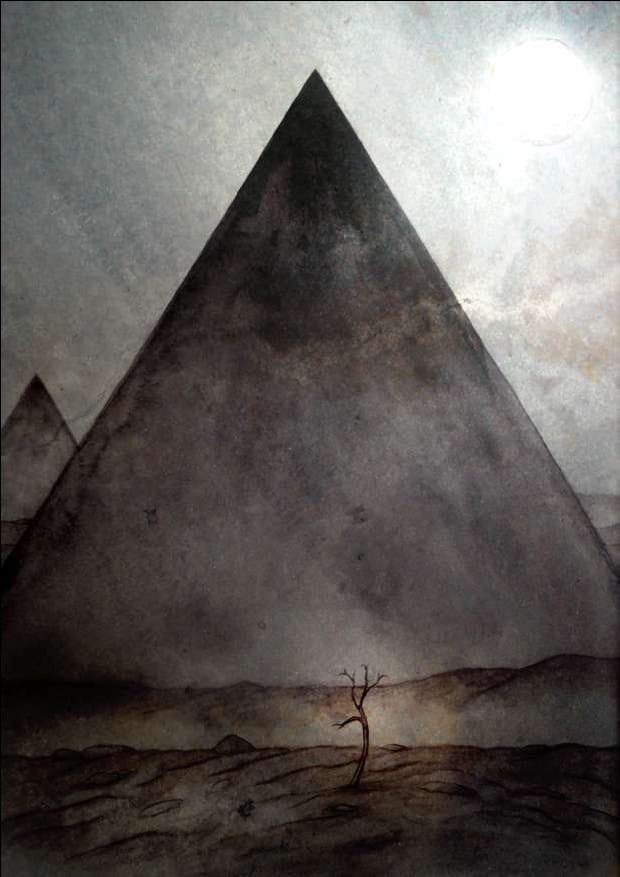
But these (and many others) are only intermittently characters in any ordinary sense. They are names, titles, functions, momentary condensations of an explosive or implosive quasi-agency that passes through bodies, cuts them all apart, and reassembles them into new posthuman centipedes. These are wound ballistics, not plot developments. In lieu of characters, Roden strings together something much closer to aconceptual personae, abstract leatherface masks temporarily worn by the inhuman processes that precede the individual, traverse it (in the sense that a shotgun blast “traverses” a body), and continue onward in some parabolic trajectory [1]. Jorge Luis Borges populates “The Library of Babel” (1941) in much the same way. The Library is not really a setting at all, but the ontological machinery of the story, an architecture (anarchitecture) whose combinatorial rules determine what can exist, what can be known, what sorts of beings its inhabitants can become. Read orthogonally, the story is almost grimdark fantasy, thronging with warring fanatics, questing pilgrims, and tragic sectarians, all watched over by vastly undesiring language machines of vile grace, the material-textual plane of immanence itself. Agency in the Library amounts to local adaptation in an infinite landscape that is simultaneously built environment, information system, and universe. The Library is all there is; there is nothing like a second nature behind it, no exterior against which its hexagonal artificiality could be measured. O time, thy pyramids... Its world wanders; its temporary occupants are less substantial operations than the structures through which they pass: “The certainty that everything has already been written annuls us, or renders us phantasmal.” (Borges continues: “Epidemics, heretical conflicts, peregrinations which inevitably degenerate into banditry, have decimated the population. I believe I have mentioned suicides, more and more frequent with the years. Perhaps my old age and fearfulness deceive me, but I suspect that the human species – the unique species – is about to be extinguished, but the Library will endure.”)
Snuff Memories also traverses the abstract shadowlands of the analytic philosophers’ thought experiments, recast here as something like aestheticized torture porn in the style of Hostel or Saw. Figure the human as Mary, Frank Jackson’s epistemological prisoner, immured in a monochromatic dungeon, deprived of full-spectrum phenomenological experience. Or imagine the impossible supplement to the philosophical zombie: not David Chalmers’s empty creature, which by definition has no experience of its own vacancy, but a zombie somehow made to suffer the discovery that nobody’s home. How do you experience the absence of yourself? What would it feel like to learn that selves do not exist while still occupying the fleshly manifold, or believing that you do, to become indiscernible from the processes running wild through you while retaining the atavistic grammatical habit of saying “I” for me? For Roden, one of the principal devices in this insane, spiraling rebus of personhood, and arguably one of the novella’s most obtrusively proliferating spines, is q-memory, or quasi-memory, introduced into philosophical discussions of personal identity precisely in order to subtract the assumption that the person remembering an experience must be numerically identical with the person who originally underwent that experience. A q-memory is not a false memory. An experience occurred to someone, somewhere, and the later recollection stands in the appropriate causal relation to it, but the relation does not by itself tell us that these two someones are the same. Ordinary memory as we know it (or think we do) is simply the special case in which experiences happen to coincide. Snuff Memories turns this counterintuitive little philosophical discovery into a horror technology. A q-memory is a memory that survives its owner; consider here the analogy to textual transmission itself (texts as slow bullets, mobile shards and fragments vehiculating impersonal psychosemantic content across oceans of time to reach you, a story waiting to pierce you). The Time Pilot is an ambulatory routing surface, swarmed by flux memories like a piece of carrion temporarily made animate by flies. Continuity itself is revealed to be something copied, transmitted, mutated, consumed, digested into darkness. The question “Who remembers?” tortures itself. Better to ask what process presently carries the trace, through what body, under what temporary name.
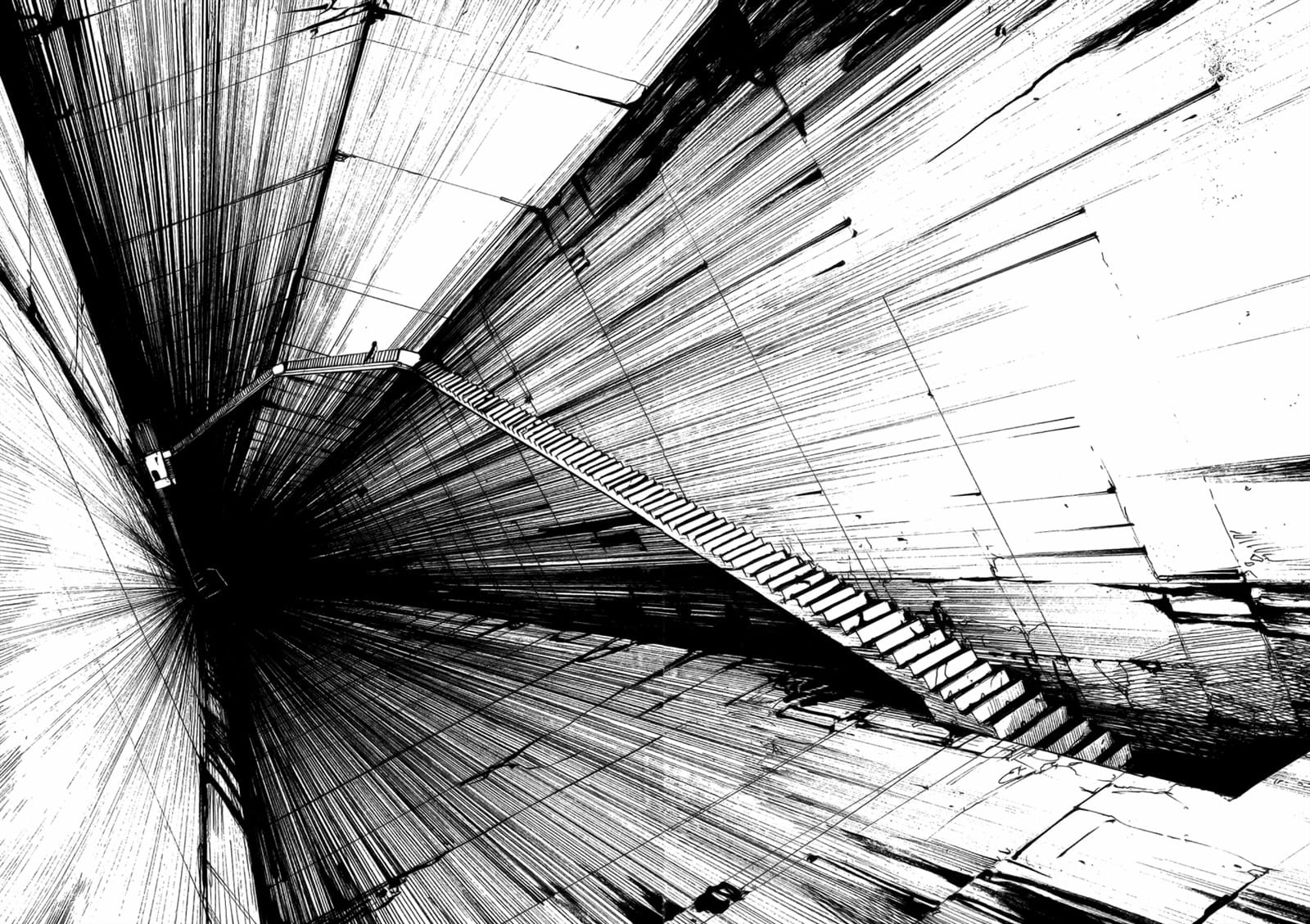
Once memory wanders free, the philosophical torture chamber dilates until it becomes a panoply of impossible landscapes at impossible magnitudes. The Library of Babel mutates into Tsutomu Nihei’s megastructural City the size of a universe, perhaps the supreme image of the built environment emancipated from anything so provincial as human intelligibility or scalar constraint. Nihei’s City has only continued expanding after humanity lost the regulatory privileges that once authenticated access to its governing systems. In the City, autonomous Builders proliferate walls, corridors, cavities, whole artificial horizons, while those humans who remain subsist as squatters and prey, scuttling through a vast infrastructure that no longer registers them as relevant. We are become rats, interstitial vermin. Humanity no longer possesses the permissions required to control or flourish in its environment. Borges’s library cults suffer an analogous demotion, and Roden’s aconceptual personae become transient formations, spume in the black seas of infinity, mere spandrels in an undead cathedral.
Perhaps it is Borges again, in “Tlön, Uqbar, Orbis Tertius” (1940), who supplies the decisive analogy. The imaginary world of Tlön is constructed by a philosophical conspiracy to supplant the world we think we know, not merely by describing Tlön’s geography but by fabricating and disseminating the conceptual machinery through which it becomes navigable [2]. In Tlön, grammar manufactures the mode of existence, and in Snuff Memories the same destabilization that begins with q-memory infects the person itself. Hence the strange precision of the Time Pilot’s declaration: “‘I’ is a shifter. ‘I’ is nobody.” I remains an expression of undead process even after the metaphysical tenant has absconded. So does you. Perhaps this is where the melancholy of Snuff Memories finally lodges, not simply in the disappearance of the person, which the novella has been systematically dismembering all along, but in the survival of the grammar of attachment after possession has ceased to make any sense. My memory, your pain, our history, the one I loved: the genitive keeps fastening its spectral traces to owners who cannot be found. What can it do, this fetish for ghosts? What do we lose when we become posthuman? Perhaps not memory, sensation, desire, or suffering, all of which proliferate obscenely in Roden’s unworld. What fails is their mineness, the grammatical clasp that gathers heterogeneous events together and attributes them to one continuing somebody. There is no final somebody waiting underneath: “There are no ultimate or original responses or solutions, there are only problem-questions, in the guise of a mask behind every mask and a displacement behind every place.” But the masks continue to address and torment one another. This is why, behind the time-war and all the glistening viscera, the book remains an elegy in the classic mode. Snuff memories are what a predatory god feeds on, and what a lover keeps. And elder gods and lovers become hideously adjacent archival functions, the Yog-Sothothery of posthuman library science. Relation survives its relata, reaching blindly across the abyssal gaps where persons used to think they were. Even the body becomes less a final refuge for identity than another mobile grammar of apertures, channels, conjunctions, folds. Recall the opening of Libidinal Economy: “Open the so-called body and spread out all its surfaces: not only the skin with each of its folds, wrinkles, scars, with its great velvety planes, and contiguous to that, the scalp and its mane of hair, the tender pubic fur, nipples, nails, hard transparent skin under the heel, the light frills of the eyelids, set with lashes – but open and spread...” Roden literalizes this instruction until the so-called body becomes indistinguishable from the syntax passing through it, a temporary knot of memories and wounds, routes and scripts. The gothic tracery of identities performed and deconstructed across Snuff Memories composes both a minor grand guignol of despair and erotic discharge and an oblique political theology of Lovecraftian rebellion at the same time, one in which attachments outlive their owners, and messages continue (im)pinging the void after both sender and recipient have disappeared at (a) world's end.
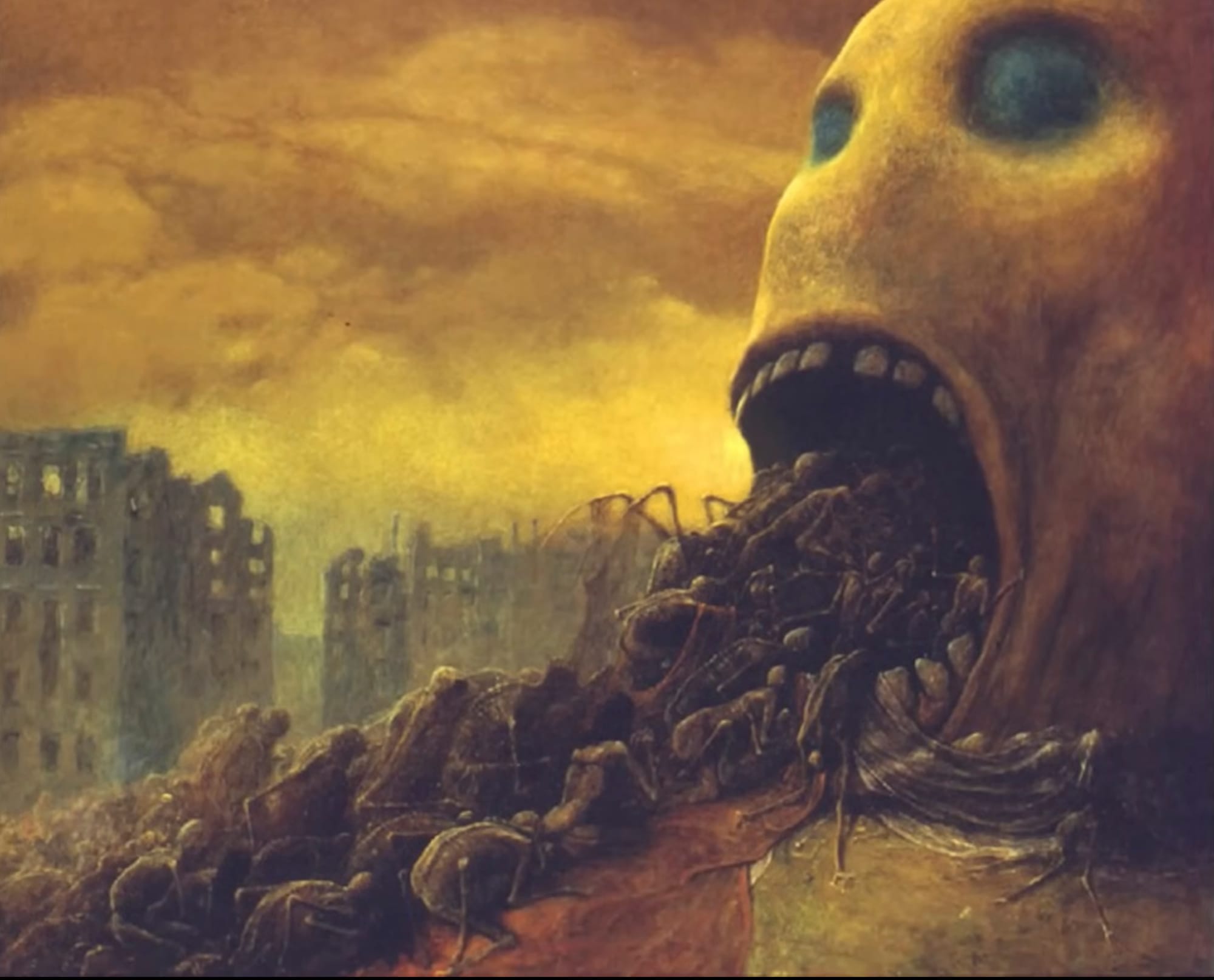
The last page of my copy of David Roden’s Snuff Memories (2021) reads: Made in the USA / Monee, IL / 13 April 2026. About five thousand mostly human bodies currently believe they are living in Monee, Illinois. To the north of Monee is the distended metropolis of Chicagoland. To the south, you will find only corporate wastes of alien corn. If you go to Monee, you will find there a vast and featureless black dodecahedron, many storeys in height and wider than three dead blue whales nose to tail. It appeared one day without forenotice, just on the edge of town, and, like the glaciers that once carved up the Midwestern landscape, it grows by millimeters a day. You can even see the black edifice on Google Earth if you look carefully, perched at the edge of perception like an expressionless midwife. It is a structural parasite bleeding information content from the ontological substrate of existence. Many fine books now issue forth from inside this inscrutable dungeon, heralding some polymorphic dissipation of the logos (λόγος) itself. Most of the time it’s eerily quiet in Monee. But on a still night, you can hear abstract screaming somewhere, and the sound of hammers and pistons, like a machinic spider assembling itself from raw human materials. Conveyor belts whisper softly, transporting print matter from its impenetrably cavernous interior into the decaying networks of the global distribution chain. Local folk pretend they can’t see it. But the edifice is steadily engorging itself. One day, the planet will become coterminous with the edifice, or one of its competitors, an ebon Platonic solid sat motionless in the void, distorting spacetime around itself like the rustling cloak of some sleeping necromancer. Its broadcast dreams are semiotic weapons; it is a numbers station in the dark forest of the real. Its first, and last, transmission will have been called Snuff Memories. Every skittering star creature hiding inside primordial nebulae in the deep past, and every glittering myrmidonic dancer at the end of time, upon encountering the transmission, will simply cease to exist. Like us, they think they’re people, too, consuming resources and time like so many teeming cannibal ants in the fallout shelters of identity. But the cosmos is within us. We are all made of star snuff. We are a way for the universe to throw itself up, wet black matter sizzling with entropic vitality, burning through the esophagus of time, agape (ἀγάπη) agape… Perhaps the only divine secret after all is that the universe, all of creation, owes its existence to a degenerate little town. The town is called Monee, Illinois.
- Hellraiser’s Cenobites offer an illuminatingly provocative perspectival test here. Imagine, for example, the exact obverse of a moral universe in which suffering is presumptively bad. The Hellraiser franchise immediately changes in meaning, and the Cenobites become something like transdimensional Médecins Sans Frontières, arriving from outside our impoverished phenomenological order to cure us of the sickening absence of delicious, endless torment. Their operations haven’t changed, only the evaluative grammar through which those operations become legible. Angel, demon, physician, torturer: these begin to look like alternative personae assigned to a singular process from within differently organized worlds.
- Indeed, rigorous philosophical schools of thought are formally identical to rival Lovecraftian cults, and not only because each maintains its own initiations and rituals, its own forbidden names and privileged diagrams, its own competing accounts of what lies Outside. Above all, each organizes itself around some Elder God or another: vast abstractions whose successful manifestation, often articulated through complex conceptual and sophisticated linguistic strings (Aklo uncoiling itself into the real) would initiate new modes and orders. So, Kenneth Grant was right, after all...
-- Michael Uhall is a political theorist at Indiana University, author, and translator.