Hot lights beamed down against the black sky, illuminating the empty walkway that led from Hollywood Boulevard to the main entrance of the theater. Grauman’s Egyptian, a temple façade of hewn, faux-stone pillars and palatial walls depicting the funeral cortege of an ancient king, escorted by Horus and Set, to find his eternal resting place embedded among the heavens. The crowd had dwindled after the film stars made their grand arrival for tonight’s movie premiere—flashbulbs exploding in bursts of metallic white, the press corps in their coats and fedoras in the late-autumn chill, the celebrities in their dresses and diamonds and tuxedos and smiles, stopping to pose and wave as they made their procession down the walkway, preceding the pharaoh as they entered his tomb.
A gunmetal blue Ford Model A was parked across the street, and in it sat Father Quigley, watching the entrance to the theater. He had been sent down from Chicago years ago by the Legion of Decency, to immerse himself in the film business and protect the interests of the Church. Quigley reached into his coat pocket and, removing a flask of wine, took a long swig. The liquor license from the Prohibition Bureau was challenging, but not impossible, to get via his city underbelly friends, granting him the authority to approve shipments of sacramental and “home-use” wine. Grape production in California might have been at an all-time high, but the vine to which Quigley had grafted himself ran rotten all the way through the valley and out into the desert.
Quigley and his partner, Max Nowacki, had been staking out since the press corps set up their hulking cameras that afternoon. Getting hungry, Quigley sent Max over to the Pig ‘n Whistle to bring back a late dinner. Max, a young but promising priest, had completed his training course at the Vatican and was assigned to Quigley to begin his apprenticeship in exorcism. Max was excited—Los Angeles was an ideal place to get field experience, and with none other than a legendary teacher, though perhaps past his prime. Stories about Quigley had travelled nearly as far as he had, across the Near and Far East, exorcising demons that others had only ever heard about in watered-down fairy tales. But that was all decades ago, as Max was discovering.
Quigley picked up his binoculars and focused in on the walkway. He spotted a woman: pale white skin, disheveled blonde hair, tattered sky-blue dress. She stood contemplating the funeral march of the pharaoh. A wind blew through her as if she were a torn rag, though the palms that lined the boulevard stood still. She suddenly looked over at Quigley. She looked familiar to him. A parishioner? A girl that worked the clubs? A few reporters milled about, chatting amongst themselves, hoping to catch an exit interview once the premiere finished. No one else seemed to notice her.
Someone tapped on the passenger side window. It was Max, holding a stack of white boxes, their glossy paper shining in the bright lights of the streetside marquees. Quigley put down the binoculars and sighed as he leaned over, his fat belly stretching as he barely reached the handle. The door popped ajar and Max handed the top box to Quigley before sliding into his seat. He loudly slammed the door shut.
“Boy, these sure smell good!” said Max as he cracked open his box, revealing the steaming pie inside.
“A little quieter next time, kid,” said Quigley as he sipped from his flask and handed it to Max.
“Thanks, Father,” said Max. “But I don’t drink.”
“It’s within regulation,” said Quigley. “I make sure of it.”
“You see anything yet?” asked Max.
“No,” said Quigley as he unwrapped the pie and took his first bite. “This is chicken, I asked for shepherd’s,” said Quigley as he kept eating anyway.
“Sorry, Father,” said Max. “Say, what are we looking for, exactly?” he asked.
“You’ll know it when you see it,” said Quigley, flecks of crust collecting in the corners of his mouth.
“So, when we do see it, what’s the plan?” asked Max.
“What’d you learn in your exorcism course?” asked Quigley.
“We never trained to watch people from across the street and follow them at night,” said Max.
Quigley sighed. “What did they teach you at the Vatican?” he asked as he took another swig to wash down the pastry.
“Well, we read the Psalms and the Gospels,” said Max. “Then there’s the laying of hands, holy water, and blessed salt. The salt! Father, I left it back at the rectory,” he said.
“Salt isn’t very effective for what we’re dealing with,” said Quigley. “Let me ask you something: when the methods you were taught fail you, what do you do?” he asked.
“What do you mean?” asked Max.
“Get my briefcase in the back,” said Quigley.
Max turned and saw a briefcase on the floor behind Quigley’s seat. He put his pie down and grabbed the briefcase, pulling it up and forward across his lap.
“Go ahead,” said Quigley.
Max unlatched the briefcase and it sprung open, revealing an array of exotic trinkets. Thin wooden slabs, carved and stained and polished, engraved with foreign symbols. A knotted cord woven with fragments of bone, a tarnished bronze mirror cast in the shape of a dragon’s mouth, an obsidian dagger that glowed a subdued red, as if something were held inside. Max turned the dagger in the ambient light, trying to catch a glimpse within, but whatever the blade contained was always just out of sight.
“Careful with the knife,” said Quigley. “Don’t let it taste blood,” he said.
“Are these properly blessed?” asked Max.
“Depends what you mean by ‘proper’,” said Quigley.
“There’s nothing remotely Christian in here,” said Max.
“Christianity is young. We’re still developing the tools. You need to remain flexible. Take one of the mezuzahs, those are good wards,” he said.
Max picked up the Hebrew amulet and inspected its finely etched letters. He slipped it into his coat pocket as he examined the other contents of the briefcase.
Quigley’s gaze shot to his rearview mirror as he watched a car slowly roll up next to him, one typically used by Al Capone’s men.
A man leaned out of the passenger side window. “Evening, Padre,” he said.
“Rosselli,” said Quigley. “How long since your last confession?” he asked.
“Good one, Padre,” said Rosselli. “I see you’ve still got quite the appetite. Given up on fasting?” he asked.
“We’re all born sinners. I try to pick the lesser of the evils,” said Quigley. “There are nine circles in Hell after all. Which one do you think you’ll end up in?” he asked.
“Not sure, Padre. But if you keep it up, they’ll have to open a new circle just for you,” laughed Rosselli as he slapped his stomach.
Quigley did not look amused.
“I stopped by to let you know that the afterparty’s at the Orpheum,” said Rosselli. “Tonight’s password is ‘peacock’,” he said.
“You’re too kind,” said Quigley.
“They should have hors d’oeuvres. Not sure if it’ll be enough for you. But you can have your little boyfriend fetch you more,” said Rosselli, laughing as his car rolled away down Hollywood Boulevard.
“Remind me why we are working with these guys,” said Max.
“We have a common goal,” said Quigley. “The mob didn’t like all the attention when Hell’s Angels came out last year. That was also a bad film for the Church. It made over two million dollars and by our count, nearly one-hundred souls were taken by the Devil here in Hollywood, just on opening weekend. Who knows how many more He took across the country where the movie screened,” said Quigley.
Just then, the theater’s doors opened and people came spilling out. Laughter and cheers as the walkway filled with movie stars and VIPs. A motorcade pulled up, ready to receive the celebrities.
“Let’s go,” said Quigley as he took another sip from his flask, shoved it between his fat thighs, and started the car.
The two priests tailed their targets, following the motorcade out of the shabby glamour of Hollywood and toward the grit of downtown LA. In the car ahead, a woman’s legs hung out of the rear window, kicking in the night air. A champagne bottle was tossed from another car as it swerved through the dark streets of Bunker Hill, the glass exploding as it hit the asphalt and shattered the silence kept by the old Victorian houses.
“You reckon they’re all possessed?” asked Max.
“Could be. Hard to tell now with the alcohol,” said Quigley.
“What I don’t get is how they get possessed from something like the movies,” said Max.
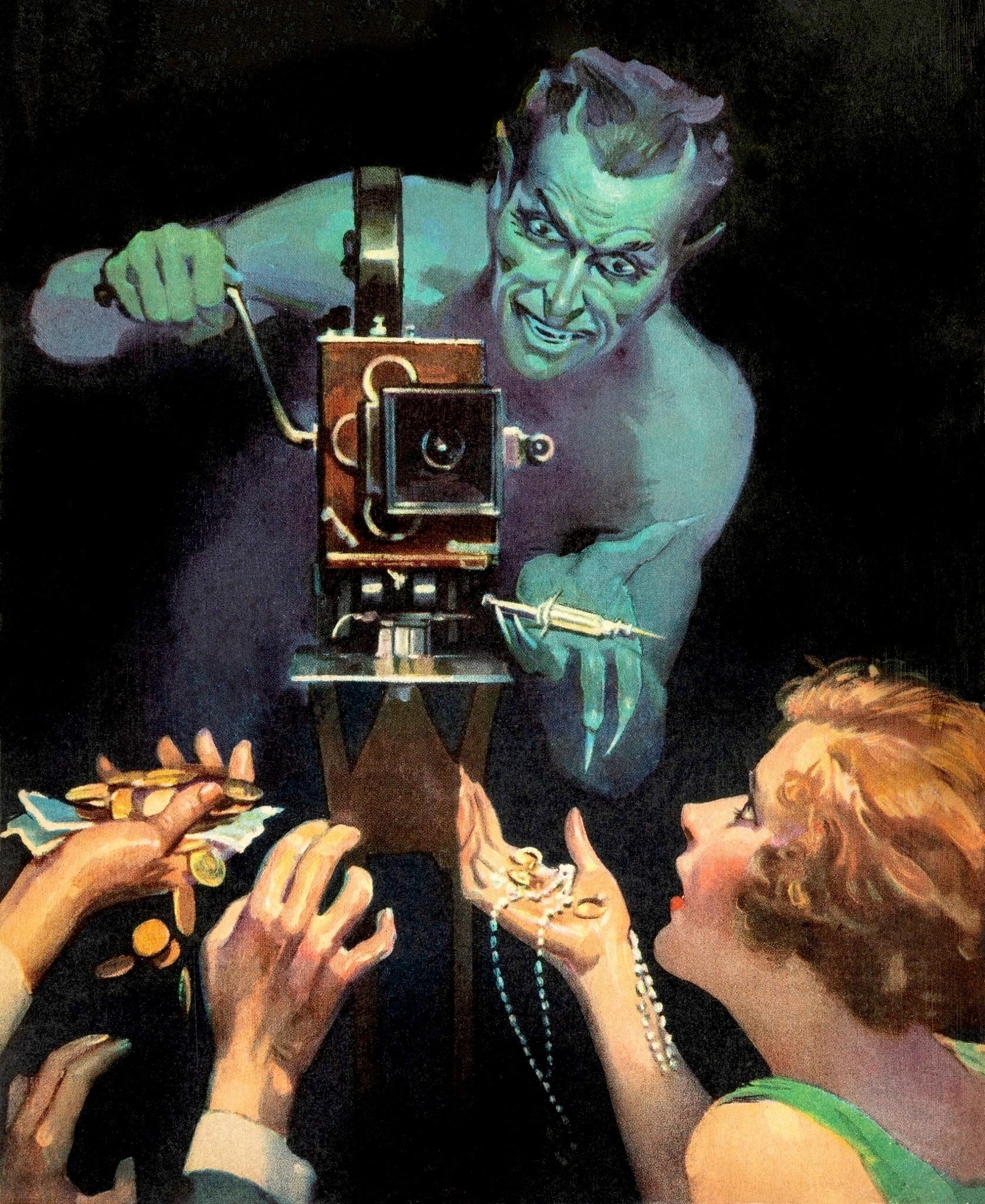
“Satan loves cinema,” said Quigley as waves of sodium-orange streetlight sporadically washed through the car, illuminating the two men as they flickered through the dark. “Demons love to look at themselves. What better vessel than an actor? They love the narcissistic gaze. The cameras, the illusions, the sets. The artificial. They built their own kingdom in Hell, you know. What is Hell if not a stage for their own perverted drama?” said Quigley as they entered the Broadway Tunnel, the exhaust still lingering from rush hour.
“What about the Hays Code?” asked Max.
“The Code is bullshit,” said Quigley. “Moral excuses to buy time. The studios will eventually ignore the Code, so we have to act while we can,” said Quigley.
“Can’t we just close the theaters?” said Max.
“Shut it all down?” said Quigley as he gripped the wheel. “People love the movies,” he continued. “Even now, the poorest you know are pinching pennies just to get a peek at the theater. The movies love money and money loves the movies. It’s impossible to keep the industry contained, as long as America is a capitalist country. And you hear me loud and clear,” said Quigley as he glared at Max. “I ain’t no stinkin’ pinko commie, so don’t go around saying that I’m not one for the free market,” he said.
“The road, Father, the road!” cried Max as the car got dangerously close to the tiled wall of the tunnel.
Quigley looked forward and righted the car.
“Sorry,” said Quigley. “These people, they really are powerless. With every new innovation, Hell finds a way to break through. America, the demon factory. That’s why we have to keep the possession rate low, by any means,” said Quigley.
“What do you mean, ‘any means’?” asked Max.
“Can’t have a possession if you don’t have a vessel,” said Quigley.
He can’t be serious, Max thought to himself.
Neon, again, as they emerged from the tunnel, the light of South Broadway overwhelming.
“If we do our job well, we’ll get our own man in the White House, and then…” said Quigley.
“Oh, you’re joking,” said Max, cutting Quigley off. “A Catholic president,” he laughed.
Quigley didn’t comment as he slowed down the car, watching the carousing motorcade park in front of the Orpheum, with its renovated art deco marquee, which was oddly not lit up. The theater appeared closed. Quigley cut the headlights and stopped the car against the curb. The celebrities and their entourage stumbled out of their cars, disappearing around the corner from the theater’s main entrance.
Quigley grabbed his briefcase and got out of the car with Max. As they walked down the brightly-lit sidewalk, they could see two bouncers standing on the corner of the theater.
Quigley approached the men. “We’re here about some peacocks,” he said.
“Around back,” said one of the bouncers.
“What’s in the briefcase,” asked the other, gesturing toward Quigley’s hand.
“Something for Rosselli,” said Quigley. “Unless you want to give it to him yourself,” he said.
The bouncer sized up Quigley, hesitating for a moment, before leading the two priests through a cement corridor and down several flights of stairs to a steel door in a brick wall. Muffled throbs of an upright bass, dampened blasts of a trumpet, muted laughter and chatter drifted through. The bouncer opened the door into a cacophony of sound and smoke.
Quigley and Max entered the hazy air buzzing with voices and music. It was a full house. Quadrants of gambling tables near the entrance, a stage in the back with the jazz band. A bar on the right side, waiters running trays in and out of the kitchen. Men dressed to the nines, women in elegant evening wear, their jewelry fracturing the light from chandeliers that loomed overhead. How is the ceiling so high in this underground place? Max thought to himself as he stood stunned among the opulence.
Quigley scanned the room, looking for Rosselli and his gang.
“I don’t see the movie stars anywhere,” said Max.
Quigley and Max moved into the crowd, pushing past the packed tables where the roulette wheels spun. The jazz band finished their set and was setting their instruments down when a blonde woman in a dazzling sky-blue dress, draped across her young body and shimmering like the wind cutting through a perfectly-shaped cloud, came on stage. Quigley and Max were unable to move as she spoke, as she warmly welcomed everyone, how she hoped they were enjoying themselves, and how they were in for a fantastic show tonight.
“Her, again,” said Quigley as the woman went backstage, the audience erupting in applause.
“She’s gorgeous,” said Max, as if under a spell.
So, the kid sees her too, thought Quigley as the dark blue curtain on stage opened, revealing a child in a suit and a goat wearing a top hat and a pince-nez.
“Hey, isn’t that the child actor from the movie premiere?” said Max.
They watched as the child in the suit instructed the goat to walk on its hind legs and jump through a hoop, which was met with moderate clapping.
“We need to find a way backstage,” said Quigley.
Quigley looked over toward the bar and thought he saw Rosselli. “Hold our spot,” he said to Max as he shouldered his way through.
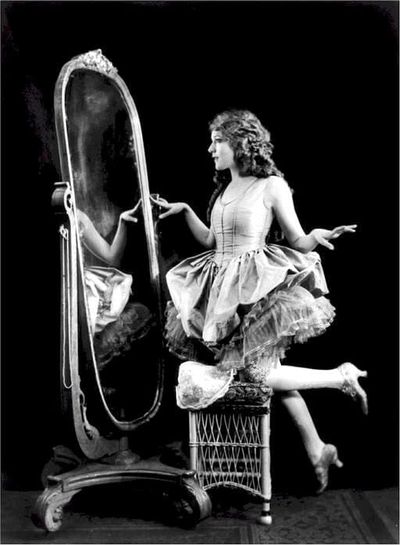
Max watched as the first act gave way to the second, the curtain opening and closing, ushered by unseen hands, revealing a wide, full-length mirror on stage. A man dressed as a Bohemian swordsman entered stage right and walked up to the mirror, which was angled so that the audience could see the reflection. Suddenly, the swordsman’s image emerged from the mirror. The two figures drew their sabers and began to spar, with each perfectly matching the other’s movements. The audience went wild.
Quigley pushed his way to the bar, which was growing more packed as the show progressed. He brushed his hand over the polished wood surface, so smooth he could see himself in it, but there was no sign of Rosselli. Quigley looked around and caught the eye of the bartender, who was staring at him.
“Drink?” asked the bartender. Quigley knew that he shouldn’t keep drinking on the job, but it wasn’t up to him anymore.
“Wine,” said Quigley, as he made a half-effort to glance around for Rosselli. The bartender reached behind him and pulled the cork on a bottle that Quigley had himself approved for delivery earlier that year. The bartender smiled as Quigley sipped from his glass—Quigley could see the eyes behind his eyes, someone trapped inside. Quigley looked around the room. How many of them were there in here? Maybe I shouldn’t have brought the kid along, he almost thought as the alcohol smothered the notion.
Quigley looked back toward the stage as one of the swordsmen drew a pistol, breaking the synchronous fight, and shot the other point-blank in the chest, rendering him into a column of smoke. The remaining swordsman holstered his pistol and bowed to the audience before clutching at his chest, his shirt rapidly saturating with blood, and collapsed. Two women in dresses fashioned from peacock feathers came out to drag him offstage as the audience roared.
“Put it on my tab,” said Quigley as he downed his glass and ordered another.
Max watched as the third act began. Two dancers came on stage, a man and a woman—the lead male and supporting female actors from the movie premiere. They waved to the audience as the band picked up a quick-paced swing rhythm and then broke into dance, the audience pairing off and following the actors’ lead. Max stood alone for a moment, not knowing what to do. A woman approached him.
“Hey there, cutie,” said the woman. Her smile, her eyes, her hair—Max felt an urge inside him and strangled it before it could manifest further.
“Sorry, miss, but I’m spoken for,” said Max.
“I don’t mind a married man,” said the woman, flashing her teeth. “Is your wife here with you tonight?” she asked.
“No, miss, I’m not married. But I’ve made a vow to our Lord and Savior, Jesus Christ,” said Max.
The woman looked at him blankly, then burst into laughter. She grabbed Max by the arm, exclaiming, “It ain’t no sin to jitterbug, altar boy,” as she yanked him into the crowd.
Quigley watched as the club erupted into dance. Beneath the bar, he opened his briefcase, looking for the dagger, but found it was missing. He grabbed the mirror and the knotted cord instead, tucking them into his coat pockets, and stashed his briefcase beneath the bar before sliding along the dimly-lit side wall toward the stage.
Quigley went up the short wooden staircase in a corner shrouded in shadow and slipped behind the curtain. He stumbled and caught himself—there were two or three curtains, he couldn’t tell how many, and got wrapped up and turned around as he muddled his way through. It reeked like a zoo. He heard giggling and followed the sound until he saw a crack of light from under a door. Quigley charged toward the door, ramming it with his shoulder, his fat body powering through.
Racks of clothing lined the room, full of ornate costumes fashioned from peacock feathers. On a table in the back was the female lead from the movie premiere, seated and facing a man. Rosselli. He was helping the woman hold her dress around her waist. His pants were already around his ankles.
“If you wanted a girl, Padre, you should’ve asked,” said Rosselli. “Or a boy, I’m not one to judge,” he said as the actress laughed.
“In the holy name of Jesus, I reject…” started Quigley, his words emerging slowed and slurred.
“You’re washed up, Padre,” said Rosselli. “Plus, there’s been a change in management. It’s time that I introduced you to the new boss,” he said.
“I renounce…” said Quigley as he drew the bronze mirror from his coat pocket and held it up, stumbling toward Rosselli and the actress. The actress howled like a leopard in pain. Rosselli reached down for his pants, trying to pull them up.
“I rebuke the spirit of temptation!” cried Quigley, nearly losing his balance as he slung the knotted cord out like a lasso with his free hand. It fell limply on Rosselli’s shoulder.
“That shit won’t work on me,” said Rosselli as he socked Quigley in the jaw, sending him to the floor. “Just ‘cause I fuck ‘em doesn’t make me one of ‘em,” he said.
Two other mobsters came into the dressing room. They held Quigley tightly as they bound him with his own knotted cord and dragged him through the dark and onto the stage. Quigley looked up and saw the movie actors dancing on the ceiling as the music blared frantically. They danced down the side walls, back onto the stage, and taking a bow, exited behind the curtain as the music stopped.
The blonde woman in the sky-blue dress entered stage left. Quigley recognized her now. Yes, the famous actress from years ago. He had performed an exorcism on her. It had killed her.
“And now for our final act,” said the woman as the mobsters pulled Quigley to his feet.
The audience got down on its knees as if in worship. The curtain parted and a creature lumbered onto the stage. It looked like a donkey walking on two legs, with massive arms like a gorilla, and a long tail made of peacock feathers that rustled along the floor. Where its genitals would have been was a festering wound that dripped with pinkish pus. The creature took center stage and raised its tail, fanning its feathers upward and outward in an arc of cruel color that made Quigley nauseous. He threw up all over his pants and shoes, wet chunks of undigested pie in a slosh of stomach acid and wine.
Two women in peacock outfits came on stage. One held a silver scimitar, the other a golden chalice. The creature took the scimitar as it turned toward Quigley and bleated in obscene tones, but within which Quigley could decipher the demon-speak.
“The cup or the sword?” the creature asked, its eyes dusk-yellow gemstones in a smothered fire.
Quigley knew this voice, one from the East.
“Adramelech,” said Quigley. “Do I have a choice?” he asked.
Adramelech, Chieftain of Hell, Grand Chancellor of Demons, and Overseer of the Devil’s Wardrobe, laughed, its foul breath permeating the air. It took the scimitar and slit the skin along the underside of its thick, hairy forearm. Blood dripped into the chalice. Adramelech offered it to Quigley, lifting it to his mouth. The stage lights changed, coating everything in a faint purple glow. Quigley looked into the chalice—its contents were boiling yet gave off no steam.
Quigley took a sip, the blood-stained wine hitting his tongue, as the rim of the chalice expanded around him, engulfing him in a tunnel through which a murky river flowed. Quigley was pulled into the torrent—something between water and blood and wine—and coursed along with bodies of the dead, the faces of which he recognized as they churned within the violent current, casualties from over the years that he had attempted to rid of evil spirits, even if it cost their lives. All to keep the numbers down. He had ceased to care if the possessed survived—as long as the quotas were met, he’d just drink his way through. The river exited forcefully from the tunnel, angled upward toward the heavens, a wave cresting toward paradise, at the zenith of which was the blonde woman in the sky-blue dress, his first victim, one of many that came after. Quigley thought he might have spared them, but even that was in vain. Had he been a patsy this whole time, providing sacrifices to the mob as it grew below the streets of LA? The flow of the river abruptly stopped but Quigley kept going—he glimpsed a ray of light that pierced the woman, a light that was blotted out as a storm blew through, the wind howling as he fell along with the river, descending like a tainted rain and plummeting past the Earth into a void that had no name, a darkness that had always existed before there was ever night, and in this nothingness he knew he would fall forever.
Quigley lay on his back, convulsing on stage. Adramelech towered over him, laughing.
From behind the stage, out stumbled Max. His collar disheveled, his neck smudged with lipstick.
“I'll save you, Father!” said Max as he rushed the demon chieftain, drawing the obsidian dagger from his coat. Adramelech did not move, did not resist, as the blade plunged into its neck. Blood gushed from the wound but was sucked up by the dagger as it drank deeply from the demon. Murderer, he heard a voice whisper as Adramelech turned its head and smiled its wide donkey-faced grin. Is the dagger speaking? Max thought as he backed away, watching in revulsion as the blade drained the demon dry, leaving a mass of loose skin and feathers that collapsed on the stage and flaked apart into dust as it quickly dried in the hot lights.
As if a spell had broken, the audience got up from their knees and looked about.
“Hey, where’s the music?” someone yelled.
The jazz band was gone, as were Rosselli and his gang.
Max knelt over Quigley and helped him sit up.
“The dagger, what did you do?” asked Quigley.
“I thought...I tried to save you,” said Max.
“I said it should not taste blood,” said Quigley.
Max untied the knotted cord that bound Quigley. Once free, Quigley removed the flask from his pocket and took a sip before spitting it out.
“Smell this,” said Quigley as he handed the flask to Max.
“Smells like wine,” said Max.
Quigley took another sip and spat it out. “It tastes like blood,” he said. Quigley sipped again and gagged. He threw the flask down and cursed. The wine leaked out across the floorboards, mixing with his vomit. His hands trembled.
The shrill sound of whistles filled the club. Panicked, the crowd rushed for the exits, but the police were already there, brandishing their batons and beating the partygoers into submission.
Max grabbed Quigley by the arm and pulled him up, looking for a way out. From the corner backstage, almost out of view, Max noticed the mirror that the swordsmen had used during the show. He hauled Quigley with him toward the mirror as the police stormed the stage. The closer Max got to its black surface, the colder he felt, as if it emanated a chill from within. Max couldn’t see their reflections as he stumbled forward into the mirror, entering a world without light. He couldn't even see the ground beneath his own feet. Then he realized that he was alone. Quigley had not passed through with him. He turned back to look at the mirror and saw himself standing on the other side, still on stage, holding Quigley by the arm. His reflection was banging on the theater-side of the mirror, shouting something inaudible. He watched as the police silently bludgeoned the priests to the floor, the batons splitting their ribs and skulls, blood spilling across the stage. What have I left behind? Max wondered, though he did not have much time to contemplate this, as from somewhere behind him in the vast chasm of nothingness, he heard the cocking of a pistol echo through the endless dark.
-- Ronald Plumber is a writer from the US based in China and is currently working on a collection of weird short fiction. He can be found on twitter @ronaldxplumber and substack @ronaldplumber.