Soft moans and gurgling echo and echo. Was a wind on the river that day. It’d stiffened like Hell in the fighting, unnerving, and sometimes I’d calm myself by thinking of the Union boys in their underclothes, engaged in some ridiculous dance. Tried to pretend it was just another April wind but we knew we was lying. “Engagement like any other,” Hampton’d said. “Plan on making it home to Julia like I done a hundred times, wind or no.” But we knew it wasn’t average. It carried with it all that anger and mighty vigor of destruction, hardened by belief.
When I first let momma know I volunteered, in the backyard under a dull and rusted sky where she’d mend tears in my clothes, she cried some, told me if I ever got scared to look up. Her gaze rose in example and she laughed, her cap falling off her head. I was looking up that day on the river, and, still looking, aint have much of a clue what she was hoping I’d find.
We was pressed on two sides. Farragut, who we knew too well from too many reports, had in his head to run up from the Gulf into New Orleans. Somewhere north of us there was mounting losses, and the faceless departments in their judgment stripped us raw of men and ships and ammo to repurpose. In the view of most everyone we was awfully ill-equipped.
It was about twenty ships in all for the defense of this most esteemed of rivers. We took heart at the sight of our ironclads, gleaming silver and dreadful to behold. Mississippi thundered and traveled gently in turns, cloudy brown and impenetrable. Blythe, smoking and pacing, said it was like the river itself knew what was coming. “Trust me, Abnes. It aint fixing to make no difference what happens,” he said, “river’s gone simply move on.”
The A.C Mosher, our steam tug of about forty-five tons, less than one hundred feet bow to stern. Built up in Pennsylvania a nondescript thing of oak and cheap paint. We wasn’t sure how it ended up floated down to us and chartered into service. About twenty-five of us on that green-stained little ship. When we asked what we was meant to do with one gun between us Captain Horace said it didn’t matter any, our plans was different. Told us we was tasked with towing what he called a fire raft up near a Yankee ship, lighting it and sending it down river, engulfing the enemy in flames. We almost laughed when he told us our aim but he wasn’t laughing none at all. The Hartford itself: a mean beast with guns of all shapes and sizes, immense, the highest quality of builds. A tugboat and raft against a lethal war-sloop. I doubted it but never showed it none.
Jackson and St. Philip, on either bank of the river, long without purpose now, were the main points of defense. A great chain ran between them like a colossal set of arms pulling the waterway closed, intending to slow the Union’s progress should they make it that far. Would sometimes imagine the two ends of chain as the arms of them two heroes the forts was named for, one the defender of New Orleans and the other gentle, handpicked by Christ himself as apostle. Both sides admired the old names. But who says them exalted folks had the full way of it? Who says all that talk aint just a means to an end? Used to think those immortals was something like honesty. Maybe they was only people.
We saw the Yankees pull in around one ay-em. Our target showed and chilled us worse than the weather. The Union boats moved swift. We watched cannons flare. Checked and checked again the chains holding the fire raft. Blythe fired our gun more for show than anything else, what slight effect it had. The raft was bigger than the Mosher by quite a few feet and piled up with pitch pine, like a whole forest rested there set for sacrifice. I looked from the raft up into the star full sky. Again saw nothing. Just knew I wanted to make it back. Wanted to milk our one skinny nameless cow and tend to our small plant of crop, patch up the disrepair on the tiny house for which I fought. A purpose, a thing that felt true.
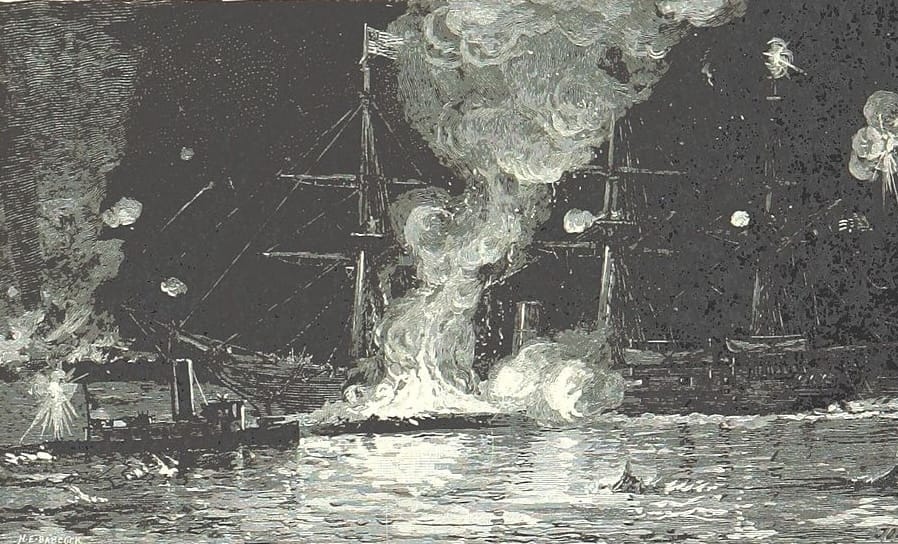
The Hartford dwarfed us as we made our approach. “Light the raft,” the captain said. We tossed torches and lit the thing and the blaze was such that it looked for a moment as if we’d been condemned to the underworld. Was taught stories on how them fires burned, and the roar of it fully encompassed our hearing and not even the booming guns could get through it, thick like a stone wall. It sucked up all the air to breath and we gasped. Our eyes locked upon it as if a spell was on us. Felt like we was ablaze ourselves.
We pushed on ahead and turned, broadside, me unlatching the chain and down the current it went. It struck; slowly but all at once the Hartford in parts went up. The cheer we gave shook our ship. We threw caps and jumped and a couple of us shot into the air. Hampton took a small photograph from his pocket and kissed it. The Hartford ran aground, its huge broadside facing us, cloaked all in fire. Was nearly moved to tears, like we’d done something great. Then a stir and suddenly a whole wall of guns opened and I tried to imagine the yanks in their underclothes and then the fire on the Hartford was extinguished while more and more cannon found us. Blythe sent himself over the side and a few followed. A ball finally found the boiler, and our simple tug and all us hands on it burst into ash, sinking into murk.
Wide waters of Mississippi, the bones of us algae covered among the stick arms of a fated ship, aint that more the truth? Blythe said it wasn’t nothing man could muster to shake it and he was right. A muddy firmament of stuck griefs, always going on. The Mosher, eroded limbs outstretched, catfish and sheepshead oblivious and uncaring swimming through them, reaches toward a surface it aint seen in hundreds of years. Remember the last things I saw was them flames going out, and a striking curved moon. I’m scared more and more that it’s a falsehood. Like momma said to look up and up and up.
-- A shambling vessel. Find more of John Biron's words in the sands of polluted beaches, scrawled above urinals, etched into sheets of igneous rock.