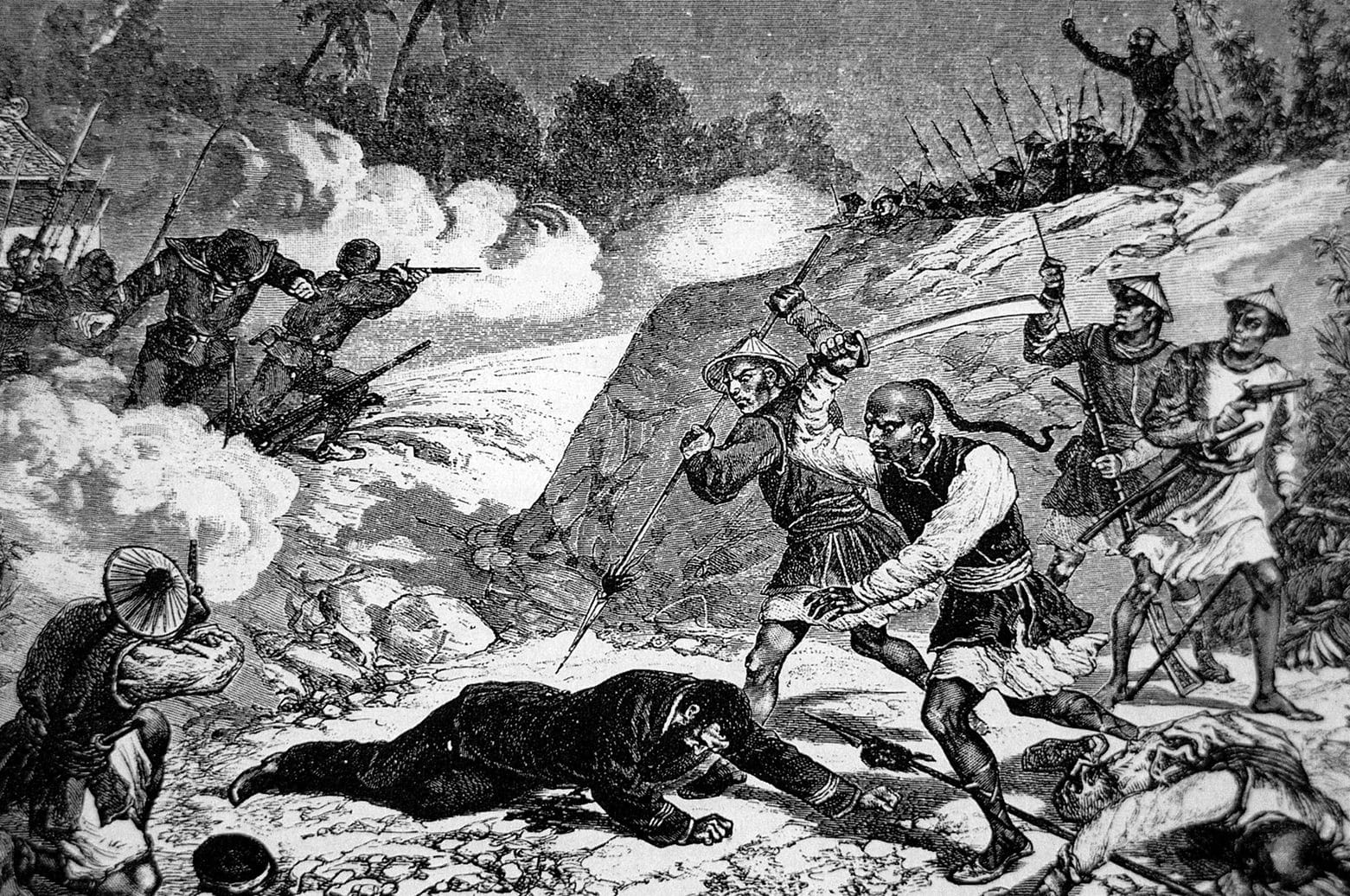
When the report came in, Colonel Frederick Ward was not surprised, but he was still furious. As commander of the Shanghai Foreign Legion, he had put Lieutenant Andres Burgevine, a fellow American, in charge of the battalion that was to take the Taiping rebel fortress at Songjiang. They had been resoundingly defeated—two-thirds of the men were now dead. They had probably fought and died drunk. Rumors would spread through saloons, and it would be difficult to recruit more soldiers from among the deserters that drifted through the port.
Ward sat at his desk, facing the window that looked out into the streets of the Shanghai International Settlement. A lamplighter was beginning his shift before dusk, igniting the streetlights with a long bamboo pole, at the end of which dangled a flaming wick. The lights were fed with the district’s gas, an innovation for a land that had always relied on moonlight. Things were changing here; Ward could feel it. He looked out at the lamps as they flickered on. They ran through rows of parasol trees that shaded the streets in broad canopies, trees brought over from France and England that thrived wherever cities sprawled, their camouflage bark peeling in the late summer heat. Ward, too, felt himself peeling, coming undone.
He rose from his chair and picked up his half-smoked cigar from the ashtray, a Filipino cheroot, and reviving it with a strip of burning paper, put out the candle on his desk. Trails of smoke drifted through the room as he grabbed his coat and headed out the door and down the stairs to the courtyard below. At this hour, he knew where he would find Burgevine.
As Ward made his way through the courtyard, his accountant and business partner, Yang Fang, stopped him.
“Good evening, Colonel,” said Yang Fang.
“Mr. Yang, good evening. I’m sorry, but I can’t talk now,” said Ward.
“I understand, Colonel, but there is a slight issue with the recent shipment,” said Yang Fang.
“That being?” asked Ward.
“Well, the munitions, they are short,” said Yang Fang.
“Short? How short?” asked Ward.
“They didn’t ship,” said Yang Fang.
“I’m sorry, what?” said Ward.
“And the gunboats, only two were delivered,” said Yang Fang.
“Two? We ordered ten. Did the donation not make it to Washington?” asked Ward.
“I am not certain, Colonel. We shipped the silver along with the letter you wrote to your brother in New York,” said Yang Fang.
“And did Henry write back?” asked Ward.
“I have received no such letter, Colonel. I will check again with the post in the morning,” said Yang Fang.
Ward had sent the letter in February, just after the Chinese New Year. The Year of the Dog. It was nearly August now. He should have already heard back.
“Let’s discuss this tomorrow. Have you seen Burgevine? Is he down in Blood Alley?” asked Ward.
“I am not sure Colonel, but it’s likely,” said Yang Fang. “Rue Chu Pao San, yes, Blood Alley, as you say,” he said.
“Thank you Mr. Yang,” said Ward as he stepped outside.
It was a hot, humid summer evening. Ward walked down the street through the International Settlement, passing through the American and British concessions. As the sun set, Ward listened to the fevered whine of the cicadas that clung to the transplanted trees. He thought of home, of the woods of Massachusetts where he used to play as a boy. It was a sound that he had never expected to find here, and yet here it was.
The street gave way to a dirt path. Here there were no lamps. Refugees clogged the streets during the day, but now they were preparing for evening, some living in lean-tos made of scraps of wood along the sides of larger brick buildings built by American businessmen—Russell, Augustine Heard, Olyphant—powerful firms making fortunes in tea and silk and cotton. The refugees often had nothing more than a blanket. Out of shame, some wrapped themselves like swaddled corpses and hid in the shadows. The influx of refugees was worse when a nearby suburb was attacked by the Taiping rebels, who on occasion made incursions into the city. The treaty with the British was keeping them out for now, but the threat still loomed among the countryside.
Ward was taking the scenic route, the long way around that did not pass near the US Consulate. He wasn’t exactly on good terms with US officials here in Shanghai, ever since he was arrested last year for conscripting ex-sailors into his protection operation for merchant shipping. He had avoided the charges by suddenly giving up his US citizenship, going so far as to hold a shotgun wedding with a local Chinese girl and getting his friend, Yang Fang, to produce documents stating that he was now a citizen of the Qing Empire—the authenticity of which were extremely dubious. He was able to dodge the authorities for now, but living in such a grey area was taking its toll. What was he now? Or what was he becoming?
Burgevine, however, was still a US citizen. The Consulate had arrested him too, along with Ward, but the charges were less severe. Nothing that a little grease couldn’t fix. Ward and Burgevine’s protection operation was bringing in 4,500 taels of silver per month per gunboat, fees that the local merchants in the textile and opium trades paid to keep their shipments safe as they navigated the rivers and coastal waterways. Their success had made the two Americans, a Yankee and Southerner duo, popular with the Shanghainese business community. But the US Consulate was not very pleased with two upstarts, “mercenary ruffians” as they were labelled in the South China Herald, carving out a lucrative niche for themselves in the morally-questionable segments of the market.
Ward made his way through the back alleys, at times stepping over entire families of refugees. He tossed aside the stub of his cigar and covered his mouth with his white handkerchief as he moved among them, fearing the spread of cholera and typhoid that was known to break out whenever new arrivals flooded the streets. Some stared at him as if he were a ghost. Others didn’t look at all. Perhaps they were afraid, or perhaps they just didn’t care. Some had expressions of emptiness that made Ward uncomfortable to contemplate.
As Ward approached Rue Chu Pao San, or “Blood Alley” as it was called, famous for its fistfights among sailors, the composition of the bodies on the street suddenly changed. They grew taller and lankier, their features longer and covered in rough, curly hair. They clustered in groups that spoke English and French and Dutch and Italian, each mostly staying to their own, drinking from filthy bottles on makeshift tables caked with mud. Coarse laughter grated the night air, soured with the stench of piss.
But the men in the alley, many of them sailors or longshoremen, grew hushed as Ward passed by. There were rumors about Ward—people were suspicious about how he rose so quickly from a hired gun to a recognized military leader in the Qing army. Ward entered an American-owned saloon and saw Burgevine at a table in the back. Some of his men were here, the ones that had survived the failed assault and come home to nurse their injuries. Their backs straightened as Ward walked past.
“I’d like a word, Lieutenant,” said Ward as he stood in front of Burgevine. The saloon grew quiet.
Burgevine looked up at Ward from his glass, in which pooled a finger of liquid the color of light, golden straw. He was already drunk.
“‘Bout what,” said Burgevine, slurring his words together. Some men got up and left, the door clattering loudly behind them.
“You know about what,” said Ward as he picked up Burgevine’s glass, finishing it off. He felt his breath evaporate as he exhaled. “Where’d you get corn whiskey all the way out here?” asked Ward.
“North Carolina’s finest,” said Burgevine, grinning cheekily. More men entered the saloon, pushing past those seated at the bar.
“You’re going to get us all killed if you keep drinking like this,” said Ward.
Burgevine grumbled. “If that’s all ya wanna talk about, why’d ya bring them coppers wit ya?” he said, pointing behind Ward.
“Them what?” said Ward, as he felt himself shoved down onto the table, his arms grabbed and bound by two men in uniform.
“You’ll be coming with us,” said one of the uniformed men, dressed in a single-breasted blue coat, the buttons stamped with the image of an eagle.
It was morning. Ward and Burgevine had been held overnight in the jail at the US Consulate. They were now cuffed and seated in a small room next to the jail, where they had been brought out for questioning. Consul General William L. G. Smith presided over the room, sitting at a desk that faced the two cuffed soldiers of fortune and the blue-coated guards that watched over them.
Smith addressed the men, reading from a document at his desk. “You are hereby formally charged with conspiring with the Confederacy. You will be extradited from Shanghai on the next available ship and tried at a court in Philadelphia once you arrive,” he said.
Ward laughed. “I sent Lincoln the equivalent of 10,000 dollars in silver, and you think that I would support the South?” he said.
“There’s no talking out of this one,” said Smith, as he procured a letter and gave it to Ward. “We know that you’re working with your brother in New York to aid the South,” he said.
Ward read the letter, dated February 23rd, 1862, a week before he had mailed his own letter and monetary contribution to the Union’s war effort. Its contents explained how to get in contact with Ward’s brother, Henry, to retrieve the money that Ward was sending over, and re-route the gunboat shipment to Wilmington. The letter was addressed to the office of Jefferson Davis and signed by Andres Burgevine.
Burgevine peered over Ward’s arm as he read. “No,” said Burgevine, still slightly drunk. “That’s a goddamn lie.”
Ward put the letter down on the desk, the iron handcuffs heavy on his wrists. Then he got up and slung his arms around Burgevine’s neck, dragging him to the ground.
“It’s a goddamn lie!” Burgevine yelled in between gasps for air. The men whirled on the floor as if running in a flattened circle, the soles of their shoes scratching up the polished wood.
One guard grabbed Ward and tried to pull him off of Burgevine. Ward had Burgevine by the collar. He refused to let go. The other guard kicked Ward sharply in his ribs. Ward winced as his hands came free. The building shook. Confused, Ward rolled over and saw bullet fire smashing through the windows. Smith and the guards hit the floor. Ward smelled blood. One of the guards had been struck through the head, his face now blank like the gaze of a fish on ice. Another explosion. Cannon fire, thought Ward, as he turned on his back and saw the roof coming towards him.
Ward woke up. He was lying in a bed, propped up by silky pillows adorned with tropical scenes. A sweet, burnt smell was in the air. The room was dim, lit by a single bronze lantern. He was in the opium den down near the docks, the one that he and Yang Fang ran to get money out of the country. Burgevine was lying beside Ward in the next bed with his arm tightly bound in a tourniquet, shirt stained with blood.
Ward tried to move. Pain shot through his right leg and up into his ribs.
“You reckon we can still catch that boat out of here tomorrow?” asked Burgevine.
“Oh shut up, Burgevine,” said Ward.
The red silk curtains that ran along the walls of the room parted and in walked Yang Fang.
“You’re awake,” said Yang Fang. “How are you feeling?” he asked.
“Like I’ve been crushed by a roof,” said Ward.
“Appears that they’ve recovered your sense of humor as well,” said Yang Fang. “Some of the locals were able to pull you and your friend here from the rubble. Your other countrymen weren’t so lucky,” said Yang Fang.
“Why did you bring us here?” asked Burgevine.
“We’ve had to make adjustments. The hospital was set on fire,” he said.
“Did the Taipings breach the Old City wall?” asked Ward.
“No, it held. The rebels tried to make it through to the salt warehouses, but the Royal Navy pushed them back up the rivers,” said Yang Fang.
Ward was relieved. He and Yang Fang were heavily invested in the Qing salt monopoly, something Burgevine wasn’t keenly aware of.
“We lost a few of the gunboats in the attack,” said Yang Fang. “Others are damaged and need repairs. This will likely cost us anywhere from—,” he said.
“We’ll manage,” said Ward, cutting him off. Ward tried moving again and grimaced in pain.
“Don’t move too much,” said Yang Fang. “We’ve prepared something for you, for the pain. It will help you heal,” said Yang Fang as he turned and left through the red curtain.
Ward looked over at Burgevine. “How’s your arm?” he asked.
“Cut bad. Deep. But it looks like the bleeding stopped,” said Burgevine. “You know I ain’t write that letter, Colonel,” continued Burgevine. “It’s a forgery. It’s a goddamned lie,” he said.
“Let’s talk about this later,” said Ward.
“They want us to fight each other,” said Burgevine. “The US Consulate is probably under pressure from the British to get us to stop recruiting the deserters. They can’t afford to lose any more sailors,” said Burgevine.
“And we can’t afford to lose any more men to your drunken leadership,” said Ward, still angry about their losses earlier. “The rebels probably attacked because they thought we were weak right now. They were right,” he said.
Burgevine didn’t say anything.
“But tell me, Lieutenant,” said Ward. “If you did take the fortress at Songjiang, what would you have done?”
“What do you mean?” said Burgevine.
“Would you have given it over to the Qing, as required?” asked Ward.
Burgevine was quiet.
“Let’s say you took all the surrounding forts in the area. Would you keep them under your command?” asked Ward. “Or perhaps set up relations with the Confederacy? Open a consulate of your own in the International District?” he asked.
Burgevine remained silent.
“I knew your loyalty only went so far,” said Ward.
“We’re mercenaries, Frederick,” said Burgevine. “You think you’re some fancy general ‘cause you got friends like Yang Fang and all his merchant buddies to get the Qing government to recognize you as some ‘foreign military expert’. I know that you don’t know any more than I do and I can tell you one-hundred percent that I don’t know shit,” said Burgevine. “I got rejected from West Point just like you, and I got paid to fight in Crimea just like you,” said Burgevine. “You ain’t better than me,” he said.
“You could make more of an effort to integrate,” said Ward.
“Oh bullshit. Integrate into what? We are foreigners, Frederick. Americans. Nothing more. Even if you shaved your head, tied what’s left back in a ponytail, and wore a qipao, all you’d get is laughter from other laowai like us. Like you, said Burgevine, pointing at Ward with his good arm.
“Men don’t wear qipao, Burgevine,” said Ward.
“Goddamnit, this is what I mean. Colonel Smartass,” grumbled Burgevine. “The way I see it, none of this is going to end well. It’s chaos out here. The Qing empire is collapsing. The British are winning up north, but it’s anyone’s game down south here. The Taiping rebellion are a bunch of religious nutjobs, and depending on how the war goes back home, well, there could be a lot of changes coming around here,” said Burgevine.
Ward laughed and shook his head. “I knew someone that thought the same and it didn’t work out too well for him,” he said.
“And who’s that?” asked Burgevine.
“William Walker,” said Ward.
A knock came from the open doorframe behind the red curtains. A Chinese man in a flowing linen shirt emerged, carrying a wooden tray with two opium pipes. He brought the tray to their beds and worked silently as he packed the two pipes with gummy, black tar.
“So, what about Walker,” said Burgevine. The name made him feel uneasy.
“After Crimea, I rode down to Nicaragua with Walker. You remind me of him sometimes,” said Ward.
“Whatever happened between you and him?” asked Burgevine.
“After a while, I realized that he and I didn’t see eye to eye,” said Walker.
Ward thought for a moment as he watched the Chinese man hold the opium pipes over a dirty glass lamp, its lips freckled with bits of old tar, heating the slick wads of opium packed inside the bowls.
“Walker thought that he could create his own empire. A lot like how you think now. It’s not going to work out. It can’t,” said Ward.
“Why not,” said Burgevine.
“There are rules. Commitments. Agreements from before you or I were ever involved,” said Ward.
“You’re talking nonsense,” said Burgevine as the man handed him his pipe.
Ward watched Burgevine take a hit, cradling the pipe in his good arm, and then did the same. The smoke was hot on the back of his throat. Ward coughed violently, the pain shooting in his ribs, as the man packed up the wooden tray and exited through the curtains.
“I was there. Saw it myself,” said Ward. “Walker was cruel. We took the town of Granada, down by the lake, with a group of no more than 60 men. Mostly boys form Tennessee and Kentucky that were shit out of luck, lost everything looking for gold in California. Walker had them kidnap the wives and children of the Legitimist government. They surrendered easily. Walker executed their leader the next day in the square.
“Walker said that there would be fair elections, but he double-crossed the Liberals, the same ones that hired us to come down and topple the government in the first place. Walker made himself president, reinstituted slavery, and sent an ambassador off to Washington.
“But then Walker got greedy. He commandeered Vanderbilt’s steamships—yes, that Vanderbilt—who owned the Transit Company that operated the ocean route to California. There’s more money in that shipping line than all the gold in the Rockies.
“That’s when shit really started to go south. Vanderbilt sent assassins after Walker. Hondurans attacked from the north, Costa Ricans from the south. We had to keep a lookout on the lake and in the jungle nearby. God that lake, big as the ocean. You ever see a lake with sharks in it?” asked Ward.
“You think I’m green or something?” said Burgevine, who attempted to laugh but only managed a weak smile, his muscles too relaxed to contract any further.
Ward took another long hit, held it deep, exhaled upwards towards the lantern hanging from the ceiling, smoke billowing like a fog in a dim sea of light.
“Then Walker’s ambassador came back with an envoy from Washington,” Ward continued. “A strange man, that envoy, I can’t even remember his name. The envoy said that President Pierce had rejected Walker’s ambassador. The envoy was sent to negotiate terms—the president wanted Walker to join the Union as a free state.”
“That so?” Ward thought he heard Burgevine say, but didn’t see his mouth move. The room was growing thick with smoke now, choking the lantern light. The red curtains loomed around them like the inside of a tarred lung.
“Walker was furious,” said Ward. “He threatened to kill the envoy. Then the envoy showed Walker a document from eighty-three years ago. The Articles of Manifest Destiny, he said it was called. A charter signed by the Founders themselves, signatures all in blood, an agreement that ensured the survival of the Union, long before the Union threatened to tear itself apart.”
Ward paused as he thought he saw the curtains move, but no one emerged.
“They were afraid, the Founding Fathers,” he continued. “When they signed the Declaration, they thought they were dead men. They met at the Pennsylvania State House on that humid August day, walked up one by one, heads hung low, and penned their names with ink that stunk of death. They thought the revolution would fail. So, they made another deal. It wasn’t hard for the Masons among them to arrange.”
“Don’t just talk, smoke your damn pipe,” said Burgevine, his voice sounding croaked and changed.
Ward hit his pipe again. Banks of smoke gathered around him. He felt himself floating along a river. The light from the lantern was soothing; it hung from the ceiling like a distant sun, veiled in dust, in a galaxy that hadn’t formed yet, or had already fallen apart. Ward wasn’t quite sure which. But he knew that he had traded one star for another. This was home now.
“Walker couldn’t accept the truth, so he shot the envoy. I helped get rid of the body. Dumped it in an empty grave outside of town. But the envoy came back that night. Strolled right up to me on the side of the road, as I crossed the street back to my room above the saloon. He handed me a folder and then vanished into the night, left me there standing in the middle of a dark road.”
Ward went to hit his pipe but couldn’t remember if he had just smoked it or not and put it back down.
“Inside the folder was the charter, same one that the envoy showed Walker when they first met. I’d buried it with the body. Walker tried to burn the charter, held it over a candle at his desk, but the paper would not alight. Didn’t even burn. Walker cursed as he tore it into pieces and tossed it down the well outside. I stood there with him and watched under the light of the full moon, the stillness of the muted dirt around us, the shreds of the charter flittering down into the shadows of the well, as if grasped by the deft fingers of a dark magician and stowed away within its sleeve.”
“Sounds like you threw away a good deal,” said Burgevine in a voice that was not his.
“I slept poorly that night. I dreamt a soldier came out of Lake Nicaragua. Dripping in algae, reeds affixed to the sleeves of his jet-black uniform. He wore the flag of the Union on his breast, but it looked somehow different, as if it were a crest from another time, from a Union terrifying in its perfection. I looked behind me—the town of Granada was aflame again. It was in ashes when we had arrived. Who had rebuilt it? Who had reignited it? The soldier fired a weapon at me that brought me to my knees, a weapon of pure force that made me vomit and shit myself. Then he threw me over his shoulder walked into the blazing town. The soldier didn’t burn, but I did, and as I screamed, the soldier told me who he was.”
The curtains appeared to billow outward but Ward’s vision was unfocused. All he saw was a dim orb of light approaching. No, receding. A red haze in the distance, a body standing over Burgevine. Or was it Burgevine standing outside of his own body?
“I saw American soldiers on a hot, flat battlefield, shot by Nicaraguans in their dusty, wide-brimmed hats. I saw Nicaraguans cut down by the Spanish in their plumed helms of silver. I saw feathered shields and spears thrust into the ribs of naked men who all ran red, bleeding into a lake and displacing the water. Women and children, throats slit, were thrown into the red lake. The innocent bodies floated together with the fallen men and gathered like logs. Trees tried to grow there but they withered and died and stood like bleached sentinels, watching over this gyre of slain flotsam. The lake drained into caves below. The sinuses of a dark mind. It dripped and bled into the pores of the earth itself, drenching its core, whirling in a hot blood dynamo that bubbled and cracked through the surface, rebirthing itself continually into the past and future. The dark mind spoke and told me the truth: that blood is greater than time as it flows in all directions.”
“No need to convince me, Colonel,” said the voice that came from Burgevine’s body.
I knew that you would come around, thought Ward as the lantern went out, and in the darkness saw what it was that he had become.
-- Ronald Plumber is a writer from the US based in China, and is currently working on a collection of weird short fiction. He can be found on twitter @ronaldxplumber and substack @ronaldplumber.